

Who was María Felicitas Jaime, author of the great Argentine lesbian novel of the 20th century?
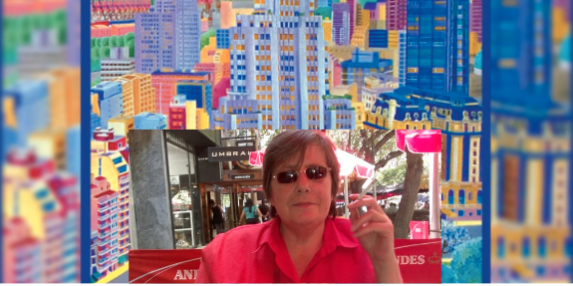
María Felicitas Jaime (1950-2017) was a journalist, writer, and feminist activist. A pioneering member of the CHA (Argentine Homosexual Community), she wrote the great lesbian novel of the last century.


Share

It's 1985. Argentina has only been back to democracy for three years. María Felicitas Jaime, writer, journalist, lesbian, sits down and writes.
“It is not easy to be homosexual in a city like Buenos Aires which, despite its cosmopolitanism, still retains vestiges of a large village and still has too fresh the memories of the last dictatorship, during which we were persecuted as in any self-respecting witch hunt.”
She writes, but not under her own name. She signs with the pseudonym María No. The text is for the magazine Diferentes, aimed primarily at gay men. And she tells them that, if being homosexual was difficult for men, “it was much harder for us, not because we are more persecuted: a simple statistic would show that for every girl arrested, there are or were 10 boys. The persecution against us works differently; women in general are denied the right to their sexuality; we exist as objects for men's pleasure.”
A pioneer
María Felicitas Jaime (1950-2017) was a journalist, writer, and feminist activist. She worked as an editor for Radio Nacional, wrote for the magazines SuperHumor and Diferentes, and for the newspaper Los Andes in Mendoza. She was also a television scriptwriter and editorial secretary for the weekly newspaper Diálogo. She wrote a series of serialized books on sex education and pocket-sized short stories on erotic themes.
According to an unpublished interview by Juan Queiroz with Marta Paz, Felicitas was part of the first group of "Women of the CHA".
Teresa De Rito, the first vice-president of the CHA, remembers her: “I was the first woman and trade unionist to speak out, the second was Celeste Carballo, Felicitas contributed her part in a magazine, then Ilse Fuskova.”
Within the editorial team of Diferentes, she championed the publication of 'Diferentes Mujer' (Different Woman). But, although it was advertised in the magazine itself, the project never materialized. As the archive , in the last 10 issues of Diferentes, María No was responsible for writing the editorials published on the front page.
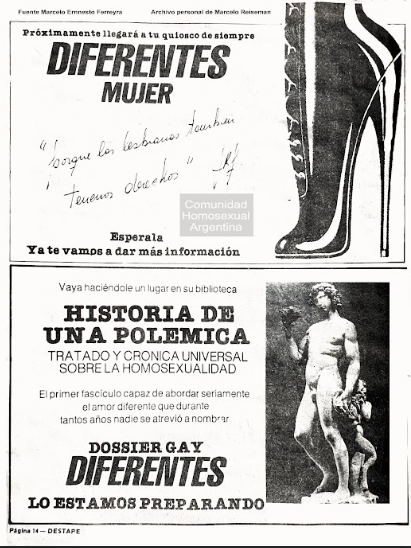
Archive: Bad Molecules-Marcelo Reiseman, CHA memory program
A lesbian novel in the 90s
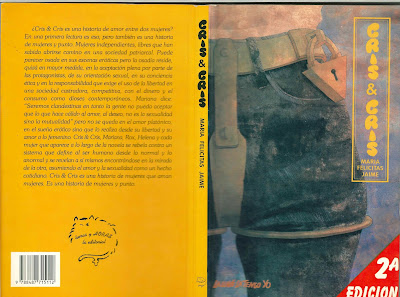
Felicitas migrated with Bea Albertini, her partner, to Madrid in the '90s. There she published Cris & Cris, in 1992. The novel tells the story of Mariana, a lesbian journalist who lives in Buenos Aires and one day meets another Cris, a lawyer married to a man.
“When the novel came out in Spain it was a huge hit, because even though it was the nineties, lesbianism was hardly ever discussed; hardly gay people at all. It sold very well. Thanks to the novel's success, she became involved with several lesbian groups who invited her and were completely charmed by her, as they came to love Cris & Cris,” Bea explains.
She taught reading and writing workshops, some in libraries throughout the Community of Madrid. The course she taught at the Maspalomas Summer University in Gran Canaria had record attendance: they discussed books, lesbianism, and feminism.
“We emigrated to Spain partly for adventure, and partly because of the political and social situation. Socially, there seemed to be no place for us; it was a pretty awful feeling you get in your own country,” says Bea.
For Bea, Felicitas was not only her partner, but also a great fighter for the rights of oppressed people, someone who “cared about all silenced minorities.” She recounts that in newspaper articles and on the radio, Felicitas denounced child labor, spoke about lesbianism and the oppression of women, and did so with irony and rhetorical devices to circumvent the censorship prevalent during the military government. However, censorship still arrived in the form of threats and dismissals.
“Felicitas was a wonderful woman, generous, open. We were together for over thirty years, from the day we met. For me, it was quite an adventure,” says Bea.
Felicitas received hundreds of letters in Spain after the publication of Cris & Cris. Lesbians and mothers of lesbians thanked her: the book had helped them understand their daughters better.
Cris & Cris was followed by Pasiones (Horas y Horas, 1994) and Cenicienta en Chueca (Edisco Editorial, 2003). She also published short stories, anthologies, and erotic paperback novels under a pseudonym.
Activism before exile
article for the magazine Diferentes titled “For a gay man, nothing is better than another gay man,” in which she interviewed four lesbians. She signed it with the pseudonym María No. It was the only column dedicated to lesbians. The magazine's audience and content were for and by gay men.
María No recounts that, after an intense search, she managed to bring together “four lesbian women to talk about their specific issues within a mixed organization like the CHA, but basically dominated by men. This interview and this testimony could well represent a call to their peers to organize themselves to discuss the self-exclusion that weighed on them and the silence of heterosexual feminism,” explains Moléculas Malucas, where this archive appears.
In the text, Felicitas writes: “Nobody cares that a man over thirty hasn’t married, one is fed up with the indirect comments from aunts who at every party or family wake ask him: “And you, when are you going to get married?”, and it is already known that he has the sign of spinster hanging on him, which is a stigma even if one wins the Nobel Prize for something.”
And he continues: “These subtle forms of repression, paradoxically, instead of granting more freedom, plunge him into a state of paranoia. When he lives with a partner, he feels singled out; at work, he interacts with women as little as possible; he has to be called twenty times by a friend (…). Because of this, there comes a point when the conclusion seems obvious: For a homosexual, there is nothing better than another homosexual. Even if, until things change, this means shutting ourselves away in a ghetto and from there fighting for our rights and achieving gradual and healthy integration with the rest of society.”
In the year Felicitas wrote that text, the CHA operated through different groups, each meeting at a member's home, generally once a week. She was a member of the Oscar Wilde group, which was founded in 1983.
“It was a small group that also functioned as a space for support, to share common stories. María Felicitas Jaime joined a little after I did. We talked about a little bit of everything. With the group we wrote some texts about the repeal of the police edicts,” says Marta Paz in Nosotras, las homosexuales, from the Moléculas Malucas archive.
She felt very comfortable in that group of about eight people, “all quite cultured and dedicated to the fight on our behalf,” says Bea. In that space, she could be an activist under her own name. During the celebration in Plaza de Mayo for the 100th day of democracy, Felicitas marched with her partner under the CHA banner.
The rescue
In 2023 it was published for the first time in Argentina by Editorial De Parado, which is run by Mariano Blatt and Fram Visconti.
Mariano and Fram consider it “the great lesbian novel of the 20th century.” Why? “Because there are no other Argentine lesbian novels from the 20th century that address the topic of sexuality so freely, not as a problem or a burden. For Mariana, the protagonist, being a lesbian is part of her life; she takes it in stride. Most gay novels of the last century are cruel to queer characters and have atrocious endings for those who dare to cross the boundaries of heterosexuality.”
They came across it through Juan Queiroz, a researcher and collector who, along with Mabel Bellucci, is in charge of Moléculas Malucas , a digital magazine and critical cultural project that recovers queer archives.
“Two novels (including Cris & Cris) and a book of short stories were published in Spain by publishers specializing in queer literature and never reached our country. We found that very strange. However, the widow told us that the book had a small circulation in Argentina among her friends and acquaintances, which turned it into a cult novel. It was just a matter of publishing it and bringing it to new generations,” Fram explained to Agencia Presentes.
Felicitas died at age 66 in Mendoza. “She left us in 2017; and she also left us an unpublished novel and an unfinished book of poems,” says Bea.
The second book, Passions, will be released in April, next month, in Argentina, published by Editorial De Parado.
We are present
We are committed to journalism that delves into the territories and conducts thorough investigations, combined with new technologies and narrative formats. We want the protagonists, their stories, and their struggles to be present.
SUPPORT US

FOLLOW US
Related notes
We are present
This and other stories are not usually on the media agenda. Together we can bring them to light.