

Alana S. Portero: “We are witnessing a fascist coming out of the closet, but these are the death throes of a world that has ended.”
"The Bad Habit," her coming-of-age novel with a trans and working-class perspective, became a publishing phenomenon. In this interview, Alana S. Portero talks about fascism, transvestite fury, literature, bodies, and rights.


Share

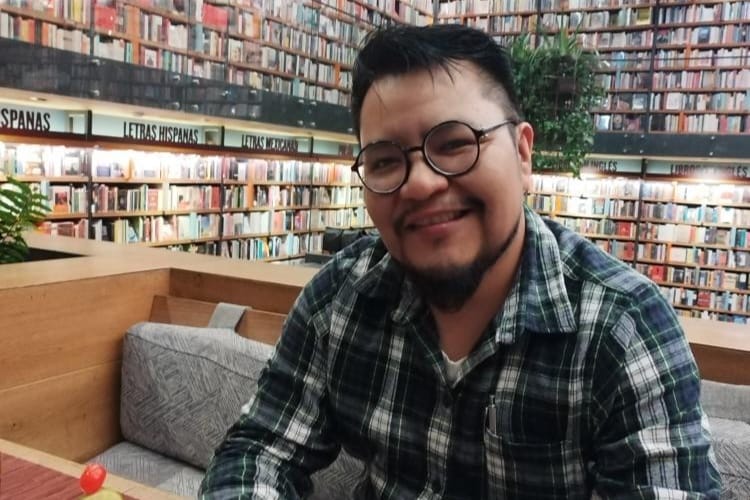
BUENOS AIRES, Argentina. Alana Portero honed her craft in the theater and the gothic subcultures that allowed her to experiment with gender when coming out in the Madrid neighborhood of San Blas seemed impossible. She began listening to Depeche Mode without understanding a word. Then came The Smith and The Velvet Underground, while in the '80s she translated the lyrics with a dictionary. For Portero, writing arrived with music and never left: it became books of poetry, theatrical adaptations of classics, columns on culture, politics, and trans identity for various media outlets. And it also became loose texts written spasmodically over years that, unbeknownst to her, were the pieces of "La mala costumbre " (Planeta) , a dazzling, at times heartbreaking novel that combines a portrait of Madrid's working class in the '80s, historical erudition with its myths and monsters, and trans fury. “I wanted to include everything: the neighborhood, the nightlife, prostitution, the music, because I live with the urgency of the last time,” she says in an interview with Presentes from the lobby of a Buenos Aires hotel, where she came to present her book. That urgency led her to write, in a month, working twelve hours a day, a coming-of-age novel with a trans and working-class perspective —a literary feat that seemed impossible a few years ago. Today it's in its ninth edition and has been translated into several languages.
Right to universality

– Do people often ask you if it's an autobiographical work?
– All the time. There's a common assumption that because it's written by a trans person and the protagonist is trans, it's necessarily something confessional. On the other hand, if it's a (cis) man writing it, it's considered "universal literature" because the universal is always masculine . And this is a very classic novel, a coming-of-age story, but they insist on calling it a trans novel, or an LGBT novel . It's not that I have a huge problem with those labels, but I'm not going to accept them being imposed by the market, because it's a self-serving distinction. I think it's used to make novels seem smaller and place them in special categories .
– The protagonist has to leave the neighborhood, encounter different characters and experiences, and then return to it. Is this the heroine's journey?
– It was conceived as a Homeric epic: leaving Ithaca and returning to Ithaca. Each chapter is an encounter with a character/oracle that propels the protagonist forward. It's a coming-of-age novel, shifting the focus from the typical Central European white man who goes on a journey and ends up on the beach. Here, the one who goes on a journey, from the neighborhood, is a woman who spends a lot of time on the street and becomes an adult. There's something of that: entering the circle of elegant writers, but as a transvestite. Although I didn't think about it that much; it just comes out that way because of my classical training.
The protagonist grows up and protects herself through an intimate mythology drawn from her books but also from pop culture. “I’m in favor of returning from logos to myth, making that journey in reverse ,” says Alana.
“Since I was old enough to understand, and as a child who needed to learn to live in two realities because I had two lives, I used to place the women around me in fantasy spaces where nothing could touch them and where I could include myself, imagining stories woven with golden thread; I saw Aphrodites, Circes, Nimues and Elaines de Astolat at the number 28 bus stop, on the Simancas metro platform or queuing at Mr. Lucas's delicatessen,” says the narrator.
Right to mysticism
– The novel is constantly on the verge of the magical. These days there seems to be a coming out of the closet of esotericism, if that's even possible. Why are you interested in those worlds?
– I celebrate this and feel completely part of this movement without any shame. The esoteric is about sublimating human experience and transforming into faith the transcendence that isn't governed by monotheistic religions. The esoteric is closely associated with the feminine. That's why it's been so undervalued. The figure of the witch, of the friends who get together to read Tarot cards. I practiced it with my friends from age 16 to 45 without us going crazy. I believe that in the transcendent, in the dark, one finds such beautiful literary aesthetics that how can we not take advantage of them?
– Identity politics and diversity have become quite separate from the spiritual.
– I think that over-rationalizing things dehumanizes us . Those postulates are fine in academia, to impress a thesis committee. I also adopted them and realized that I was dehumanizing myself, seeing myself as an object of study. And I didn't like it at all. Besides, we as trans women and transvestites have a right to mysticism. I don't have to be more rational than others . I don't want to justify my life with extremely long essays. It would be important to look back and see who we're leaving behind. I think many LGBT people are being left behind in this over-academic justification of our lives .
Right to trans memory
– What connotation does the word transvestite have in Spain? Because you use it a lot in the novel and also now.
– It's always been associated with cabaret artists or drag performers. For many trans women of a certain age, it's the only word they've ever known. Now there's a vindication of that word. I also have great respect for the Latin American transvestite-trans genealogy; it's a devotion for me, with Lohana Berkins , Diana Sacayán , Marlene Wayar . I started reading them in the early 2000s, after having read a lot of queer , which is all well and good, but it left many of us out, especially those who came before us . And the most deliberate thing in my novel is that it's a tribute to a generation of trans women who would be 70 years old today, and almost all of whom have died . They are women who were overlooked, who have been used as objects of ridicule and fetishes, and without them, our history wouldn't be complete. Here in Buenos Aires, I went to visit the Trans Memory Archive , and looking at the photos, tears streamed down my face; my heart ached with the stories. The care with which they do it. I find it so magical and so valuable. Since I'm on the subject of advocacy: transvestites and trans people also have the right to memory . The world needs to include trans and travesti genealogy in universal genealogy . The most important things I've learned in my life I've learned from them. I hope a similar initiative is launched in Spain.
Right to emotion

It's clear that Alana S. Portero comes from poetry and playwriting—she founded her own company a few years ago where she writes and directs—because the writing of "La mala costumbre" (The Bad Habit) places settings and feelings on the same level. In addition to the neighborhood portrait (San Blas is the other main protagonist, with its sorrows and transformations), the novel is built on dualities. The solar (daytime, masculine) is opposed to the lunar (feelings, the night, the world of women, transvestites, and prostitutes). The internal (the protagonist's emotional world, the house, the neighborhood, the closet) versus the external (the rest of the city, dangers, and freedom).
“I was interested in that duality, because the protagonist is also bisexual, that's always there. And the emotional aspect is part of my understanding of literature. I seek to evoke emotion when I write, perhaps because I come from the theater and I like the audience to be moved. I am a proudly emotional person; I like to be deeply affected, I don't know how to protect myself from that, I don't know how to do it. And when I enter the tunnel of literature, it's more difficult to put up barriers.”
– Emotions reside in the body. Is the body the big problem?
– As a woman of the theater, I believe the body is at the beginning of everything; it's what summons us . Before we even know what's happening to us, our hair stands on end, our face heats up, then comes fear, excitement, pain. The bodily experience is profoundly emotional, and vice versa; they cannot be separated. This protagonist's experience is constantly one of body and emotion. That's why I place so much emphasis on the sensory: describing the wardrobe was something that was important to me to tell well; the wardrobe isn't an empty place, it's a place full of things.
– In the novel you don't make a distinction between trans women and cis women. Is that an exercise in bringing them closer together?
– That's my absolute aim. Because femininity is a trajectory that encompasses many women, and the specificities of being a trans woman could be those of women in other geopolitical, cultural, or class contexts. I'm tired of the microscopic classification of women's lives . Some problems may have been specific to trans women, but I know that most of them happened to non-trans women. I believe there's a general and concrete narrative that goes far beyond the trans experience. I consider myself a feminist, but if feminism is going to be used to exclude others, then feminism needs to be rethought. Those hateful currents are a thing of the past.
– But the far right continues to advance, and with force.
– They're waves, and I truly believe it's a dead world that's now breathing its last with these right-wing movements emerging. And the death throes of a rabid animal are extremely dangerous. And they have money. They buy very powerful platforms. They influence anyone susceptible to that ideology. There's a fascist coming out of the closet , but I'm convinced it's the end.
– You have hope, then.
– I think pessimism is reactionary and leads nowhere. I'm convinced, for example, that Milei will be defeated sooner or later. And so will everyone else.
Share
We are present
We are committed to journalism that delves into the territories and conducts thorough investigations, combined with new technologies and narrative formats. We want the protagonists, their stories, and their struggles to be present.
SUPPORT US

FOLLOW US
Related notes

We are present
This and other stories are not usually on the media agenda. Together we can bring them to light.