

Norma Vázquez: “In feminism, there is too much discourse and not enough contact with women's experiences”
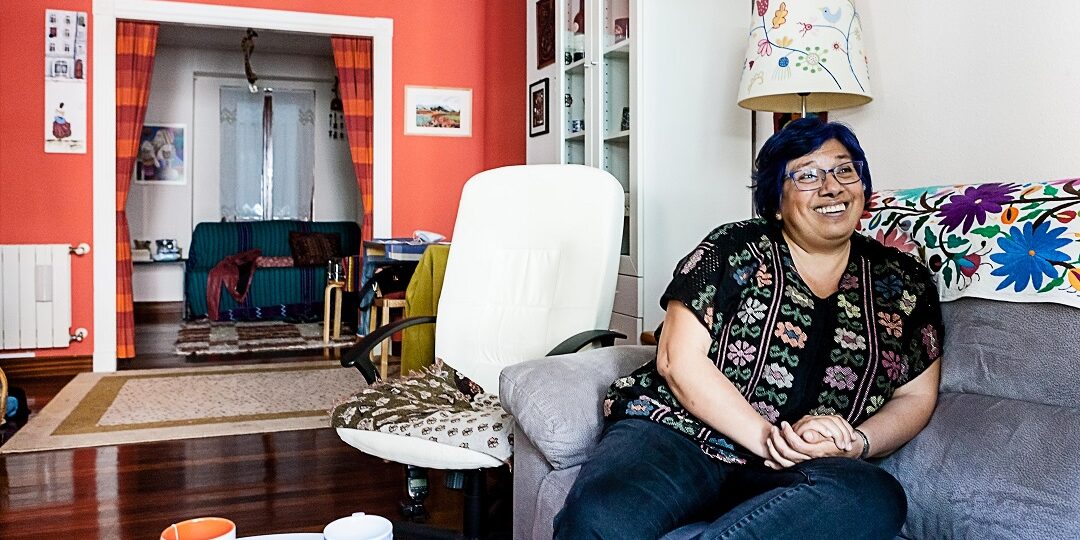
Norma Vázquez, a social psychologist of Mexican origin, has spent four decades supporting empowerment processes and overcoming gender-based violence in Bizkaia.


Share

Norma Vázquez (Mexico City, 1960) began her career as a social psychologist in the 1980s at a feminist center that facilitated safe, clandestine abortions. In the 1990s, she explored the lasting impact of clandestine life and war on former guerrilla fighters in El Salvador.
Since 2003, she has directed the feminist consultancy " Sortzen " in Bilbao, from which she has brought to light invisible violence, such as that experienced by domestic and care workers in live-in positions.
The word “clandestinity” evokes, without going any further, the very experience of feminism and lesbianism until very recently.
Clandestinity vox populi
Vázquez became involved with feminism in her adolescence in what was then called the Federal District (DF), when the movement was beginning to take shape. On the one hand, small consciousness-raising groups were flourishing, publishing magazines. On the other hand, in 1975 the Mexican capital hosted the First World Conference on Women, convened by the United Nations , and an institutionalized form of feminism emerged around its organization: “They were bourgeois women; we, on the other hand, were the 'working-class' ones, linked to the labor movement.”
That “we” includes feminist colleagues who worked at CIDHAL (Communication, Exchange, and Human Development in Latin America), considered the first Latin American feminist center and founded in the late 1960s in Cuernavaca. In 1985, an earthquake devastated Mexico City and particularly affected seamstresses in clandestine workshops. The feminists organized solidarity brigades, and it was in this context that CIDHAL hired Vázquez.

Voluntary termination of pregnancy was legalized in Mexico City in 2007; until then, it was only permitted in three specific circumstances, and even then, it wasn't covered by public healthcare. “We put them in touch with doctors who performed safe, low-risk, and inexpensive clandestine abortions. It was a clandestine activity, but it was common knowledge. Our methods of secrecy were very basic; we even used code names like Blanca Flor!” Like the other workers, she learned to perform cervical and breast exams. They provided contraceptive methods that were unknown at the time, such as the diaphragm, and even menstrual cups. “We were very modern!” she laughs. However, she soon focused on developing the issue of violence against women.
-What kind of violence were you talking about at that time?
We were talking about sexual violence, denouncing the fact that in the Mexican Penal Code, stealing a cow was punished more severely than rape. We were talking about domestic violence and sexual harassment in the workplace; in fact, we were the first country to legislate against this type of harassment. The cases of violence that came to us at first were from women we knew, and we organized actions to confront the aggressors.
-Did it give good results?
Yes, as individual warnings, because we knew these men and we knew they wouldn't report us. In 1988, it came to light that the head of the State of Mexico's judicial police was encouraging officers to rape young women. We launched a campaign against sexual violence, and more cases started coming to us. At that point, that strategy of individual confrontation was no longer effective. We began to build a network against violence and created a guide for addressing all these issues in Mexico and Central America.
Mountain women
In the late 1980s, CIDHAL began by assisting Guatemalan war refugees and gradually strengthened its relationship with organizations and women's groups in Central America. During the first Sandinista National Liberation Front (FSLN) government, the Nicaraguan Women's Institute invited them to train health promoters in contraception and safe abortion.
-Was Sandinismo in favor of abortions then?
"Only if they were clandestine! We had translated into Spanish the emblematic book Our Bodies, Our Lives , by the Boston Women's Collective. The director of the Women's Institute took it without our permission and mutilated it: she removed the chapters on abortion and lesbianism because, according to her, they didn't reflect her reality. I was furious, she was angry too, and she told me: 'In the Revolution, we don't have to ask anyone's permission.'"
In 1990, the FSLN lost the elections, and from that crisis, autonomous feminist organizations flourished. The same thing happened in El Salvador: the organization Las Dignas was founded that year, in the context of the Peace Accords. CIDHAL supported both groups. “They thought we were from another planet, but we connected well because they were just as crazy as we were!” she laughs.
The following year, the Feminist Coordinating Committee of Mexico City launched a campaign, "Women to Power, Women to Congress," demanding that political parties include its members as independent candidates on their electoral lists. "The candidates were feminists in favor of abortion and against violence, openly lesbian, sex workers... It was a wonderful adventure, my first and last in politics, my last in Mexico. We decided that if we lost, we would go live in El Salvador. We lost by a narrow margin," she recalls.
She speaks in the plural because she was already in a relationship with Clara Murguialday, a gender and development consultant whom she had met at feminist gatherings in Ecuador. During the interview at her home, Clara prompts Norma when her memory fails her.
Mexico was one of the first countries to celebrate LGBT Pride, and respect for free sexual orientation was among the founding principles of the Feminist Coordinating Committee of Mexico City. In Central America, however, even feminists struggled to accept lesbianism. She lived in El Salvador between 1992 and 1998, working with Las Dignas, and, together with Cristina Ibáñez, conducted research that, when published as a book, shook the Salvadoran left: Mujeres montaña. Vivencias de guerrilleras y colaboradoras del FLMN (Mountain Women: Experiences of Guerrillas and Collaborators of the FMLN) . They were struck by how deeply the clandestine life had permeated their new comrades: “People didn’t have a social life, they only worked and were activists. They never invited us to their homes, even after the war ended, when we were already friends and living there. All the parties, meetings, and workshops were organized at our house. They were very traumatized by noise. While doing the research, I understood many things.”
-Was it difficult to get the women to speak up?
No, they were very eager to talk, but it was us who had trouble listening. I conducted nearly 60 interviews and felt like, "One more story and I'll die." I even developed skin rashes. Its publication caused a scandal. We went into the heart of a guerrilla group, a leftist organization, and talked about taboo subjects like the sexual persecution of women in the camps if they didn't find a partner, or the abortions that female leaders were forced to have.
-Were there reprisals?
There were reprisals from the very beginning of Las Dignas. They cut off their funding, but it didn't work because CIDHAL and other feminist organizations supported them with European cooperation agencies. Another form of retaliation was discrediting: they were called crazy, lesbians, abortionists. The left vilified us, saying we were allies of imperialism because we denounced men's violence, not just state violence . But this bad reputation only increased Las Dignas' prestige among Latin American feminists.
Migration empowers
Norma Vázquez says that in El Salvador, the years weigh twice as heavily. They were exhausted from the activist turmoil and the constant upheaval. Her partner's homeland, the Basque Country, seemed like a good place to further her training in clinical psychology and find the peace she craved, as she approached 40. At first, she struggled to find her place. She felt that her skills weren't valued in the Basque Country and that she had gone from being recognized as a feminist role model to being treated as if she lacked expertise. “Migrating is an empowering experience because you have to survive and adapt to a very different reality. It's a humbling experience; you have to work hard on your self-esteem to escape the place where racist prejudice has put you.”
In 2003, she founded the consulting firm Sortzen, specializing in gender violence and women's empowerment. Two years later, the equality officers of Basauri, Ondarroa, Getxo, and Ermua founded the Bizkaia Empowerment Schools Network, inspired by Latin American experiences, and hired her as a trainer. "They were the first to call me to do what I knew how to do, which was lead workshops with women."
One of Sortzen's strengths is its work with migrant women. Once I was settled, I was able to start working with them and see a reality I hadn't experienced firsthand, because I'm somewhat privileged . While my colleagues in heterosexual relationships could get married and have legal status from day one, I couldn't until same-sex marriage was legalized in 2005. Around that time, a large influx of diverse migrants began arriving, regularization opportunities were eliminated, and domestic work, often under very precarious conditions, flourished. City councils hired us to run empowerment workshops for migrant women, without understanding that empowerment involves things like learning to navigate the subway on your own or understanding the institutional framework. We provided them with those tools.
Two decades later, she observes with interest the emergence of racialized feminist collectives, although she doesn't entirely identify with their methods and proposals. “Perhaps it's because I didn't become involved in feminism based on my race, but rather on my knowledge and experiences in a specific area. I will always be racialized, but I no longer feel like a migrant. I understand that some women feel attacked, belittled; I understand them because I experienced it myself. Back then, there were too few of us to make a fuss.” When she explains concepts like structural violence against women in workshops, she emphasizes that gender cannot be separated from class or race. “I've returned to my origins, to 1975 when bourgeois Mexican women would say, 'Above all, we are women,' and we would reply, 'We are poor women.'”
-You have shed light in various investigations on the violence experienced by migrant women. What remains hidden?
same feminist movement that talks so much about putting care work at the center doesn't do so in partnership with the women who work in care . There isn't enough light on the mistreatment of the elderly by their children, nor on institutional abuse. In El Salvador, families are built on affection, not blood ties, because the mother might be in the United States and the father might be dead. Here, on the other hand, it's the migrant women, both internal and external, who hold the key to unlocking the strength of the Basque family. I think it's an interesting challenge to illuminate the complex emotional and professional dynamics that intertwine within that family when a caregiver with such a different background bursts into that cultural homogeneity. To see who influences whom. It's fascinating.
-You give workshops on gender-based violence to men, including police officers. How do you experience that?
"It's rewarding, because first they throw all their hegemonic masculinity in your face, and then they're taken aback. My role isn't to convince them, but to tell them the truth: that the world doesn't belong to them, that they have to respect other people's rights and obey the law. That puts me in a position of power. I think women can do this job better than men, who will look out for each other more."
-You also participate in community intervention processes. Patriarchal justice doesn't protect us, but we get lost when we try to develop these alternatives…
Yes, punitive measures often creep in. I was saying to some feminists I was advising, "How long are you going to keep banning this kid from the youth center? Because I'm against life imprisonment." I've also argued with those who believed that the non-punitive solution was to send the aggressor to therapy. It might help him, but what will the punishment and reparation measures be? It could be asking for forgiveness, acknowledging the harm done, thinking about how to make amends for the victim. Women experiencing violence, during their healing process, may want the aggressor to die or go to jail, but afterward, they're usually not punitive, especially if they have children together. I think we're sometimes very out of touch with women's lived experiences.
–So how can we get closer?
I teach in some master's programs and I find an over-ideologization of violence that doesn't help us work with women. I read in a class assignment: "Women become objects to be violated." That statement makes me shudder. There's too much talk and not enough connection, also with our own lived experience. Because you see feminists who have seemingly very clear and decisive ideas, but they get tangled up in their relationships. I wrote an article titled 'The Therapy of Complexity.' I wondered why a young woman can feel like she wants to die because she sees intimate photos posted online, while a woman who has been raped by a paramilitary group can recover. Much of it has to do with subjective experience. We feminists are very used to fighting with the outside world and trying to explain to women what's happening to them based on very general ideas. Perhaps it's an occupational hazard, but it seems to me that there's a lot of talking and very little listening.
This article was published in Pikara Magazine and is part of issue number 9 of Pikara Papel , a media partner of Agencia Presentes.
We are present
We are committed to journalism that delves into the territories and conducts thorough investigations, combined with new technologies and narrative formats. We want the protagonists, their stories, and their struggles to be present.
SUPPORT US

FOLLOW US
Related notes



We are present
This and other stories are not usually on the media agenda. Together we can bring them to light.