

How does the government's austerity measure impact trans people in Argentina?
The interruption of the National Social Protection Plan and the reductions in the Potenciar Trabajo program worsened the vulnerable situation of trans people in Argentina.



Share

BUENOS AIRES, Argentina. WhatsApp groups that had been created during previous emergencies—such as the Covid-19 pandemic—have been reactivated in recent weeks with a widespread concern: the lack of payments on food assistance cards. One by one, messages arrived from transgender and transvestite individuals who had been receiving financial support through the National Social Protection Plan . They stopped receiving these payments in January. They are also complaining about being dropped from the Potenciar Trabajo and the outstanding delivery of dry goods at the establishments they used to attend.
“We found out through WhatsApp and social media fundraisers for trans people that they weren't paying out on food stamps. WhatsApp groups for trans people are exploding . If it's not enough for food, it's enough for rent and medicine,” Pato Laterra, an activist and professor of Economics and Gender at the National University of La Plata and the University of Buenos Aires, Presentes He is also part of the TTNB Workers' Front in the State and the Zaguán trans-union collective.
Essential social protection
The National Social Protection Plan aims to "promote social inclusion and improve the living conditions of households with the highest degree of exclusion and social vulnerability."
“Since transgender people do not meet the requirements for the Alimentar cards because they do not belong to a 'family group,' the previous government, through Program 54 – National Social Protection Plan, provided prepaid cards through the National Social Security Administration,” Laterra explained. This benefit is specifically aimed at the transgender and transvestite population in situations of high vulnerability due to gender-based violence, discrimination, and institutional violence. It also applies to women and LGBTQ+ individuals with the same vulnerability criteria.
However, Laterra warned that “ if one consults the open budget , Program 54 of the Undersecretariat of Human Development and Solidarity Economy, which contains the Program of Resources for Social Promotion where these cards are located, was not executed in January or February.”
The program represents 0.0087% of the national budget. “It’s a very small amount to guarantee food security. It mainly affects transfers to the provinces of Buenos Aires, Tucumán, and Misiones,” Laterra explained.
No answers
The Ministry of Women and Diversity of the Province of Buenos Aires sent a letter to the National Ministry of Human Capital regarding the non-compliance with agreements that coordinated the resources for social promotion (RPS) under the National Social Protection Plan. These agreements provided up to 5,000 RPS payments via prepaid cards to a total of 4,305 transgender and transvestite individuals in situations of high vulnerability.
Despite the fact that the agreements remain in force, “hundreds of inquiries and complaints were registered” given that “all of the registered people did not receive the payment corresponding to December 2023, to be collected in January 2024,” details the note to which Presentes .
In response, the provincial gender affairs office urgently requested information regarding payments owed to beneficiaries and the current status of the implementation of the aforementioned initiatives. Furthermore, it offered its support to continue this crucial collaborative work to ensure food security.
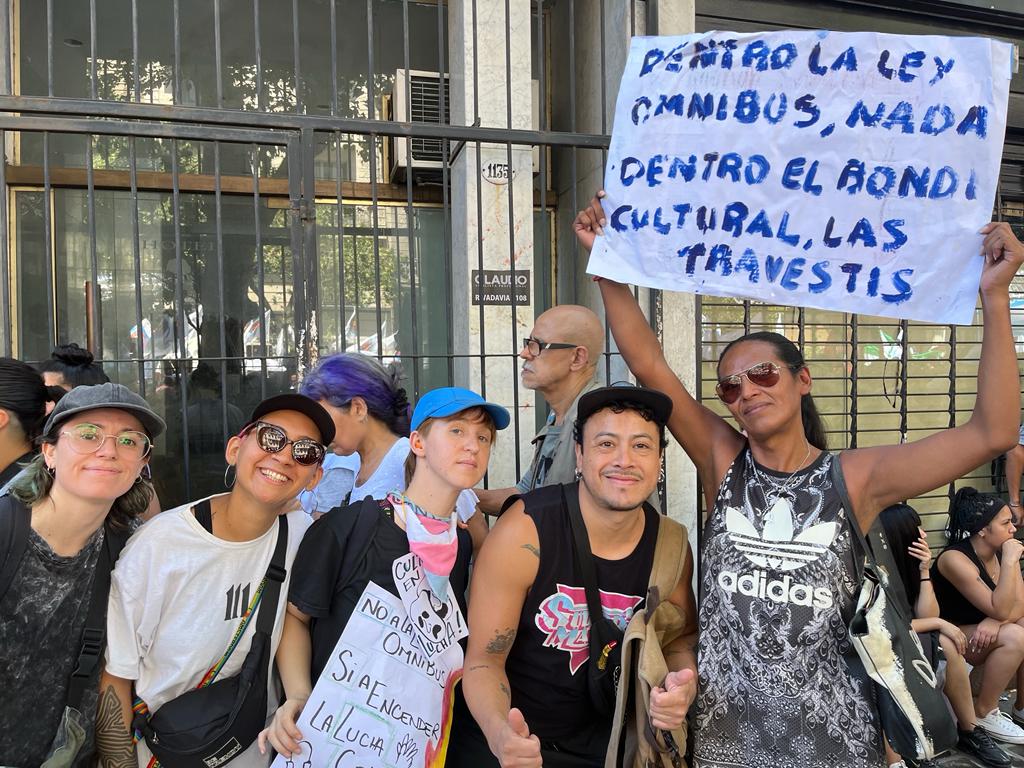
Photo: Presentes Agency.
"This aid provided the possibility of paying the rent."
This situation is repeated throughout the country with different characteristics. In Río Negro, trans activist Georgina Colicheo, 56, warned of it. “Most of them were receiving a social card from the province and the Potenciar Trabajo program for more than two years. It’s February and they haven’t received anything, neither provincial nor national,” Colicheo told this agency.
“Most of us are sex workers, and this aid gave us the possibility of paying rent. Today we're in a housing emergency,” she warned. She also shared that the provincial government “stopped providing social services such as food assistance. Not to mention condoms or healthcare.”
Colicheo got her job at PAMI through the trans and travesti employment quota. So far this year, several of her colleagues who had also obtained formal employment in Villa Regina and Cipolletti have been laid off.
Discontinued programs
On the other hand, Georgina Orellano, general secretary of the Union of Sex Workers of Argentina (AMMAR), shared that there were “many dropouts from the Potenciar Trabajo program of colleagues who accessed that program because they require it due to their vulnerable situation, their socio-housing context, and health.”
When asked why they were dropped from the program, the answers they received were that the reason was that they had gone on a trip or had already joined other programs.
“Some of my colleagues managed to save enough money to visit their families again, something they haven't been able to do for many years. Others appear in the system as having already accessed other programs, and that wasn't incompatible before,” Orellano explained.
Furthermore, “some colleagues used to receive goods at branches, but they stopped receiving them last November. They haven't received any response. In some provinces, they managed to access goods, but with a 50% reduction,” she warned.
“There are many needs within the trans community.”
These policies are “extremely important” for the trans and travesti community, activists agreed. They also warned that they were insufficient to address the realities of this community.
“The trans community has many needs. These are people whose access to education, we believe, has been disrupted, and therefore, they lack the tools to integrate into society, especially in terms of employment. They are often alone, without a family support system, because heterosexual families resist accepting their gender identity,” explained social psychologist and trans activist Marlene Wayar in an interview with Presentes .
The current context, with a 118% devaluation and a monthly inflation rate of 25.5% for December , coupled with cuts in social benefits by the Ministry of Human Capital, “is leading to the collapse of living conditions for transvestites, trans people, and non-binary people. But also for LGB people ,” Laterra emphasized.
The response was repression.
Faced with the economic and social crisis, the national government responded with pepper spray to the demands for emergency food assistance from protesters at the Human Capital headquarters.
Meanwhile, Minister Sandra Pettovello, who had stated she did not want intermediaries in the distribution of social aid, signed a food assistance agreement with the Christian Alliance of Evangelical Churches of Argentina (ACIERA) . She also signed an agreement to combat child malnutrition with the Child Nutrition Cooperative Foundation (CONIN) .
The president of CONIN, Abel Albino, is the same person who, in 2018, during the debate on the Voluntary Termination of Pregnancy Law, confused the HIV virus with acquired immunodeficiency syndrome (AIDS) and said that condoms do not protect against HIV. "The AIDS virus can pass through porcelain," he said, and was met with widespread condemnation for spreading false information.
“What the government is doing is serious because it’s playing with people’s right to food security. It’s even more serious for trans women because they have fewer material and community support networks to access than cisgender people, due to historical discrimination from society, which they constantly deny,” Laterra explained. She warned that “direct and explicit action from the State is necessary to ensure the distribution of essential resources and services for everyone.”
We are present
We are committed to journalism that delves into the territories and conducts thorough investigations, combined with new technologies and narrative formats. We want the protagonists, their stories, and their struggles to be present.
SUPPORT US

FOLLOW US
Related notes



We are present
This and other stories are not usually on the media agenda. Together we can bring them to light.