

The Central American Northern Triangle expels sexual diversity
In Honduras, Guatemala, and El Salvador, sexual minorities choose to flee to save their lives. The weight of religion in Latin America.


Share

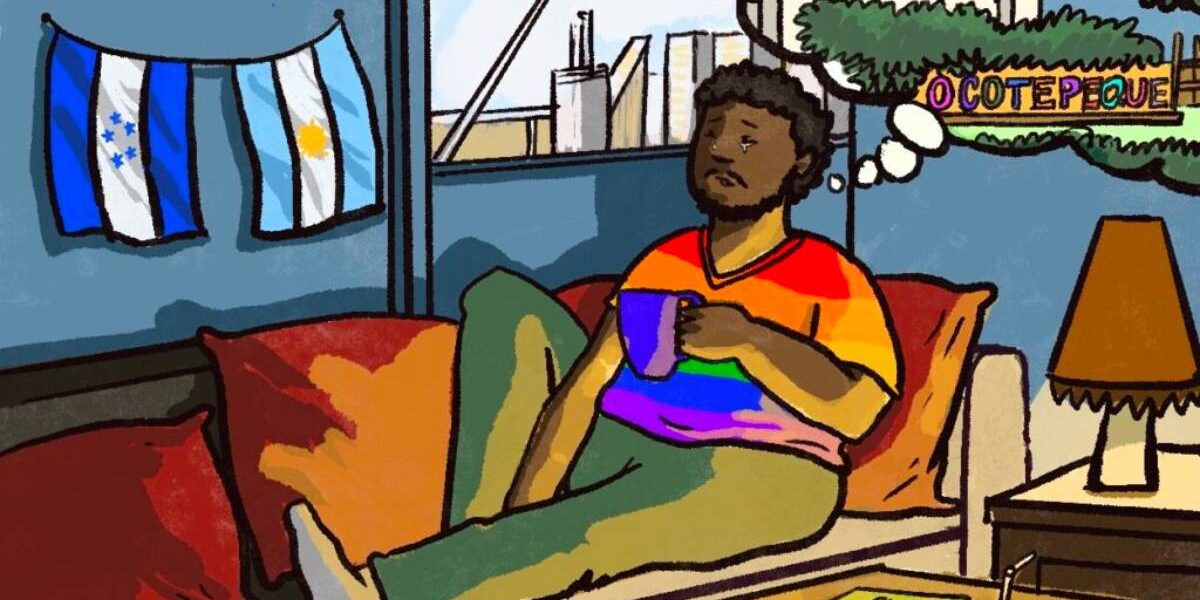
Among the three books on display in a living room cabinet, one stands out: The Exile . It's a book of poems by an Argentinian author, a gift from an event she attended with one of the three lovers she's met through Grindr, the most popular app for male hookups.
Next to that book, there's another one that Arturo picks up. He opens it and shows the back cover, where there's a photo of the writer lover he's been showing off this spring afternoon.
Arturo lives in a building overlooking Cabildo Avenue, an iconic and busy thoroughfare in Buenos Aires , the capital of Argentina. He arrived in the city four months ago and has no country of his own. At 43, he has lived between Honduras and Costa Rica, and now he is in Argentina.
He was born in Honduras in the 1980s, when the World Health Organization (WHO) considered homosexuality a mental disorder. His childhood was spent in Ocotepeque , a Honduran mountain town bordering El Salvador and Guatemala, in the heart of Central America's Northern Triangle.
Between the ages of six and twelve, his parents beat him because his older brother told them he saw him playing and caressing other neighborhood boys his age. His brother also beat him when he was drunk, and his Catholic aunts told him he would go to hell for being effeminate.
At 17, Arturo ran away from his village. He finished high school and moved to San Pedro Sula. This industrial city and Tegucigalpa, the Honduran capital, are the most important in the country. They have also sometimes been listed as some of the most dangerous in the world.
Structural discrimination
Violence against LGBTQ+ people begins at home, continues in schools, and extends to all social spaces, including those where political decisions are made.
“The biggest problem in Latin America is that it’s a religious region, primarily Catholic,” says Adriana Espinosa, director of Emergency Travel and Financial Assistance at Rainbow Railroad , a Canadian organization with a global presence. It helps LGBTQ+ people leave their countries due to the violence they face for not conforming to heterosexual norms.
The organization is currently supporting 400 cases of LGBTQ+ individuals fleeing persecution based on their sexual orientation, gender identity, and gender expression. These cases include a Honduran man and two Nicaraguan women who have been resettled in Argentina.
At a cultural level, Latin America does not agree with sexual diversity, Espinosa adds, and people are Catholic by birth, even if they are not practicing.
The Guatemalan Congress, for example, approved the commemoration of the Day for Life and Family in 2022, setting the date as March 9th. The decree approved by the representatives explicitly obliges the three branches of government to carry out activities to “protect” the traditional, heterosexual conception of the family, and prohibits any discussion of sex education in the country.
…
After learning about sexual diversity and understanding that the attraction he felt for other men was also felt by other men, Arturo became an LGBTIQ+ activist.
In San Pedro Sula, he had his first boyfriend, his first gay friends, and was diagnosed with HIV. In 2007, using what he had learned up to that point, he began working within an organization on the prevention and treatment of LGBTQ+ people living with HIV.
But Honduras was about to explode. On June 28, 2009, a year before the end of his term, President Juan Manuel Zelaya, a left-wing military officer, was overthrown in a coup, and a de facto government was subsequently installed.
On the day of the coup and the days that followed, curfews were in place. State security forces, including police and military, were denounced internationally by social organizations for their excessive use of force and the crimes they committed against civilians.
One of the victims of the coup was a friend and coworker of Arturo's. He says the military killed him while he was walking down the street. He was an organized man, and this, along with his effeminate manner, led to his murder.
On the night of June 28, a group of police officers also murdered Vicky Hernández , a trans woman, while she was working as a sex worker. For this still unpunished crime, the Inter-American Court of Human Rights (IACHR) condemned the Honduran state in 2021 .
This condemnation describes the human rights violations in Honduras. In total, during the coup, there were 300 murders, and thus the Central American country, according to the Inter-American Court of Human Rights, became one of the most dangerous in the world. And San Pedro Sula, one of the most dangerous cities in the world.
Of all the LGBTIQ+ population groups, the trans population, especially trans women, has been the most vulnerable due to their visible gender identity and expression, which are contrary to heterosexual norms. The Inter-American Commission on Human Rights (IACHR) estimates that the life expectancy of a trans woman in Latin America ranges between 30 and 35 years.
Without a Gender Identity Law that recognizes them, transgender people continue to lack access to basic human rights such as health and education. And, unable to integrate into the formal labor market, some transgender women have no option but to seek income through sex work.
“Being LGBTIQ+ is a death sentence in Honduras, there is no protection law,” says Osmán Lara, president of the LGBTIQ+ Committee of the Sula Valley , which is made up of 15 organizations with a presence in 16 Honduran municipalities.
The stigma and violence against sexual diversity in Honduras are so pervasive that when a person is visibly LGBTQ+ and wants to access healthcare, they first have to undergo HIV testing. In addition to social discrimination, gangs force some trans women and gay men to sell drugs, Lara points out.
Honduran organizations, with the few resources they have, work to provide legal support to people from the LGBTIQ+ population and record the violence they face.
In 2023, according to the LGBTIQ+ Committee, 48 LGBTQ+ individuals were murdered in Honduras. Guatemala reached similar levels of violence, with 34 cases reported. These homicides are based on hatred toward people's sexual orientation, gender identity, and gender expression; therefore, they are called hate crimes and, in most cases, go unpunished.
“In LGBTIQ+ victims, Honduras has a sad record,” acknowledges Tony García, Vice Chancellor for Consular Affairs and Migration in the government of President Xiomara Castro, who took office in January 2022.
Despite acknowledging violence against sexual minorities, García downplays its impact, stating that it is not one of the main reasons for migration in Honduras. According to him, Hondurans primarily migrate to reunite with family members in the United States, where 1.5 million Hondurans reside. The second leading cause of migration is unemployment, and lastly, the threat of gangs.
The same is true of the Guatemalan government, which does not recognize in its records migration as a result of violence, much less the structural violence faced by the LGBTIQ+ population.
Alharaca requested an interview with representatives of the Guatemalan Migration Institute. Alejandra Mena, from the press office, responded to the interview in writing. In it, she states that Guatemalans migrate for "improvements" and job opportunities, social and "family" reunification.
From El Salvador, there was no response from the authorities regarding forced migration.
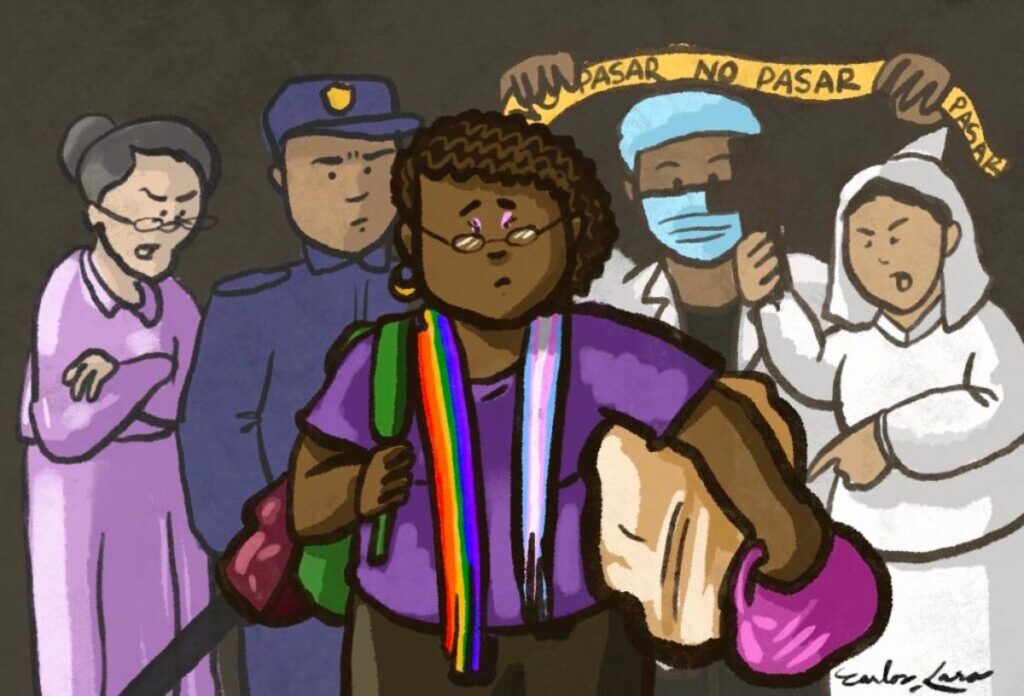
Arturo had no choice but to flee San Pedro Sula during the curfew . Along with one of his colleagues, he requested protective measures from the IACHR due to the state persecution activists were experiencing at that time. These measures did not guarantee their safety, because those protecting them, under orders from the IACHR, were police officers who openly boasted about the violence they perpetrated against the LGBTIQ+ community.
In the Northern Triangle of Central America , states have failed to legislate in favor of the rights of sexual minorities, making them more vulnerable to violence. Crimes against these individuals go unpunished, there are no gender identity laws recognizing transgender people, and same-sex marriage is not permitted. In this region, not only are gangs present, but, parallel to these groups, police and military forces have also been perpetrators of violence against people of diverse sexual identities, even murdering them or expelling them from their countries.
“These acts of violence are mostly experienced in silence and are not reported, because the perpetrators are also police officers or judicial public officials,” emphasizes Patricia Vargas, a Guatemalan researcher specializing in the LGBTIQ+ population and violence against women.
Vargas has spent years documenting the migration processes and exclusion experienced by sexual minorities in Guatemala. One of her studies indicates that, in Zone 1 of Guatemala City, the capital, one out of every 100 homeless people is part of the LGBTIQ+ population.
These are people who often travel from the interior of the country, the specialist says, believing that the discrimination and racism they experience in their communities will change in the capital. But in the capital, they encounter a "diluted" racism and also more classism than in their communities of origin.
Exhausted by constant movement and after suffering another loss within his organization, Arturo decided to flee to Costa Rica. This decision stemmed from an incident in 2012 when a colleague, after gangs murdered his partner and her entire family (10 people in total), was forced to flee to the United States. Arturo lived in Costa Rica for a decade.
In Central America, Costa Rica is becoming a possible destination for those fleeing violence, but mass migration does not allow the country to respond quickly to all migration processes.
Dennis Castillo is a gay man who sought refuge in Costa Rica. He fled Honduras in 2012 and, a year after arriving, joined other activists to form the Institute on LGBTIQ Migration and Refugees for Central America (IRCA-Casa Abierta) , which provides legal and psychological support. It also helps LGBTQ+ people seeking refuge with social integration. “LGBTI people don’t migrate with biological families; we travel alone, we choose our family ,” Castillo explains.
IRCA is assisting 902 asylum applications. Half of them are awaiting a final decision. But, according to Castillo, since 2018—when the political crisis erupted in Nicaragua—Costa Rica has processed 250,000 applications.
Refugee status is international protection granted by states to people fleeing violence in their countries of origin. Two conventions regulate this issue, one from 1961 and another from 1967. Both consider that a person can be a refugee if they are persecuted for reasons of race, religion, nationality, political opinion, or membership in a particular social group.
According to regulations developed by the United Nations High Commissioner for Refugees (UNHCR), the agency in charge of refugees, asylum applications from LGBTQI+ people are processed under the last two causes.
The report Leaving Everything Behind: Stories of People Forced to Flee Central America and Mexico , published by UNHCR in September 2023, indicates that, up to 2020, 3.9 million people from Guatemala, El Salvador, and Honduras had migrated to different regions.
The same report reveals that, as of July 2022, there were one million refugees or asylum seekers from Central America and Mexico worldwide . This figure represents a 590% increase compared to the number of cases in 2015.
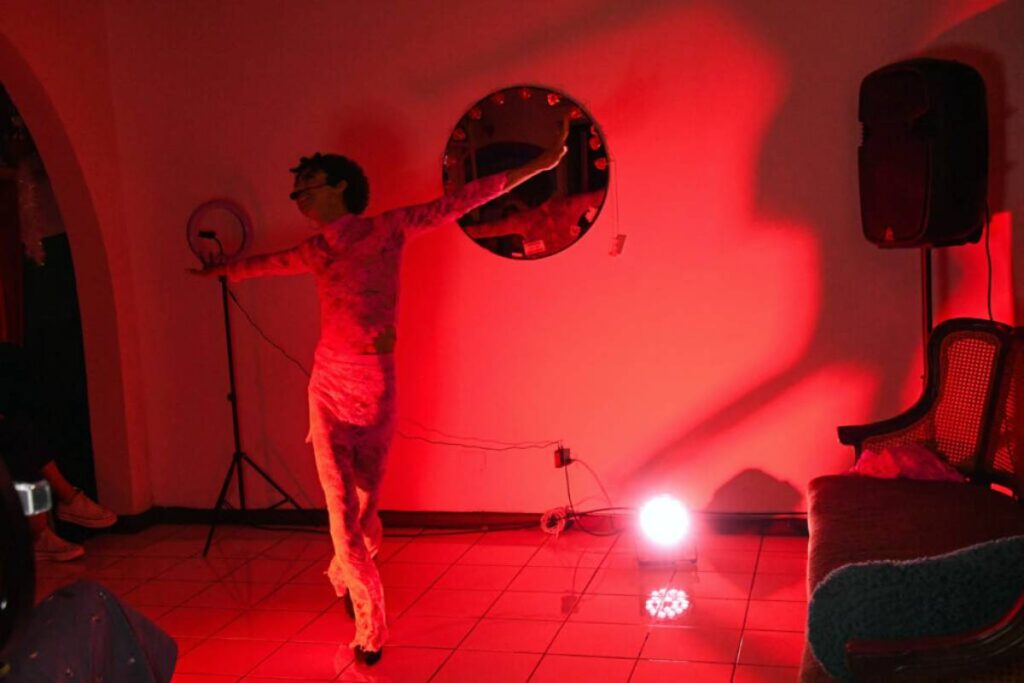
Photo: Kellys Portillo.
In the City of Buenos Aires, Alejandro Córdova discovered ballroom dancing and, thanks to this subculture representative of the Latin and African American community of the early 20th century, he rediscovers his sexual identity.
Taylor, as she calls herself in the art world, in reference to the American pop singer Taylor Swift, is a non-binary person from El Salvador who traveled in June 2019 to study a master's degree in dramaturgy in Argentina on a scholarship.
After the COVID-19 pandemic, he chose to settle in Buenos Aires to further his career. However, during a five-week trip to El Salvador between October and November 2023, he decided to return. Economically, Argentina is no longer viable for him: on his first day in office, Milei devalued the currency and implemented measures that liberalized the economy amidst rampant inflation. Furthermore, his focus on cutting public spending has led the far-right president to threaten the closure of arts institutions, including the National Arts Fund.
"I am making a decision based on opportunities," Córdova commented in a telephone interview with Alharaca , a few days before returning to El Salvador.
La Taylor's time in Argentina was marked by the stage: one of her projects, Yender, a work about experiences within ballroom culture, won the National Arts Fund; and, in Buenos Aires, inspired by the American singer, she began presenting her shows, in which she blends poetry and music to talk about her romances with men. In 2022, she also married a non-binary person and was able to access her antiretroviral treatment free of charge after receiving her HIV-positive diagnosis.
In El Salvador, Córdova did not experience domestic violence due to his sexual orientation when he still identified as a gay man. He acknowledges that, at a social level, not all LGBTQ+ people have the same experience. “El Salvador is a very hostile place to grow up as a sexual dissident,” he states.
Since the approval of the 1961 Convention relating to the Status of Refugees and its adherence to it, Argentina has recognized as refugees 773 people who have fled due to the persecution they suffered in their countries of origin for their political opinions or for belonging to a certain social group, such as the LGBTIQ+ population , according to official data from the National Commission for Refugees.
In 2011, the government of this South American country considered granting humanitarian visas to people from the Northern Triangle of Central America, inspired by the Syrian Program, which provides humanitarian visas to Syrians fleeing a 12-year war. According to Esteban Tome Fuentes, a former official in charge of the program, the discussion of visas for Central Americans did not come to fruition.
From Mexico to South America, LGBTQ+ people are persecuted by their families and communities, often based on religion; and in the case of activists, by the state, notes Espinosa of Rainbow Railroad. Some, she says, are subjected to “conversion therapies.” These so-called “conversion therapies” should be banned, as Víctor Madrigal-Borloz, the United Nations Independent Expert on Sexual Orientation and Gender Identity, stated in a May 2020 report on protection against violence and discrimination based on sexual orientation or gender identity that they can be considered forms of torture.
In Guatemala, the Latin American Faculty of Social Sciences (Flacso) obtained testimonies from four LGBTIQ+ people who experienced these therapies that were intended to "correct" their sexual orientation and gender identity different from heterosexual.
The investigation, called “Cure or torture? ECOSIEGCS —Efforts to change sexual orientation, gender identity, gender expression and sex characteristics—. The so-called 'conversion therapies' in Guatemala,” explains that in Guatemala, people from the LGBTIQ+ population are not only “corrected” through religion, which views diverse sexual orientations and gender identities as illnesses, but also through psychotherapies.
In schools, the researchers from FLACSO explain, there is direct and indirect repression against LGBTIQ+ people, such as expulsion from educational institutions and the cover-up of homophobic and lesbophobic bullying by the educational community. This exclusion then evolves into the expulsion of people from their countries of origin.
"My migration is different from the migration of leaving to improve your economic situation or because you don't like the country. In our country, there is persecution for LGBTI people," warns Arturo, the gay activist from Honduras.
Argentina, on the other hand, has approved rights that the Northern Triangle countries of Central America lack, guaranteeing the development and a dignified life for LGBTIQ+ people. But these guarantees are threatened by the government of far-right politician Javier Milei, who took office on December 10 and has already begun cutting public spending, leaving sexual minorities and women more vulnerable.
In Argentina, transgender people have the right to change their name and to access hormone therapy through the public healthcare system. Currently, healthcare is free for both Argentinians and foreigners, as is education at all levels. Comprehensive sex education is also taught in schools. Furthermore, the country has legalized same-sex marriage and civil unions for LGBTQ+ individuals.
“LGBTIQ+ people migrate because they do not have equal opportunities,” says Karla Guevara, a trans activist, director of the Alexandria Collective and general secretary of the Salvadoran LGBTI+ Federation.
The organization led by Guevara has worked for the past 11 years supporting Salvadoran trans people in accessing rights such as healthcare and information on HIV prevention and treatment. They also recently opened Casa Francela, a community center created to serve as a meeting point for sexual minorities.
Given the shared history of violence across the three countries of the Northern Triangle of Central America, forced migration has been a constant. But between 2018 and 2019, it became more visible and widespread. During those years, migrant caravans departed from Honduras, El Salvador, and Guatemala for the United States, prompting the Trump administration to pressure the governments to curb migration.
In these caravans, Lara, the Honduran activist, says that organizations in Honduras identified 62 cases of LGBTIQ+ migrants.
Because of the collective imagination of the "American dream," Amaral Arévalo, a Salvadoran researcher specializing in violence and homicides against LGBTIQ+ people in El Salvador, within the Fernandes Figueira Institute in Brazil, indicates that the main destination country sought by Central American migrants is the United States.
At Rainbow Railroad they intend to "dismantle" migration to North America and offer other Latin American countries for resettlement to asylum seekers, says Adriana Espinosa.
This year, the organization launched a program to relocate LGBTIQ+ Latin Americans to Argentina, where asylum is processed in less than a year, but not all applicants accept this destination.
“We Latin Americans don’t want to go to Latin America. We have that bad perception of ourselves and our peers in Latin America, of the country or of the economic situations ,” the specialist mentions.
Guevara, the Salvadoran activist, believes that LGBTQ+ people don't choose to migrate to a country other than the United States because not everyone can afford a plane ticket, as is the case for traveling to Argentina. For LGBTQ+ individuals, there is no other option but to risk their lives crossing the migrant route by land.
…
During the 1990s in Europe, Arévalo explains, many gay men fled to the United States because they were persecuted for being attracted to other men. Since the late 1960s, the United States had been at the forefront of the fight for LGBTQ+ rights worldwide.
From 2016 to the present, the Argentine LGBT+ Federation (FALGBT+) collaborates by advising people from different countries of the world who, because they are part of the sexual dissidence, in addition to suffering internal conflicts in their places of origin, are forced to migrate or take refuge in Argentina.
This type of migration is called sexile, which is a word derived from the combination of sex with exile: people forced to leave their countries or who leave for their own reasons, because they do not follow social and heterosexual norms.
The forced displacements occurring today in the Northern Triangle of Central America are characterized by the fact that in this region the main oppressors are the states , which do not guarantee any rights for LGBTIQ+ people , Arévalo argues. "They basically guarantee death," he emphasizes.
The UNHCR representation in Argentina, consulted by Alharaca , clarified that it could not speak in detail about asylum cases in that country, due to the confidentiality of the information, but sent reports that account for the displacement and forced migration that has occurred in recent years in the Northern Triangle of Central America.
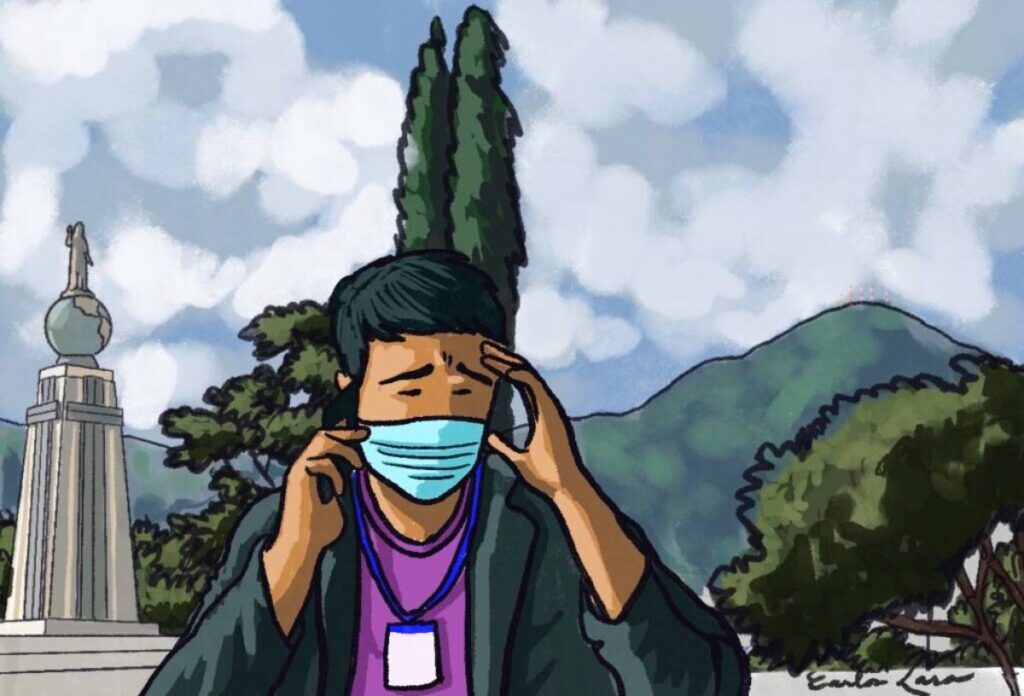
Sigfredo Funes did plan his escape. He has been living in Buenos Aires for over a year and doesn't want to return to his country. Under the guise of migrating, he applied for a scholarship to pursue a master's degree in Argentina, hoping to leave El Salvador.
Previously, in 2021, during the commemoration of LGBTIQ+ Pride Day, he was kicked out of his home after his parents found out he was gay. When he finally became independent, the state of emergency began in El Salvador, and he, a member of the Farabundo Martí National Liberation Front (FMLN), the Salvadoran left-wing party, and a social media critic of President Nayib Bukele's government, was persecuted and even received a death threat.
Funes received an anonymous call on Telegram. It was a woman's voice who, after telling him she was going to die, abruptly hung up. Days later, a motorcyclist he didn't know came to his parents' house to pick him up.
He assumes this happened as a result of his criticism of the government. On Facebook, where he frequently posts against Bukele, he has over two thousand followers.
Funes had already completed his degree in International Relations. This degree allowed him to apply for a master's program. In August 2021, he was accepted to an Argentinian university to study for a master's degree in Human Rights and traveled to Buenos Aires.
In October 2023, he had to return to El Salvador because he had finished his studies, but his mother warned him not to come back because a van with tinted windows is often parked outside the house, and she suspects they are looking for him.
One of the conditions for asylum is that the person cannot return to their country of origin, since doing so implies that the state granting asylum assumes the dangerous conditions that motivated their flight no longer exist. Funes intends to settle again in El Salvador in the future, so he is not applying for asylum. He plans to live in South America until he can return.
“The intersection between access to resources, skin color, unfortunately, and the educational level of people who migrate greatly influences what their process is like, what their process will be like, and what access they have to certain things or certain information,” says Vargas, the Guatemalan researcher.
María Fernanda Parada, a Salvadoran woman in her twenties who identifies as pansexual and acknowledges her privileges, has lived in Buenos Aires since January. She has never experienced discrimination in her family because of her sexual orientation. She attended primary and secondary school at the French Salvadoran Lycée, a private school where, she recalls, teachers frequently told students they should leave the country.
Last year, she began her degree at a university in France, but dropped out because she didn't like the approach. However, there she was able to explore the freedom of the metropolis, her sexuality, and went out with women for the first time. In El Salvador, she says, her queer group was small and everyone knew each other.
“There are a lot of people we’re leaving helpless, and they can’t save themselves just like that,” she points out. This year, Parada is taking the first course to study Anthropology at the University of Buenos Aires, and in the few months she’s been living in Argentina, she’s made a variety of friends. After graduating, her plan is to return to El Salvador to work as a journalist and research the LGBTQ+ community.
…
Of the 200 inquiries that FALGBT+ has received in recent years from people seeking refuge in Argentina, most are from Ukraine and Russia, countries that have been at war since February 2022. One case, explains Maribe Sgariglia, Secretary of International Relations for FALGBT+, sometimes translates into more cases, because some people flee with partners and children.
Sgariglia explains that these migrants prepare their escape with savings, find remote jobs, and also seek advice in advance about the immigration processes they must complete. Once in Argentina, they form a community among their own nationalities, even creating a Telegram group to communicate.
The same cannot be said for those who, in addition to the language barrier in another country, find themselves alone. There are Jamaicans who have not been able to adapt to Argentina and have had to return to their country, even though they know that there, where homosexuality is criminalized, their lives are in danger , the activist adds.
Most Latinx LGBTIQ+ people seeking refuge in the South American country, says Sgariglia, have experienced homelessness: “They arrive here perhaps without any resources, neither economic nor social, without any support networks. Most of these people come alone; their families are left behind with a very difficult relationship.”
As in Arturo's case, forced migration of LGBTQ+ individuals occurs in two steps, Amaral Arévalo emphasizes: if people are from the interior of the country, they first move to the metropolitan area and then migrate. However, these journeys are conditioned by the support networks they have in their country of origin or destination country.
In Costa Rica, Arturo didn't work as an activist. He was a bank teller, a waiter in fast-food restaurants, a hotel manager, and a butcher.
She felt that in Costa Rica, the LGBTQ+ community had already gained rights that were not recognized in Honduras. Therefore, she couldn't find work in her field. Although she could have migrated to the United States, because one of her sisters lives there and because her colleague, whose partner was murdered, had also migrated there, it wasn't a country that appealed to her. And she didn't want to seek refuge in Costa Rica, as she considers it a xenophobic country.
In 2021, believing that, almost a decade after fleeing Honduras, her family and the country had changed, she returned. But the violence remained the same.
He considered moving to his parents' house in Ocotepeque, where they lived alone. He wanted to take care of them, but his mother dictated how he should dress, act, and who he should associate with in town. He also couldn't talk about things that might make the family uncomfortable, such as his homosexuality and his HIV-positive status.
In an argument, his father assaulted him for speaking about his homosexuality. From then on, Arturo decided never to return to his childhood home. He left again for San Pedro Sula, where he couldn't find work. He stayed for a few days at another sister's house, but then he began to be followed by a car from which, on three occasions, a group of strangers got out and beat him. The last time, in addition to beating him, they stole his cell phone.
He tried to report the first attack, but when the police officers at the station saw his face bruised, they mocked him. Arturo said it wasn't worth continuing to live in Honduras.
Thursday afternoon falls in Buenos Aires. Outside, the usual noise of the city fills the air; inside this apartment, a gay Honduran man seeks refuge after being expelled from his country.
There are days when Arturo doesn't leave the house. He feels like a newcomer, alone in this city of four million inhabitants, which he's only just learning to navigate on his own. In a basket in the center of the dining room table are two bananas, a fruit abundant in the Central American tropics. From time to time, Arturo prepares Honduran food, especially bean soups and fresh salads, to feel like he's back home.
“There I was alone, but I was going, maybe, to where my friends were. I left everything, but at the same time I have nothing,” he laments.
With Milei's rise to power and the economic adjustment in Argentina, Arturo is reconsidering whether to continue his asylum process and intends to return to Honduras, where his life is not guaranteed.
Note: This report was produced with the support of the International Women's Media Foundation (IWMF) as part of its Express Yourself initiative. The name of the main subject of the text has been omitted for security reasons. It was published by our partner media outlet, Alharaca .
We are present
We are committed to journalism that delves into the territories and conducts thorough investigations, combined with new technologies and narrative formats. We want the protagonists, their stories, and their struggles to be present.
SUPPORT US

FOLLOW US
Related notes


We are present
This and other stories are not usually on the media agenda. Together we can bring them to light.