

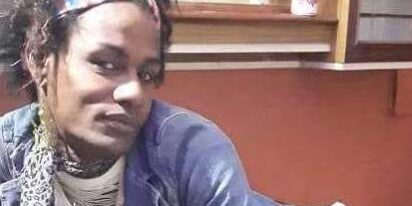
Diva, a trans woman living in the Constitución neighborhood of Buenos Aires, was murdered.
She was killed by a neighbor from the hotel where she lived. Diva was Dominican and had arrived in Argentina ten years ago.


Share

BUENOS AIRES, Argentina. Diva liked to say that she was the first transgender migrant from the Dominican Republic to have legally changed her gender marker. She had arrived in Argentina more than ten years earlier and had settled in the Constitución neighborhood of Buenos Aires, where she was murdered on Saturday, January 20.
The news reached the women at Casa Roja , where Diva Reina de los Santos Contreras frequented the soup kitchen and therapy sessions, in the early hours of the morning. Police had already confirmed her death, and neighbors recounted the events.
Diva was struggling with severe substance abuse and was in treatment. Her killer was a neighbor from the hotel where she lived, a Dominican woman who was also struggling with substance abuse. That morning, an argument between the two escalated into violence and ended with Diva being stabbed in the back, which led to her death.
A hotel guest called 911 around 7 a.m. to report a body on the grounds. Upon arrival, police could only confirm Diva's death.
The woman who killed her was arrested without offering any resistance. She confessed to the crime and remains in custody. The case is being handled by Criminal and Correctional Court No. 48.
Diva Queen's Place
Georgina Orellano is the president of the Association of Sex Workers of Argentina (AMMAR). The organization founded Casa Roja in the Constitución neighborhood in 2019. From there, they took charge of notifying Diva Reina's family and completing the necessary procedures to retrieve her body and hold a funeral service.
“ Diva is a colleague who has experienced many situations of violence in her life. She had to flee and leave her country because her community did not accept her gender identity. And here she has suffered situations of severe police abuse,” Orellano tells Agencia Presentes.
The woman went through delicate health situations. She was hospitalized for a long time, and after collaboration between social organizations, they were able to ensure her treatment was monitored by the Hogar Cristo Rey (Christ the King Home), whose staff visited her weekly to supervise her medication.
“She was so happy that there were people who cared about her. That, being a migrant, a trans woman, and living in the Constitución neighborhood, doctors came to her hotel once a week to talk to her, to see if she had eaten and if she was actually continuing her treatment,” says Georgina. And she adds, “Her death speaks to the precariousness of people’s lives, it speaks to the lack of policies, and it speaks to the absence of the State.”
A vulnerability without brakes
Diva Reina frequented the dining hall at La Casa Roja and the therapy sessions offered there. According to staff, she was a regular visitor who accessed the various services provided at the center.
The Friday before his death, he had gone to find out when the lawyers would be available because he needed advice. They gave him an appointment for February 5th.
Casa Roja is a shelter for dozens of vulnerable women and transgender sex workers. There, they find refuge from institutional violence, access to food, and assistance with legal and health matters. It served as a food distribution point during the pandemic and was also a COVID-19 vaccination site.
Anmar and La Casa Roja also took responsibility for Diva's body to give her a dignified farewell. “We spoke with the prosecutor's secretary. Above all, to explain that she had no direct family ties here. In these cases, we, as an organization, always intervene to take charge and give our comrade a dignified send-off. The prosecutor fully understood the situation and facilitated the procedures, taking into account that it was nothing less than a violent death,” Orellano explained to Presentes .
Diva Reina was in contact with her mother, who lives in the Dominican Republic. She also had siblings in different parts of the world. Georgina managed to contact a sister who lives in Italy. They were grateful for Ammar's intervention, saying, "They were very afraid that he would claim Diva's body from the morgue, that she wouldn't have a proper farewell, that no one would pray for her. They are a very religious family, just like Diva."
Stigmatization and hate
Since learning of Diva Reina's murder, the women of La Casa Roja have been working tirelessly, handling paperwork and resolving issues related to this tragic event. "Perhaps now that we have our own private space, we can begin to grieve," Orellano reflected.
It wasn't just Diva's death that distressed the women. It was also everything that had been said since the crime became known. "It hurt us deeply that Crónica TV showed up at that moment and displayed our friend lying on the floor. The ambulance hadn't even arrived yet, and that was happening. We hadn't been able to contact Diva's family yet; we wanted them to find out through other means, not by seeing that image."
The channel's broadcast was followed by comments from local residents. " Some neighbors are taking advantage of the situation to say xenophobic and racist things about the various migrant groups living in Constitución . They're using racism to say it's a conflict between people with drugs, as if justifying that she deserved to die," says the Ammar representative. "Instead of denouncing the lack of public policies or the institutional violence these women suffer daily, they're using the platform to be exclusionary and to promote a sanitized view of the neighborhood where we live, where we have our organization, and where we also have our headquarters."
The rise of precarity
Orellano also emphasized that Diva's killer was another woman in a highly vulnerable situation. “The person who tragically murdered her was also someone facing numerous hardships, with a history of violence, and very much on the margins of society. This crime should lead us, as a society, to reflect on the fact that, given the precariousness that exists in our country today, these are unfortunately the kinds of situations that will inevitably arise in our neighborhoods.”
Regarding Diva's murder, it was said, among other things, that it was a settling of scores and that both women were "drug dealers".
“It was also said that Diva had gone there to buy drugs. The truth is that Diva was a resident of Constitución. She had lived in the neighborhood since she arrived in Argentina. She rented a room in that hotel. She wasn't someone who just happened to be passing by and met her death, but someone who lived there. She was a neighbor, she was our friend.”
Diva's body will be buried in the Chacarita Cemetery, before which there will be a wake at Casa Roja.
We are present
We are committed to journalism that delves into the territories and conducts thorough investigations, combined with new technologies and narrative formats. We want the protagonists, their stories, and their struggles to be present.
SUPPORT US

FOLLOW US
Related notes

We are present
This and other stories are not usually on the media agenda. Together we can bring them to light.