

Maby Ibañez, a beacon in the diversity of the Calchaquí
From Cafayate, Salta, the trans woman builds organization and community among indigenous diversities.


Share

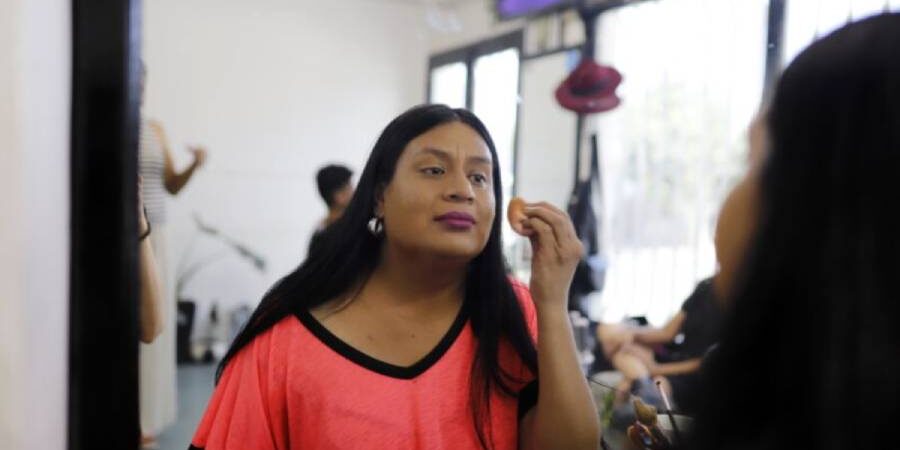
“It’s historic!” This phrase sounds like a catchphrase coming from Maby Ibañez. Her friends and colleagues laugh at her repetition of the statement, whether in a meeting, an interview, or around a fire. She says it loudly, emphasizing the vowels. And it’s convincing. Perhaps it’s because she’s aware that reality isn’t passing her by, but that she and her sisters in the community are writing a new history.
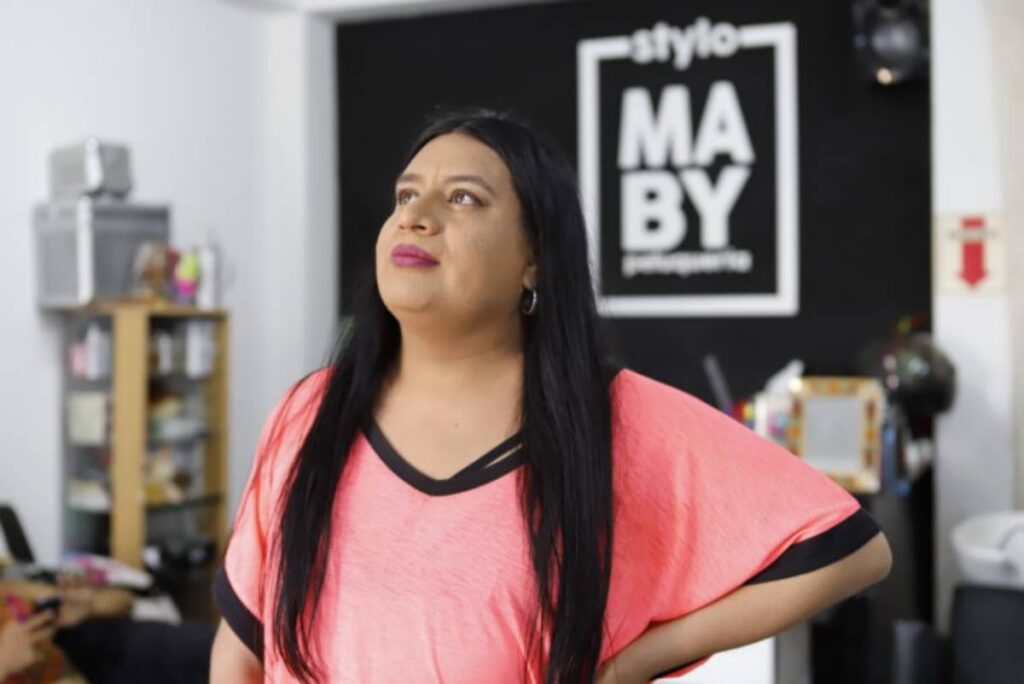
Maby Ibañez is 37 years old and a trans woman from the Diaguita community of Cafayate, a town in the Salta province of the Calchaquí Valleys. She is a leader of Mujeres Trans Argentina (MTA) , an activist with the Movement of Indigenous Women and Diversities for Good Living , and has run her own hair salon for over ten years, just a few blocks from downtown Cafayate. Together with her colleagues and other groups, she organized the first Pride March in the city and is now recognized regionally and nationally as a leading figure for Indigenous diversity.
A trans girl in the interior of Salta
“Our identity as trans children was denied to us, as well as our original identity, at school and in other spaces, and today we have to reclaim it,” says Maby, who, with the tenacity of a Scorpio, was born on October 24, 1986, a few months after the Argentine men's soccer team won the World Cup for the second time. She was the first of six children born to a middle-class couple from Cafayate.
The process of constructing one's gender identity begins in childhood, which is why Maby was already subject to censorship and repression from a young age. Her teacher would scold her in kindergarten for playing with dolls, for looking delicate with her straight hair, and for insisting on wearing a pink apron. Maby recounts this in a calm and serene voice. She acknowledges that she doesn't think about it much "because the mind learns to block out things that cause pain." While she feels that the acceptance process must have been difficult for her family, her story includes ample acknowledgments of the support they gave her. Her transition was further solidified at "Bachi Corazón," the name they used for the high school that is now the Cafayate Agricultural Technical School – EET 3155.
“That process was key because that's when I decided I didn't want to be a sissy, I wanted to be a woman and build a feminine image. In high school, we solidified that process and were able to carry it out as a group, and I was the first trans woman in that school. It was a space that embraced us and gave us strength for what was to come.”
The girls and the gay men started getting dressed up, waxing their eyebrows, growing long nails, and wearing makeup. Maby took care of everyone's hairstyles; her mother had studied hairdressing a bit, and she would grab the books and practice. Something that had started almost as a game would become her greatest support. Around that time, one day a two-year-old girl who was learning to talk said "Maby," and that name stuck. It was Mika, the youngest of her five siblings.
Hairdresser by trade
Maby's uncle was part of a carnival troupe in Salta. There, he often interacted with trans women and was a staunch advocate for their rights. One afternoon, he arrived in Cafayate and told his brother, Juan Carlos Ibañez, "You have two options: do you want your daughter to study and stay with you, or do you want her to go far away and work as a prostitute?" The next day, her father asked her what she wanted to study. For Maby, her uncle was a crucial support in her journey of self-discovery.
Maby traveled to study at the Burgos hairdressing school in downtown Salta, graduated in a year, and became the institution's first trans teacher. From a young age, she dreamed of opening her own salon in her hometown of Cafayate. When Maby sets her mind to something, there's no stopping her. She started by doing some family lobbying: a space in a business that had closed down here, a loan from her retired grandmother there, acquiring the necessary tools… And that's how “Stylo Maby” was born, just a few blocks from the main square of her town.
“I’ve been doing this for thirteen years now. I claim to be a hairdresser by trade, resourceful, and able to solve everything on my own,” says Maby. She acknowledges that her profession was a great support in developing her gender identity in that community.
What drives us
“Being able to be in Cafayate, changing the realities of my trans and travesti sisters, and transforming lives is what drives me. I feel that moving towards a good life is possible because we have already inhabited it. And that is what motivates me so strongly today,” says Maby. She explains that, during the pandemic, just when the world stopped, they mobilized to organize, marking it as her personal starting point in the struggle and activism. The economic crisis and the job losses brought on by the 2020 quarantine hit the diverse community hard, leading them to organize for the first time in Cafayate in response to the basic need to ensure food security. This was especially true in places that depend on tourism, like this city.
She didn't have any clients at the hair salon either. So, pen and paper, a list, a contact list, and it was time to knock on doors. That list expressed the food needs of more than thirty people in the community. But it was much more than that; in a way, it was about making themselves visible as an organized collective. That's how, in addition to obtaining food packages for their fellow members to get through those difficult months, they decided to establish the local branch of the Argentine Transvestite and Trans Women's Movement (MTA), with the support of Luz Bejarano from MTA Salta. “The main difficulty we encountered was how we were going to make the LGBT community visible in Cafayate and how we were going to generate acceptance without confrontation or conflict. And the strategy—which we later understood was a strategy because initially it was the only resource available—was art and culture.”
Besides being a hairdresser, Maby was already a cultural activist in the region. Together with folk singers, artists, and illustrators, they began to fill the streets and the cultural calendar of Cafayate with performances, murals, songs, and folk gatherings. In 2021, they presented “Orgulloses, una varieté diferente” (Proud, a Different Variety Show), a performance entirely created by local diverse groups. And in addition to generating employment, they were giving voice to a historically marginalized community through new forms of expression.
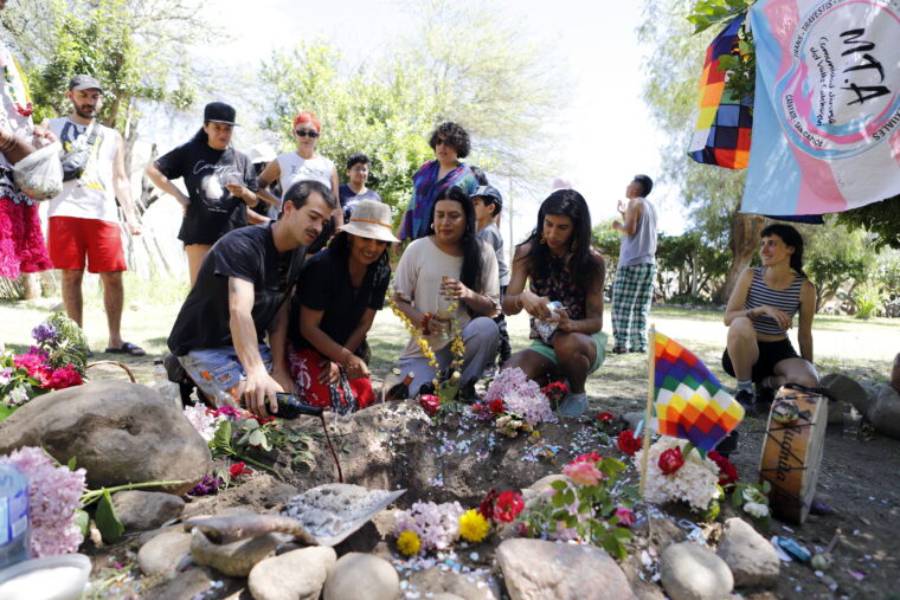
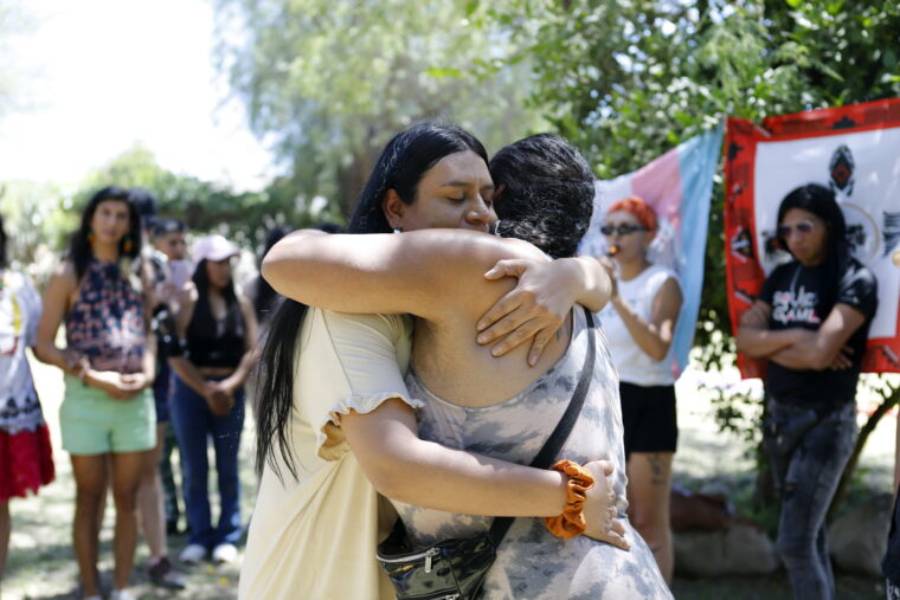
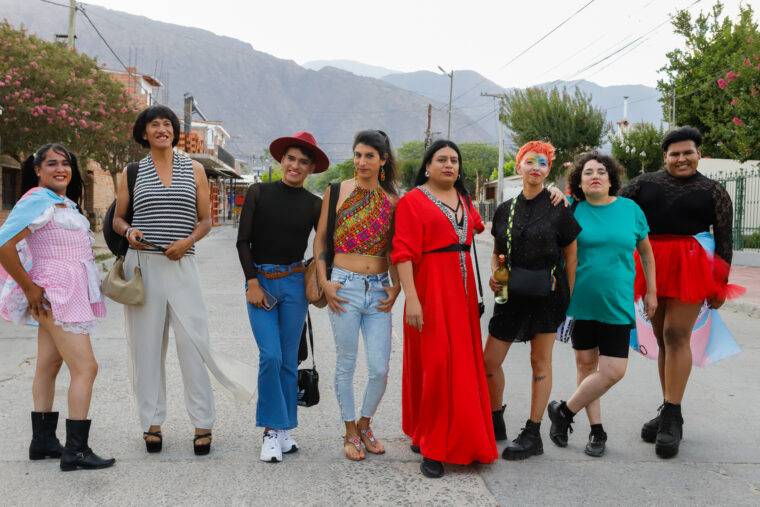
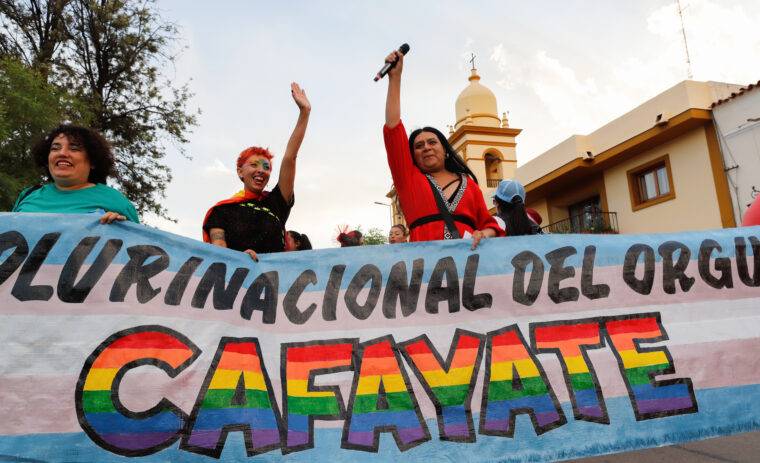
With the need to solidify an agenda for the diverse community of the Calchaquí Valley, they began celebrating LGBT commemorations. Maby was reignited because she had always dreamed of holding the famous Pride March in her hometown, incorporating Indigenous rituals. They formed the organizing committee, gathered people, and made the call. “The first feeling was fear; we didn't know what might happen. We coordinated with all the institutions and planned a long march that would cross the entire city. This also shows that we are a movement that permeates all spaces; it must be inclusive. For the second march in 2022, we decided to name it PLURINATIONAL, emphasizing the struggle for our territory and natural resources, understanding that our struggle is about recognizing Indigenous peoples and reclaiming that Indigenous identity.”
It's November 2023, and Maby is hosting the various delegations from Northwest Argentina participating in the third Plurinational Pride March of the Calchaquí Valleys at a hostel. She misses nothing, attends to every detail, takes the time to greet and talk with each person, and is both warm and pragmatic. It's clear everyone respects and loves her.
The day before the march, around a campfire in a circle of conversation, Quillay Méndez, a friend and comrade from Jujuy, shared powerful ideas. And as in a collective speech, where it doesn't matter who's speaking, Maby paraphrases her and adds: “As Quillay says, our pride lies in existing and resisting in our own territories. I can't imagine myself far from Cafayate; my struggle and resistance are here. It's the place I love and defend. It's a source of pride and joy to be here and live on this land. The mountains, the forest, the fields, the trees give me the strength I need.”
This article was published in our partner publication, La Nota de Tucumán.
We are present
We are committed to journalism that delves into the territories and conducts thorough investigations, combined with new technologies and narrative formats. We want the protagonists, their stories, and their struggles to be present.
SUPPORT US

FOLLOW US
Related notes
We are present
This and other stories are not usually on the media agenda. Together we can bring them to light.