

The Jujuy Justice system has charged 16 people from the indigenous community of Caspalá
Since 2022, the Caspalá community has suffered violence for defending its territory. The role of Gerardo Morales and the Jujuy justice system.


Share

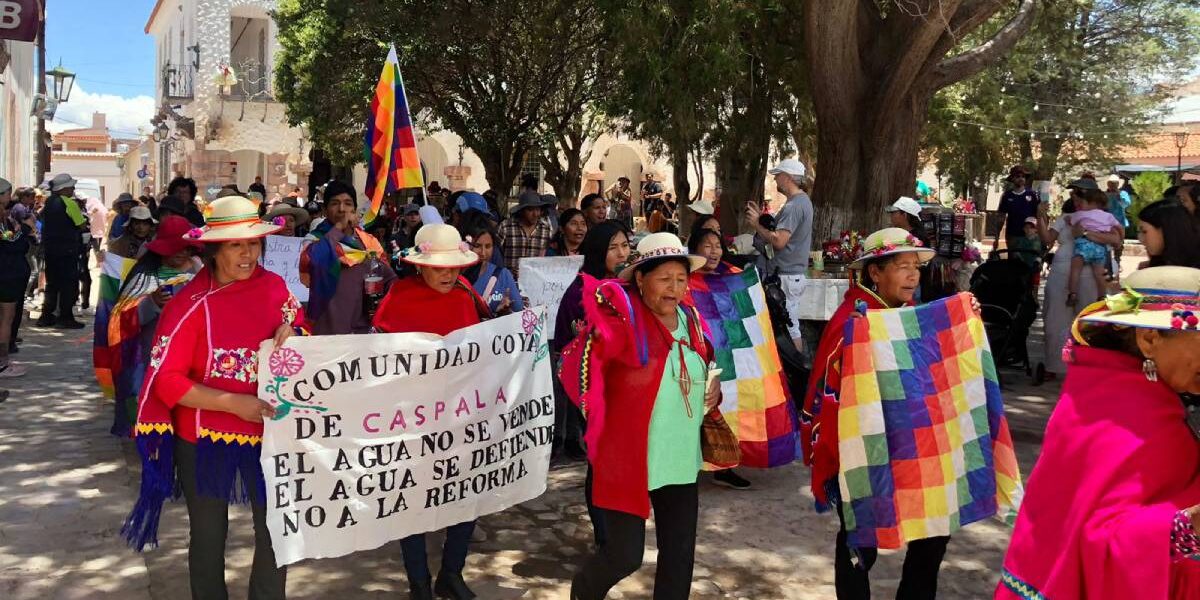
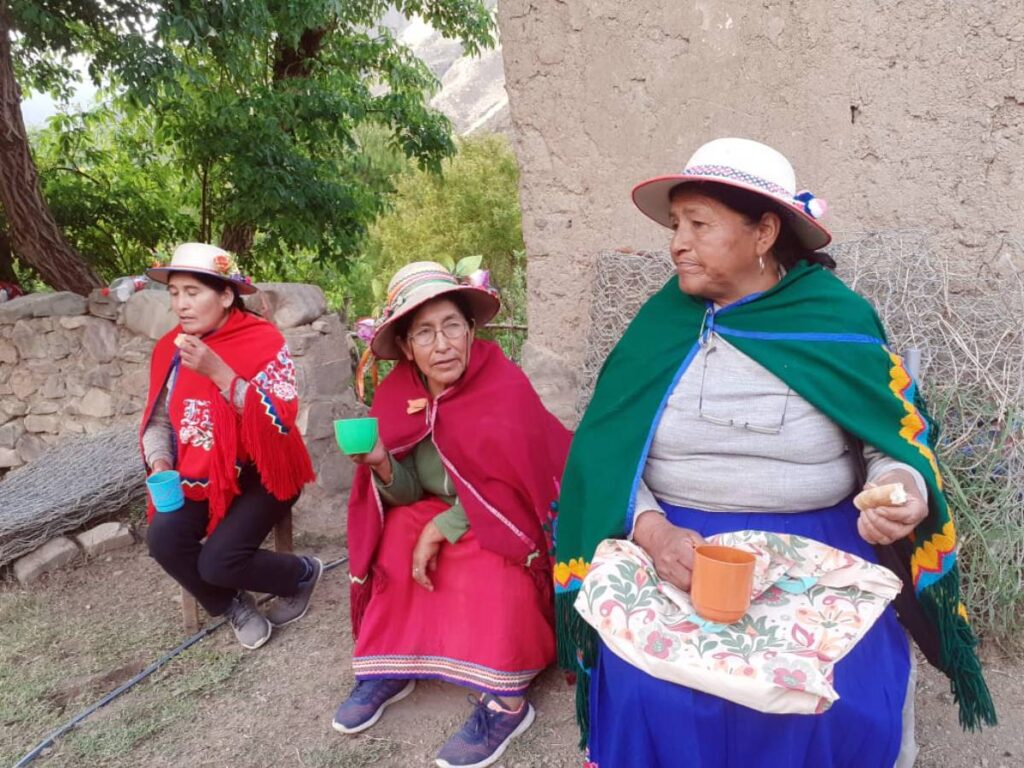
With a population of 350 inhabitants, nestled in the high valleys that extend northeast of the capital of Jujuy, the small town of Caspalá , rated as one of the ten most beautiful on the planet, lived until the end of 2022 in the tranquility that comes from the distance from the main urban centers.
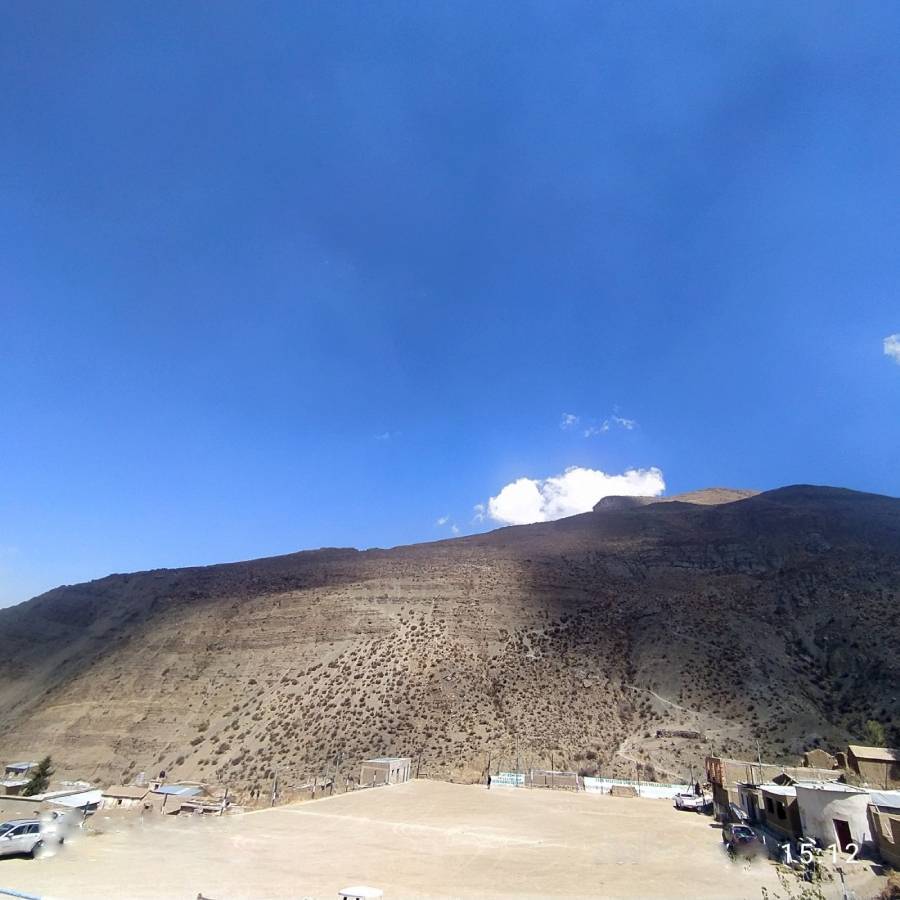
That changed in November 2022. A contractor, Urbania SRL, arrived with its workers and machinery to set up a construction site on the community sports field, which the town itself had cleared of stones and maintained for years. The Jujuy government chose that location to build a secondary school, for which the Caspalense community had already designated another plot of land.
The community opposed the destruction of the community sports field, leading to a confrontation in which community members were repressed and persecuted. The latest charge is aggravated robbery, aggravated damage, and usurpation. On January 11, 16 community members from Caspalá were questioned on these charges. Among them were Lucía Apaza, president of the Indigenous Community of the Kolla People of Caspalá, and Rosa Apaza, the municipal commissioner.
The Community and its defense lawyers stated that this is a “hostile persecution” that “dates back more than a year.”
The conflict
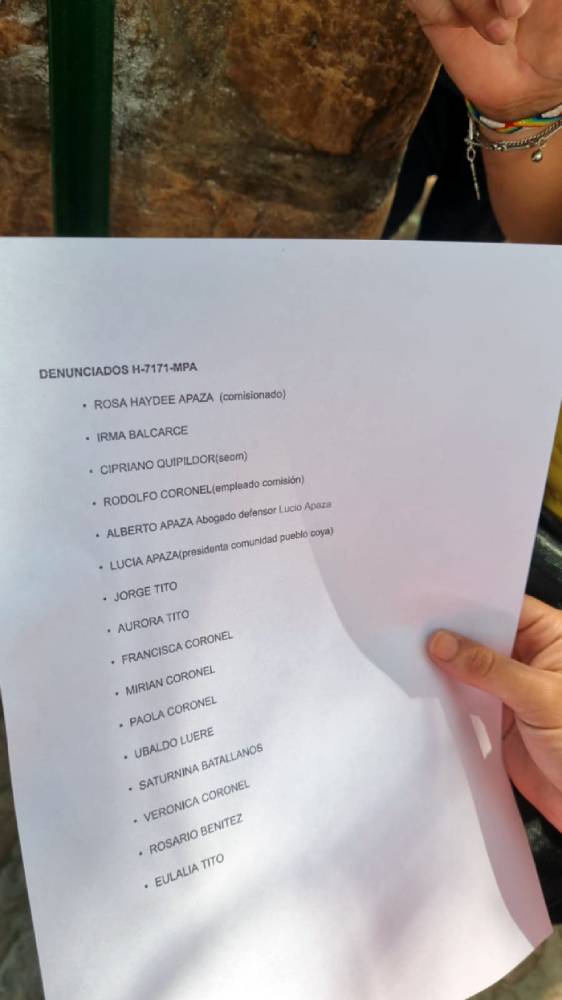
On January 11, the Humahuaca Criminal Investigation Prosecutor's Office No. 1, headed by Leila Rodríguez, formally charged the 16 members of the community. In addition to the community president and the municipal commissioner, Francisca Coronel, Paola Coronel, Saturnina Batallanos, Aurora Tito, Eulalia Tito, Ubaldo Luere, Mirian Coronel, Jorge Tito, and Verónica Coronel were formally informed of the charges against them. Also formally notified were Irma Balcarce, a member of the Municipal Commission; Cipriano Quipildor, a union delegate; and Alberto Apaza, a lawyer. The municipal secretary of government, Rodolfo Coronel, and Rosario Benítez, the Justice of the Peace from the town of Santa Ana (near Caspalá), were also formally charged.
The case began with a complaint filed by a three-person group comprised of former municipal commissioner Natividad Apaza, the Jujuy State Prosecutor's Office, and the contracting company. Regarding the former commissioner, the community and its lawyers reported that he is "close to former Governor Gerardo Morales and a political opponent of the current municipal administration."
Natividad Apaza, who was Morales's wedding godfather, "has multiple complaints against him, none of which, surprisingly, have made any progress in the prosecutor's office," they stated, highlighting the contrast with the speed with which the complaint against the community members was processed.
On the other hand, the community members' legal representatives have argued that the provincial court lacks jurisdiction over these events. The Federal Court has been involved in all matters related to Caspalá. Among other reasons, this is because an Indigenous community is involved and the National Institute of Indigenous Affairs (INAI) . Furthermore, an archaeological site is at stake, and rights recognized in the National Constitution and international treaties to which Argentina is a party are being violated.
Indeed, in Federal Court No. 2 of Jujuy, a case is being processed against former governor Gerardo Rubén Morales and other people who served in his administration for the crimes of "theft, usurpation, abuse of authority, violation of the duties of a public official, usurpation of water and others."
On August 27, 2023, Federal Judge Carina Gregoraschuk ruled that the case falls under federal jurisdiction. She also ruled that these lands, which are in the possession of the Kolla people of Caspalá, are unseizable and cannot be executed. She affirmed that the case involves “constitutional and conventional guarantees.”
The territory, under discussion
“The core of the discussion is the defense of community lands and territories, pre-existing rights guaranteed by the National Constitution and International Conventions . Specifically, the ancestral soccer field, belonging to the legally recognized Indigenous community,” the Community and its lawyers insisted after participating in the hearing on January 11. At that hearing, lawyer Silvana Llanés argued that the provincial court lacked jurisdiction, but predictably, her argument was rejected.
From the beginning of this conflict, the Caspaleña community has stated that it is not opposed to the construction of a school. However, it rejects the destruction of the community sports field, which is part of the town's history. For over twenty years, the Summer Confraternity Championship has been held there, a true social event that brings together thousands of families from eleven towns in the Valle Grande department . The children of the community play there, and the space also serves as a meeting point during emergencies, such as the earthquake that shook the town in 2020.
Ignoring these sentiments, the Jujuy government moved to demolish the community sports field. To replace it, they planned to build a new field on another property, which, instead of calming tensions, had the opposite effect. To this end, the government expropriated the property of community member Pablo Cruz Mojoya. His family was suddenly invaded by road construction equipment, and violence was even perpetrated against Pablo's partner, Ramona Chapor. Adding to the discontent, in addition to destroying crops, terraces, and agricultural platforms, the machinery uncovered pre-Hispanic structures while excavating the land.
Silvana Llanés, the community's representative, reminded Presentes that the land where the community sports field is located "belongs to the Indigenous Kolla community of Caspalá and not to the Provincial State." And, as the Federal Court stated, "these lands cannot be seized or alienated; therefore, the Provincial State cannot claim rights it does not possess, using public institutions to falsify information and seize territories belonging to Indigenous communities," she asserted. "What is rightfully ours cannot be damaged, stolen, or usurped," the community and its lawyers affirmed in response to the accusation.
“This case is just another example of the persistent harassment of the community. Now, an additional element has been added that increases its seriousness: the political persecution of local municipal authorities, elected by popular vote and who have only been in office for a month,” added lawyer Amelia de Dios. She represents the officials of the Municipal Commission.
There is no legal certainty in Jujuy
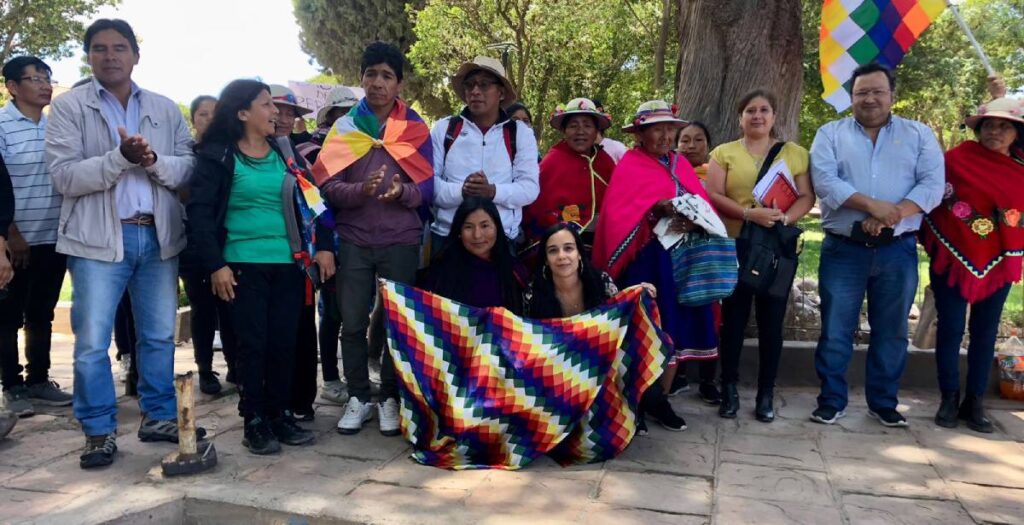
“This situation demonstrates that in Jujuy there is no legal certainty and constitutional guarantees are not respected. Nor is there a separation of powers, since the judiciary is not independent,” stated the community and the human rights defenders. Attorney Alejandra Cejas is assisting Llanés in the defense of the community members.
Since June 2023, a precautionary measure prohibiting any alterations has been in place on the community sports field. Llanés denounced the Jujuy government for violating this Federal Court order. He stated that the company Urbania SRL, “a contractor owned by powerful figures here in Jujuy, began bringing materials onto the field” and “continued with the construction.” He recalled that the community had reported this on several occasions, but “the federal prosecutor’s office never did anything.”
According to Llanés, the lawsuit filed in the Jujuy courts is a strategy to assert provincial jurisdiction and resolve the conflict in Caspalá. “They want to bring it into the provincial court system to seize the land,” the lawyer stated.
“They should have reported this in the main case” being processed in the federal court, but “shamelessly” they are trying to bring the case to the provincial court “in order to keep the people’s land,” which is serious because in Jujuy “we have no legal security, there is no separation of powers, they arrogate to themselves the judicial power,” he insisted.
Former Governor Morales was succeeded by another man from his party, Carlos Sadir, also of the UCR. But the defense lawyers and the Caspalá community maintain that there have been no changes in the repressive policies. “They are still the same,” “Sadir doesn't exist; the Morales family is the one governing. Today we are still in the same situation,” Llanés stated. And like community members who spoke at a demonstration in Humahuaca after the arraignment hearing, she warned that this attack is not only against the Caspalá community, recalling the criminal charges against union members and activists from other social organizations.
“They’re rehashing all the accusations.” “We need to spread the word that there’s no rule of law in Jujuy. That Jujuy doesn’t have a separation of powers, and that the governor here is an infamous traitor to the nation because he’s arrogating all political power to himself. Executive, legislative, and judicial power are concentrated in a single person.” “And it’s very important that they say this, because otherwise we can’t defend anyone.” “Constitutional guarantees don’t exist,” Llanés affirmed.
We are present
We are committed to journalism that delves into the territories and conducts thorough investigations, combined with new technologies and narrative formats. We want the protagonists, their stories, and their struggles to be present.
SUPPORT US

FOLLOW US
Related notes


We are present
This and other stories are not usually on the media agenda. Together we can bring them to light.