

Ecuador: neoliberal model, narco terror and militarization
Lawyers, academics, and indigenous leaders shed light on the social and economic context of Ecuador and the current violence.


Share

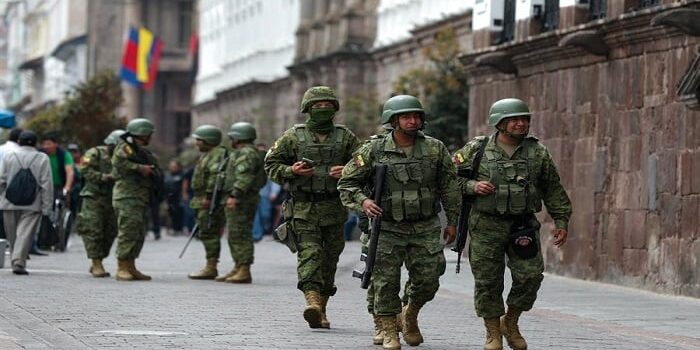
The escalation of violence and militarization in Ecuador following the escape of a drug cartel leader and the government's declaration of a state of siege and "internal armed conflict" has disproportionately affected vulnerable populations, including women, Indigenous people, and people of color. This was the assessment given to Presentes by activists and lawyers in the country, where the conflict has so far resulted in 14 deaths and the deployment of 22,400 troops.
Last Sunday, news broke of the disappearance of José Adolfo Macías, known as “Fito ,” the head of one of the country's main criminal gangs, Los Choneros. He had been imprisoned in the city of Guayaquil since 2011, serving a 34-year sentence for organized crime, drug trafficking, and murder. Fabricio Colón Pico, leader of Los Lobos, also escaped.
State of siege
In response, Ecuador's President Daniel Noboa declared a two-month state of siege "due to serious internal unrest." This measure grants the military greater powers, allowing them to enter prisons and collaborate with the police nationwide, in addition to imposing a national curfew between 11 p.m. and 5 a.m.
The response was a wave of violence. Notable incidents included masked individuals entering the TC television station in Guayaquil , shootings near the Executive branch headquarters, and an attempted takeover of the University of Guayaquil.
Finally, the government issued Decree 111, declaring a state of “internal armed conflict” and deploying 22,400 troops . The incidents continued: prison riots with prison guards being held hostage, bomb attacks in several cities, car fires, and attacks on hospitals. To date, 14 deaths and 375 arrests have been reported.
Given these events, the streets of Ecuador were practically empty, although activity has tentatively resumed today in the main cities. However, many businesses remain closed and public transportation is running less frequently. Furthermore, classes at universities and schools are being held primarily online.
Women and racialized people, the most vulnerable
“Being unable to work due to the wave of crime and violence means being deprived of basic necessities like food, medicine, and education. This is the reality faced by thousands of women who worked in the informal sector. Public institutions are moving online, as are universities and basic education. This leads to layoffs for those without contracts. States of emergency close doors and open a very dangerous one: an increase in domestic and gender-based violence which, coupled with the hunger caused by precarious living conditions, increases the risk to women's lives,” Indigenous leader Nayra Chalán explained to Presentes
The factors that led to Ecuador's current situation are numerous. Among them, those interviewed highlighted the growing impoverishment of the population, the country's neoliberal and dollarized economic model. This was exacerbated by the increase in drug trafficking and state policies that do not address the problem comprehensively but only punitivistically, as well as by corruption.
Traces of the pandemic
“The criticism should be directed at the State. It has to do with the brutal impoverishment that deepened during the pandemic, especially in cities like Guayaquil, which has also been a bastion of inequality and of the Social Christian Party and right-wing parties in general that have promoted punitivism in Ecuador. In Ecuador, the Afro-descendant population, in particular, has been dispossessed of their lands,” stated university professor Lis Cabo.
For her, it is the women who “have to watch their children endure this radical impoverishment, this lack of a healthcare system, public services, and education. Their children are locked up in prisons, where the poorest and most abused members of the population are simply concentrated.” This population “becomes cannon fodder for drug traffickers and criminals,” she asserted.
This context and its governmental response imply "a process of military, punitive, punishing masculinization of society that of course impacts each of the homes of all the people in which this patriarchal logic of punishment is embedded in all homes," Cabo analyzed.
A dollarized economy facilitates drug trafficking
Ecuador's neoliberal macroeconomic model is another variable that interviewees highlight to understand the conflict.
“ The fact that we are a dollarized country undoubtedly facilitates illegal transactions, such as money laundering, drug trafficking, and the exchange of drugs. Another factor that facilitates our position is our location between two drug-producing countries subject to control (Colombia and Peru),” explained Ramiro Ávila Santamaría, a jurist and professor at the Universidad Andina Simón Bolívar-Ecuador, to this agency.
7,592 violent deaths were recorded , representing a homicide rate of more than 40 deaths per 100,000 inhabitants , according to the National Police. This number represents an increase of approximately 64.9% compared to 2022, when there were 4,603.
According to leader Chalán, the large mobilizations that occurred in 2019 against a neoliberal package of measures announced by the government of Lenín Moreno, indicated by the International Monetary Fund (IMF), are related to the current situation.
“ In their spirit, these mobilizations challenge neoliberalism. They aim to liberalize fuel prices to international levels through free trade agreements (FTAs). They want to strengthen the export model by expanding the field for mining, oil, and agribusiness. Furthermore, they want to reduce coverage for health, education, family and peasant farming, and small and medium-sized enterprises. Fewer guarantees for an ever-growing sector of the poor means a reserve army of criminal mafias ,” he said.
Informality and corruption
Chalán added that “extractive projects, agribusiness, and the central government’s deliberate neglect of agriculture continue to be the root causes of internal migration and migration to other countries.” People move from “the precariousness of the countryside to the precariousness of the city.” In this context, those who migrate in the most vulnerable conditions are primarily women.
“According to INEC data, around 4.4 million people work in the informal sector . This sector includes a wide range of rural and indigenous women who work in agriculture, domestic service, street vending, and hourly work,” she added.
In addition, Cabo warned about “the corruption associated with different governments in Ecuador.”
“We see complicity from all the authorities, from previous governments. The government of (Guillermo) Lasso, whose relatives have been involved with organized crime . Now we have a government that is the son, the prince, of a banana-growing dynasty that owns multiple businesses in the country, and that promotes all these far-right policies, as well as the repeal of many other rights and transformations at the level of neoliberal liberalization,” he said. He is referring to the fact that the current president, Noboa, is the son of the banana billionaire Álvaro Noboa.
The declaration of a state of “internal armed conflict” received the support of the National Assembly (unicameral parliament). They also endorsed “the adoption of pardons and/or amnesties in cases where necessary to guarantee the work” of the Armed Forces and Police. However, human rights leaders warn of the potential consequences of increased militarization and the growing punitiveness promoted by the president.
Bukele Model
Noboa's administration is taking as its model the policies implemented by El Salvador's president, Nayib Bukele, against criminal groups. That country has been under a state of siege for just over a year, and the current government's flagship against gangs is the Terrorism Confinement Center , a mega-prison with a capacity of up to 12,000 inmates.
Noboa announced the creation of two new prisons in the “Bukele style .” This Thursday, the central administration displayed images of the prison design planned for the Amazonian town of Pastaza and the coastal town of Santa Elena, each with a capacity of 736 prisoners.
“The prison problem began in 2014 due to two events. The first was the enactment of a punitive penal code, which drastically increased the list of crimes, increased penalties, and increased aggravating circumstances. The second event was the construction of three mega-prisons. All three prisons were filled with inmates related to drug trafficking offenses,” explained Ávila Santamaría, who warned that “they became bases of operations.”
"The fear of organized crime is similar to the fear of COVID."
According to the legal expert, the consequence of declaring an internal conflict “is that the Armed Forces are not subordinate to the National Police. There is enormous fear in Ecuadorian society, to the point of closing public services, such as schools. The fear of organized crime is similar to the fear of COVID. People are shutting themselves in, avoiding public spaces, and are wary of strangers.”
In this regard, leader Chalán warned that in the “fight against terrorism” “leaders have also been persecuted.” She added: “With this, they intend to legitimize this supposed fight by lumping together organized crime and social protest.”
“Since the first prison massacre linked to organized crime in 2019, all the solutions have been to declare states of emergency,” Ávila Santamaría recalled, acknowledging that “they haven’t worked.” The jurist believes a comprehensive response to the problem is necessary, one that includes social policy.
“As long as we have societies where people have no parents because they migrate through the Darien jungle due to lack of work, where schools close or offer inadequate education, where we have high infant mortality rates, terrible health services, and zero job opportunities, then organized crime has fertile ground to thrive. This can only be achieved through policies of social and economic inclusion,” he concluded.
Share
We are present
We are committed to journalism that delves into the territories and conducts thorough investigations, combined with new technologies and narrative formats. We want the protagonists, their stories, and their struggles to be present.
SUPPORT US

FOLLOW US
Related notes



We are present
This and other stories are not usually on the media agenda. Together we can bring them to light.