

Solidarity and feminism in the midst of genocide: an interview with a Palestinian lesbian activist
Queer activist Ghadir Shafie recounts how diverse people live in a context of war and genocide.


Share

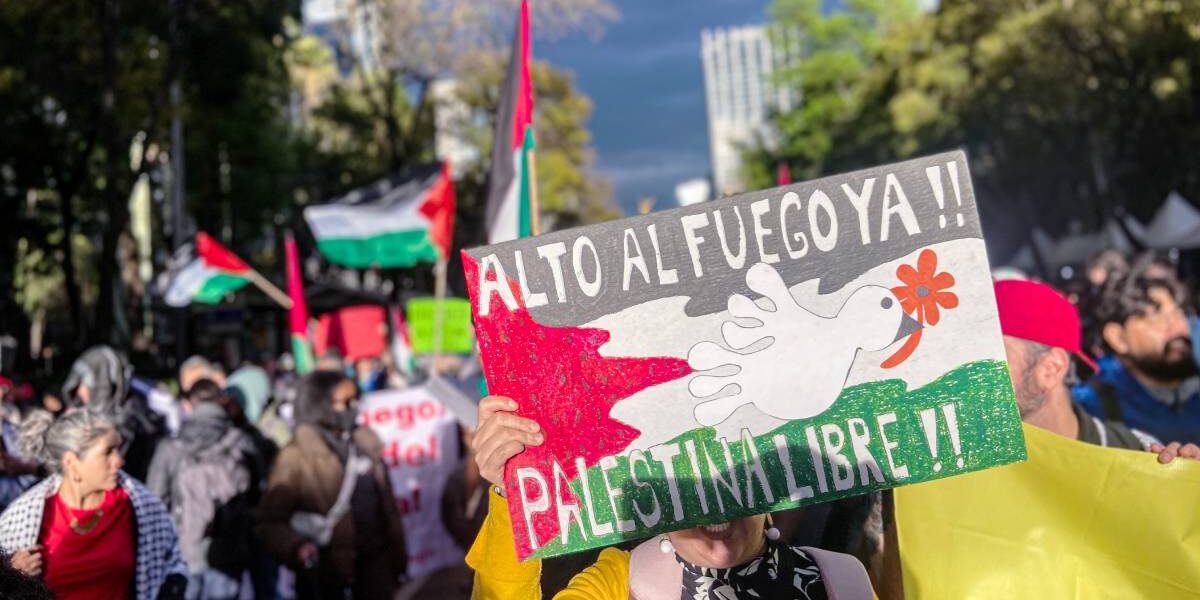
Since October 7, 2023, following the Hamas terrorist attack on Israel, the Palestinian population, particularly in the Gaza Strip, has been suffering an accelerated genocide. Furthermore, invasions and settler colonialism throughout the Palestinian territories and in refugee camps worldwide.
In this context, from Presentes we contacted Ghadir Shafie, a queer Palestinian activist and co-director of Aswat, to listen to and shed light on queer experiences, the pinkwashing strategies of the Israeli government, and the reality that the entire Palestinian population lives today.
Before starting the interview (the English version of which can be seen here ), Ghadir makes a clarification:
“ Today, the most urgent demand is to stop the war in Gaza. We need an ceasefire , and in this context, we need to talk about how Israel is trying to cover up this genocide. I want to frame this interview around that, and I want queer activists to be more supportive and active with Palestine. It’s time to do everything in our power to exert pressure. We want to end the genocide of all Palestinians, which is directed at all people, of all genders, of all ages.”
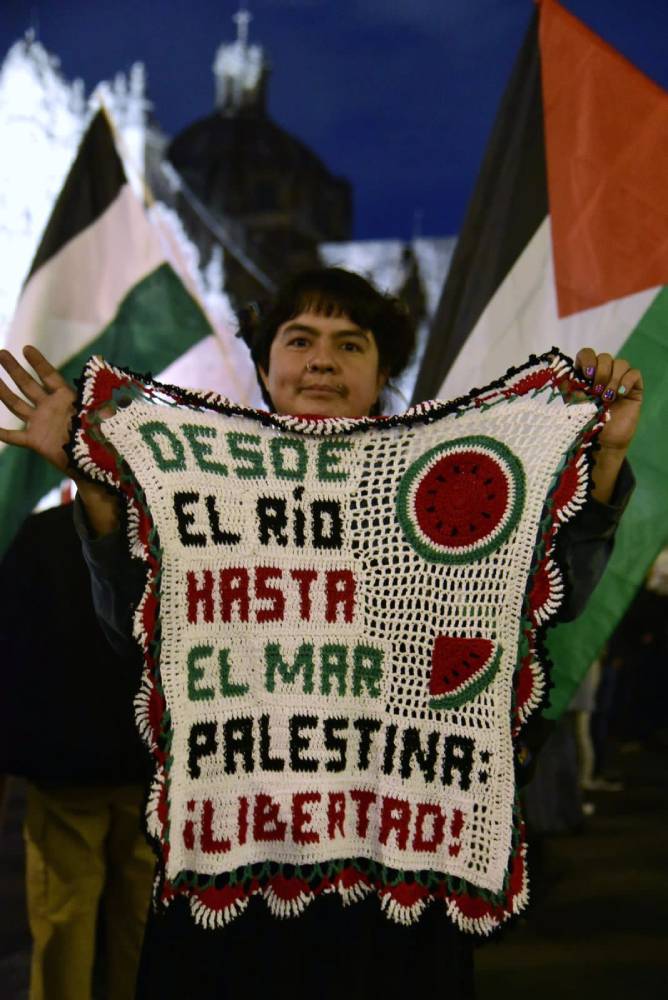
Photo: María Ruiz
-What does it mean to be queer in Palestine?
It's similar to other places around the world; LGBTQA+ people face the same universal challenge as all queer people worldwide. Very often in the West, you hear people say they want to "save" Palestinian queer people from homophobic society, from conservative society, from the backward family, and we usually say, "Thanks, but no thanks." We don't need to be saved as queer people. We've managed to raise the bar within our own community, within the Palestinian feminist movement, within the Palestinian National Movement. We've managed to create a discourse that encompasses all our struggles, that unites the queer struggle, the feminist struggle, and the resistance to all forms of oppression.
But I believe that now we need active solidarity, international and queer solidarity, to liberate ourselves as Palestinians. Today, people from other places can go out and demonstrate against the genocide, but as a Palestinian sitting in Israel, I can't do anything. It's illegal for me to share messages that show sympathy. It's illegal to go out and demonstrate; it's illegal to speak Arabic on public transport . If you speak Arabic, they can shoot you.
It's important for us to emphasize our narrative that all Palestinians are worthy of life. And that queer Palestinians are being killed by Israel, not by Hamas, not by terrorists, but by the Israeli army. And it's important to clarify this. Because this is the narrative and propaganda that Israel is trying to promote: that they want to protect queer people from Hamas because they are being killed.
Today we have all the functional pressures at play to commit this genocide, which is still ongoing as we speak here. I don't want to give figures, because the numbers are much higher than what we see. Palestinian queer people face the crimes of apartheid, occupation, settler colonialism, and now genocide. Today, the demand of all Palestinians is the right to live in freedom.
-Is this an intersection of identities?
Being oppressed has nothing to do with my society. I've been able to grow up in my society, I've even been able to have a child, I've grown up as a queer woman in my society, we've even managed to become part of the BDS (Boycott, Divestment, Sanctions) movement, which mentions us in all its publications in all its languages. We've created visibility within our own communities.
We Palestinian queer people don't just talk about sexual and gender identity. It's impossible to talk only about identity without addressing the elephant in the room . For the queer movement in Palestine, which began to take shape about 20 years ago with the creation of grassroots organizations, it was important to create an intersectional narrative, one that connected the circles of oppression . Because ultimately, my oppression doesn't depend solely on my queer oppression.
I am also oppressed as a woman in a very conservative, militaristic, and somewhat religious society, where women's rights are very often compromised for the sake of society, religion, men, or whatever. And, of course, as a Palestinian, it depends on where you live, whether you are under occupation, settler colonialism , or apartheid, but also in the context of pinkwashing or homophobia.
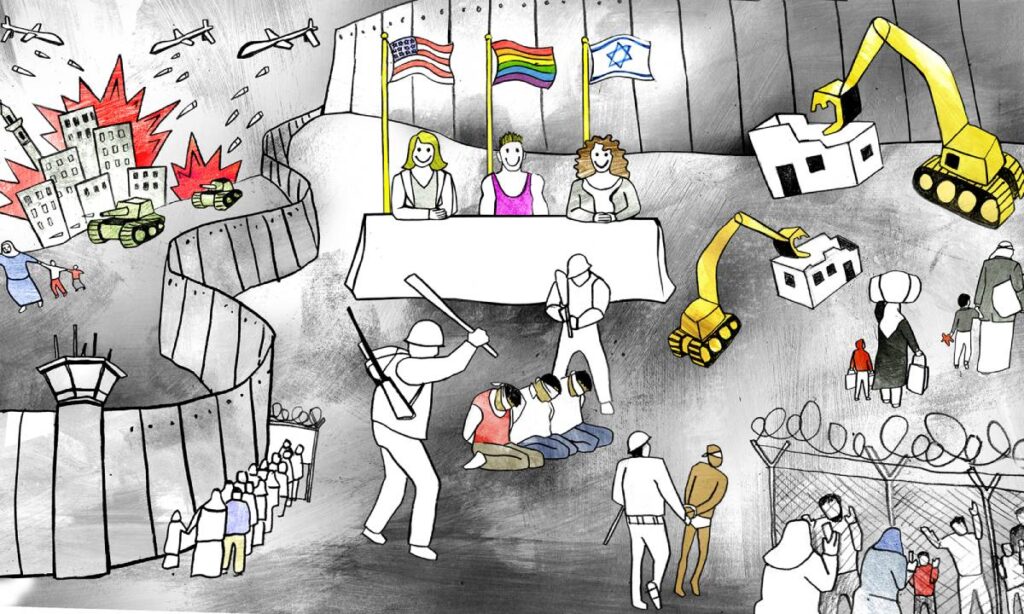
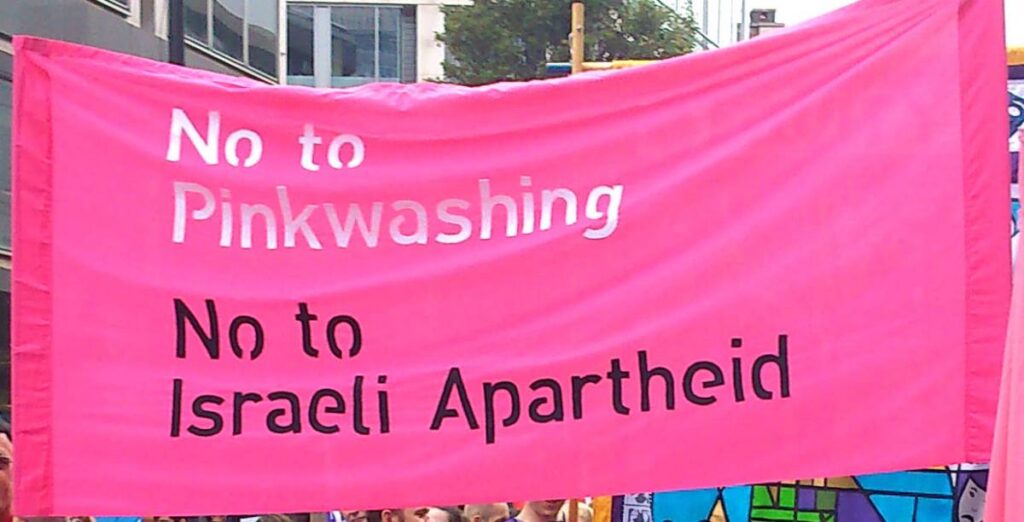
The well-known issue of “pinkwashing”
Pinkwashing is nothing new in Israel. In fact, they use different types of whitewashing to justify genocide, occupation, and colonization against Palestinians. There is a close relationship between Israel, tourism, and pinkwashing.
The article “Boycotting colonialism: the link between Israeli pinkwashing & tourism” defines it as follows:
“Israel has been developing strategies and investing enormous sums of money in Pride marches and the tourism industry. They work methodically, which means that several political entities are involved, not just the Israeli government. One of the projects carried out by foreign organizations is the so-called Aliyah, a Hebrew word meaning return or immigration to the Promised Land. They are using the concept of Pride Aliyah to encourage gay Jews to 'return' to the Land of Israel. This is just one of many examples…”
-How does pinkwashing work today? What strategies do they use and for what purpose?
Homosexuals around the world face homophobia. But here, in the context of Israel, in addition to homophobia—which can come from Palestinian or Israeli society—there is also a whitewashing agenda, a pinkwashing campaign, that is truly very dangerous. Because it says, “Israel is a gay paradise, come to Tel Aviv and celebrate your identity,” which is not only a lie, but also goes a step further to portray all Palestinians as backward, homophobic, and therefore deserving of oppression. It thus creates this colonial superiority of Israelis over Palestinians.
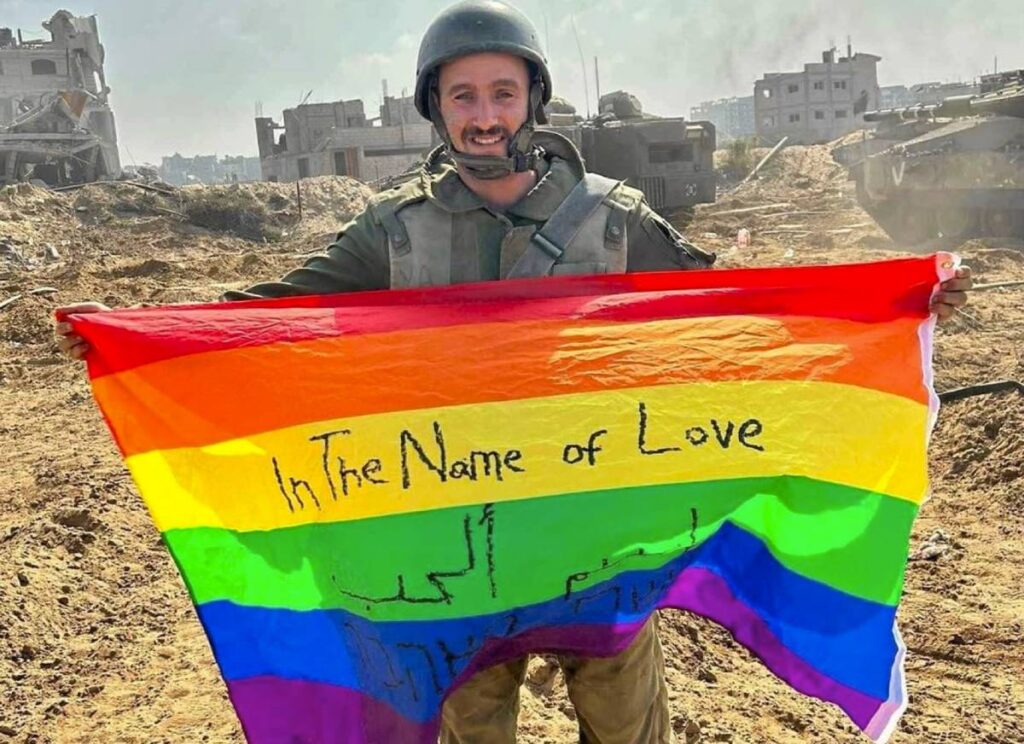
Israel has used many whitewashing tactics, such as greenwashing, purplewashing , and now, the whitewashing of genocide. And I think that with all the disturbing images we have seen and continue to see from Gaza, one that was truly horrific was an Israeli soldier standing amidst the rubble of Gaza's destruction, with many tanks in the background, holding a rainbow flag and saying that this is a message of peace—we have to defeat Hamas because if Hamas knew I was gay, they would kill me too. Even this genocide is being pinkwashed by Israel, claiming they will bring liberation, peace, openness, and acceptance of homosexuality, while in reality they are destroying entire families and neighborhoods and killing every sign of life.
Pinkwashing has been perverse since 2009, because when I was a teenager questioning my sexuality, there was nothing in Arab schools to talk about identity. There was only a support line, a "white line" in Tel Aviv, which I called, and they told me, "You have to come live in Tel Aviv if you're a lesbian."
– What was your life like in Tel Aviv as a Palestinian?
After graduating, I moved to Tel Aviv, and very soon my Israeli friends wanted to change my name. They said you had to look and sound like an Israeli, because that's how you can be gay. I was very young and naive, but for me it was very clear: I've been Palestinian my whole life, and I was just beginning to question my sexuality, so it was very difficult to accept this discourse and the imposition of my identity.
It's like, "You can't be a queer Palestinian, you have to be a queer Israeli," and change your identity and character. For me, it was very strange and insulting. I remember waiting until the end of the school year, then I left Tel Aviv and never looked back. Actually, it was Tel Aviv that put me back in the closet. And it took me about 10 years to get involved with Aswat (a queer feminist movement for the sexual and gender freedom of Palestinian women, who are part of an indigenous minority living and being discriminated against in the state of Israel). The first time I went to Aswat, it was the first time in my life I could be a queer Palestinian woman and not have to apologize or explain anything. It was the first time I could reconcile my national identity with my sexual identity.
The reason Aswat was created was that many Palestinian trans and lesbian people were part of Israeli LGBT organizations, which had obviously started to establish themselves earlier for their political, social, and economic convenience.
Many queer Palestinians wanted to go to Israeli organizations and were welcomed as lesbians, but not as Palestinians. You have to prove your identity at the door, and they tell you: "Here you can't talk about Palestine or liberation or occupation, you can only talk about lesbian rights."
A few weeks ago, a lesbian member of Queer for Palestine, who was passing through Mexico, recounted one of the many difficulties they face living in territory occupied and controlled by Israel: “There are 700 checkpoints in Israel. That means that every kilometer our brown bodies are searched by invaders. It has been considered, for 17 years now, the longest concentration camp in the world.” In the war between Ukraine and Russia, people felt and still feel more connected to the situation, precisely because they are white bodies, not brown bodies being displaced and killed.
I think the world still doesn't understand the suffering of the Palestinians, the urgency of doing something to stop it, and the belief that each and every one of us can do something. This isn't the first war in our lifetime, nor the second, nor even the third war we've witnessed. And if you want to count all the wars since I was born, there have been more than fifteen. War is something we see throughout our lives, but we don't get used to it; the world is getting used to it, getting used to what it sees.
I think most people who want to see, can see now. Before, there was a veil, but today anyone can understand what's happening. It's not a war between two armies; it's not a war that allows people to flee like in Ukraine. In Ukraine, they can flee, despite the horrific situation there; some at least have the option to leave. The people of Gaza don't have that opportunity . There's nothing in the world or in modern history that can compare to it, anywhere. So I think difficult times require difficult measures. Extreme times require extreme measures.
The idea of war creates a lot of fear and chaos. It's very difficult to organize. If you live in Gaza, you're dying; if you live in the West Bank, they're invading. They're invading Jenin, they're invading Nablus, and many more places—it's impossible to go there. They're arresting people, creating a lot of chaos, and disrupting people's lives. If you live inside Israel, it's like Korea; everything is really monitored.
-What is your current situation? How are people from other cities in Israel coping with the war and genocide?
I live in a mixed city; there are five mixed cities where Israelis and Palestinians live in the same building, on the same street. This government is giving M16 rifles to settlers walking around. It's not just the police or the army; there are civilians walking around with guns. If you go to a grocery store to buy bread and milk, you see it. It's very scary, even though the streets are still empty.
It's an atmosphere of fear, chaos, sadness, and helplessness. Many people don't know what to do about the war; there are no resources, you can't say anything, they won't let us post anything on social media. A girl posted, "God help us," and she was arrested. And every day a Zionist protester threatens her at her shop. She calls the police, and the police come and help the Zionist protester intimidate her. They cut off her electricity and water. At the only demonstration they tried to organize, they came and arrested everyone: children, men, women. They took everyone away and said, "Who wants to go out and demonstrate? We'll give the police permission to shoot any Palestinian protester with live ammunition."
So you don't see anyone protesting because everyone is afraid. There's no way to express yourself, you can't do anything at all. And that creates more trauma, more anger, and more hatred in your body. I meditate, I have support groups, but most people don't. Anyway, to be free from all the anger of this war, we have friends, people have family in Gaza, the suffering is universal. How much you suffer depends on your geographical location, whether you're in physical danger, emotional danger, or both. It's madness right now.
A strategy for living
increasingly global and powerful BDS movement
Boycott, Divestment, and Sanctions (BDS) is a Palestinian-led movement for freedom, justice, and equality. It was created in 2005. BDS upholds the fundamental principle that Palestinians have the same rights as the rest of humanity. Inspired by the South African anti-apartheid movement, the BDS call urges action to pressure Israel to respect international law.
There is a news outlet where you can find all the brands that support Israel or are complicit in the genocide: The Witness
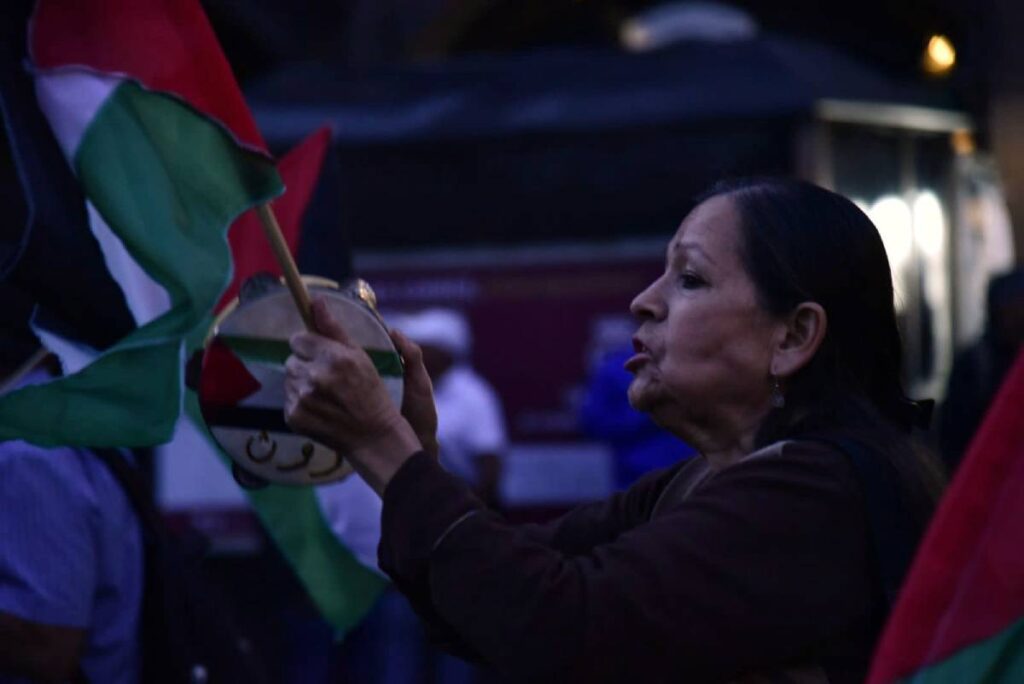
Photo: María Ruiz
-Do boycott strategies work? What do they need to continue demanding a ceasefire?
People think we're very well connected, but that's not the case. People don't know what to do; there's no leadership for Palestinians. People are usually inspired by the leadership of organized communities. Today, we organize individually because organizations can be attacked.
We see that the government has its own interests; they wanted gas, now they want gasoline, and so on. But people are obviously showing solidarity, and we've seen this in many nations, and we think this is what makes the difference. People around the world have power; they have the power to boycott, and that is extremely effective. We see how Starbucks and many others are paying the price for their complicity; they are paying the price for supporting a regime that continues to commit genocide against innocent people.
I know it hurts to see children and women die, but everyone deserves a chance at life, and that's the message. I believe that as activists, we have a duty to dismantle this narrative, and I understand why they're doing it, because Israel claims that with these killings it's fighting terrorist fighters. But how can a 1- or 5-year-old child be a terrorist? How can a pregnant woman be a terrorist? I think this narrative is fueled by the UN, because they have a specific protection department for women and children, and also because Israel is claiming that it's mostly killing Hamas members, yet the number of women and children killed is extremely high.
Today we are more aware of how defenseless we are, and we are also aware of how powerful we can be when we all commit to boycotting, when we all commit to not resting until Palestine is free. This commitment will allow us to live liberated lives, to live as normal, peaceful, happy people, free in body, heart, and mind.
We are present
We are committed to journalism that delves into the territories and conducts thorough investigations, combined with new technologies and narrative formats. We want the protagonists, their stories, and their struggles to be present.
SUPPORT US

FOLLOW US
Related notes


We are present
This and other stories are not usually on the media agenda. Together we can bring them to light.