

Peru 2023: Setbacks in LGBTI rights and an increase in transfemicides
Anti-rights groups advanced against the LGBT community, in the context of Dina Boluarte's repressive government.


Share

LIMA, Peru. Peru is in the midst of a crisis, with a rampant recession and its main authorities illegitimate. President Dina Boluarte and the Congress of the Republic face a disapproval rating of over 90%. The Constitutional Court, with its Fujimori majority, managed to release dictator Alberto Fujimori before he completed his full sentence, thus disregarding all the agreements Peru has signed within the International Human Rights System.
The Attorney General, appointed by Congress, was suspended for allegedly leading a criminal organization that sought to control the National Board of Justice. During her tenure, she obstructed investigations against corrupt politicians (Lava Jato) and judges (White Collars), as well as against her sister (illicit enrichment).
Municipalities against the LGBTIQ+ population
In February, the traditional symbolic weddings that take place in the Miraflores district (Lima) every 14th for Valentine's Day were targeted for obstruction.
Mayor Carlos Canales denied permission for weddings to take place as part of the "Love Doesn't Discriminate" event, now in its 21st year. The event went ahead anyway, but without a stage.
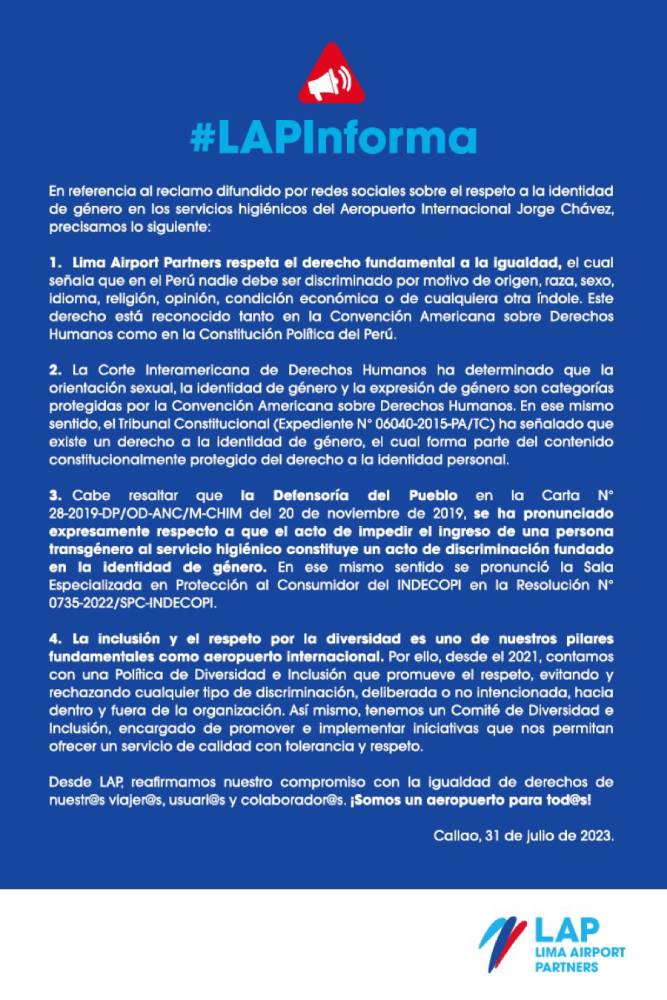
In July, a complaint from a business partner of Congressman Alejandro Muñante regarding inclusive restrooms at Jorge Chávez International Airport (Lima) led to a formal complaint filed by the congressman with the District Attorney's Office for Crime Prevention against Juan Salmón, general manager of Lima Airport Partners (LAP), the airport's operator. Thanks to a series of protests by transgender organizations, the signage was maintained and improved, adding "Women in their diversity" and "Men in their diversity."
Also in July, the mayor of Lima, Rafael López Aliaga, lashed out against the Pride March and the Outfest Lima LGBTQ+ Film Festival.
The first one changed its route so that it would not end where it historically culminates, which was Plaza San Martín, and ordered that the final show take place in the Alameda 28 de julio, causing traffic that could not be overcome until the early hours of the morning, since the alameda, unlike the plaza, is the passage for various districts of Lima.
The mayor rudely demanded that Outfest remove the image from the graphic design of its 20th edition, claiming that the image of Saint Rose of Lima was being ridiculed by placing a multicolored crown of thorns on her. The festival did not remove the image, but it was also unable to hold its opening ceremony in a state auditorium, as was customary.

Transfeminicides
The establishment of human trafficking rings in Peru, which extort money from sex workers, has intensified the murders of transgender women. Between January and February alone, 11 transgender women were brutally murdered, most of them sex workers.
At the end of February, organized trans women, along with networks of sex workers, held a march. They demanded better prevention measures against the violence they experience, a specialized commission to dismantle trafficking and sexual exploitation rings, and swift and timely action from justice officials in cases of sexual exploitation and extortion of sex workers. They also demanded that the National Police implement strategies and protocols to guarantee the safety of sex workers.
Cases of murders committed against trans women
– On January 20, the charred body of Erika Quintana Ávalos was found inside a car in Moche (Trujillo), after she left a nightclub accompanied by a man.
– On January 22 , Ale Castillo Limache was found murdered and showing signs of torture in a hostel in Camaná, Arequipa. She had also left a nightclub accompanied by a stranger.
– On February 11, Priscila Aguado was shot to death by a prostitution ring in Chorrillos.
– On February 13, Rubí Ferrer was kidnapped and taken from Cercado de Lima to Carabayllo. There, she was shot nine times.
– On February 16, the body of Camila Sánchez was found with signs of torture between the districts of La Victoria and Pimentel (Chiclayo) by the Jardines de la Paz cemetery.
These cases are joined by Cataleya in Amazonas and several others that don't appear in the news. All are registered by LGBTQ+ human rights organizations.
An Ombudsman's Office that turns its back on the LGBTQ+ community
The institution that traditionally defended the LGBTIQ+ population from a series of injustices took a different course after opposing right-wing and left-wing parties joined forces to place Josué Gutiérrez Cóndor in that important position.
When a group of congressmen interviewed him to decide whether he would be elected, one of them asked his opinion on a publication by the Ombudsman's Office commemorating Lesbian Visibility Day. "These are deformities that must be corrected," the then-candidate said about homosexuality.
The new ombudsman, who is unqualified for the position, did not hesitate to meet with the fascist group "La Resistencia," which had attacked a children's library a few months earlier. This group persecutes, threatens, and assaults those they consider their political adversaries.
Furthermore, violating the principle of secularism, the ombudsman met a couple of times to pray with a homophobic evangelical church in his office. The ultraconservative church Plenitud de Vida (Fullness of Life) is linked to Brazilian neo-fascism and frequently uses hate speech against the LGBTQ+ community.
Outlaw
In the 2023 legislative session, three bills were debated in committee. Congresswoman Ruth Luque presented a bill on same-sex marriage, Congressman Alejandro Cavero presented a bill on civil unions, and Congresswoman Susel Paredes presented a bill against hate crimes. The first was shelved in the Justice and Human Rights Committee with 12 votes in favor, 2 against, and 4 abstentions; the other two remain in committee, on the verge of being shelved, given that we are dealing with a Congress dominated by the right and the ultraconservative left.
Two evangelical congressmen, Milagros Jáuregui and Alejandro Muñante, continue their work to limit the rights of women and LGBTQ+ people.
This year they achieved a law protecting the unborn. The law seeks to obstruct access to therapeutic abortion, the only legal abortion in Peru, which is applied when the pregnancy endangers the life and health of the woman or involves a non-viable fetus. They eliminated inclusive language from school textbooks and government entities, so these institutions can no longer use "las y los" to refer to women and men. Everything will revert to non-inclusive masculine language.
Furthermore, they seek to change the name of the Ministry of Women and Vulnerable Populations to the “Ministry of Family, Childhood, Senior Citizens, and Persons with Disabilities”—even though this is not a prerogative of Congress, but rather of the Executive Branch. Their aim is to obstruct a gender perspective in public policies and eliminate any state support for LGBTQ+ populations.
We are present
We are committed to journalism that delves into the territories and conducts thorough investigations, combined with new technologies and narrative formats. We want the protagonists, their stories, and their struggles to be present.
SUPPORT US

FOLLOW US
Related notes
We are present
This and other stories are not usually on the media agenda. Together we can bring them to light.