

Explainer: How much power does the RAE have over inclusive language?
Is it the ultimate authority on Spanish or an outdated institution? What the Royal Spanish Academy (RAE) can actually decide.


Share

There are 493 million Spanish speakers, and the Royal Spanish Academy (RAE) evokes mixed feelings. Some maintain that it is the ultimate authority on the language, while others see it as an outdated institution that opposes the evolution of Spanish. Anti-rights groups have used the RAE as justification for denying identities. But what exactly does this private institution do?
In recent years, major debates – especially on social media – have revolved around inclusive language.
While it is true that the most recent update of the Dictionary of the Spanish Language (DLE) includes the term "non-binary," it is actually a partial recognition . Furthermore, it has fostered the spread of misinformation regarding inclusive language and has reinforced stigmatizing narratives.
Regarding the inclusion of the word "non-binary" in the RAE dictionary pic.twitter.com/Rjz0zElbtl
— Non-Binaries Spain (@NoBinaries_es) November 30, 2023
The Royal Spanish Academy rejects inclusive language
The DLE's 23.7 update incorporates 4,381 words, articles, variants, and deletions. Social media users shared posts claiming that the RAE still rejects the use of inclusive language despite incorporating the concept of "non-binary.".
"The Royal Spanish Academy (RAE) rejects the use of 'todos y todas,' 'todxs,' and 'todes.' If you speak or write like that, YOU ARE NOT INCLUSIVE, YOU ARE IGNORANT. Spanish is a highly inclusive language in its grammatical rules. Distorting the language in the name of inclusion IS UNNECESSARY," several publications state.
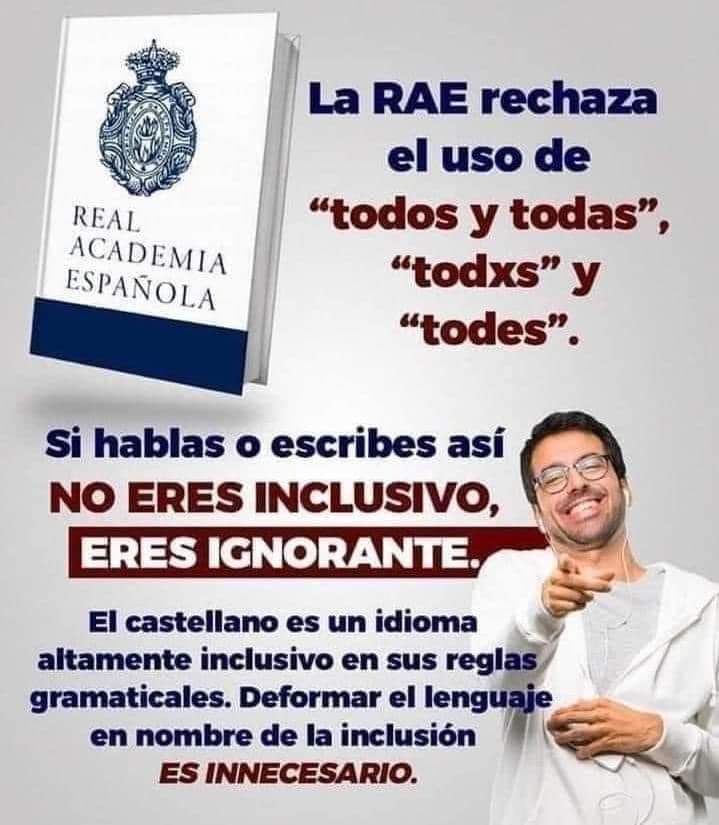
Regarding the image that has been circulating since 2022, the RAE responded via X (formerly Twitter) that “inclusive language” is a set of strategies that aim to avoid the generic use of the grammatical masculine, a mechanism firmly established in the language and which does not imply any sexist discrimination.
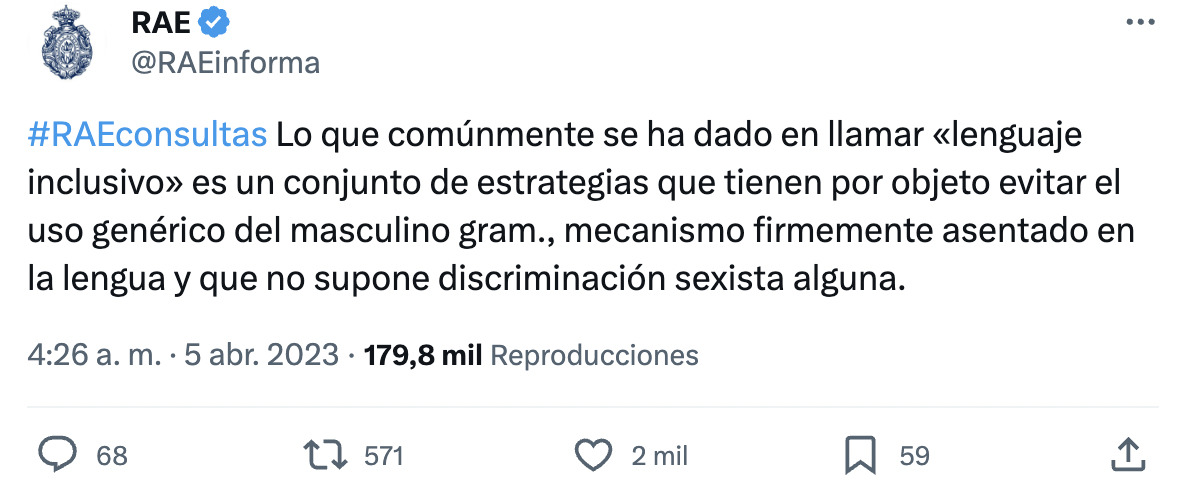
However, the generic masculine is an exclusionary parameter in writing and speech that makes women and other identities invisible.
According to the United Nations (UN) , inclusive language is understood as the way of expressing oneself orally and in writing without discriminating based on sex, gender or identity.
Inclusive language can help prevent discrimination in spoken, written, and visual communication. It is an affirmative action of a corrective nature.
Inclusive language is the one that makes visible
The Language Guide for the Inclusion of Non-Binary People, created by It Gets Better, Homosensual, and Pride Connection Mexico, describes inclusive language as that which makes visible and names appropriately the groups and individuals who face discrimination. This includes, for example, people of color, people with illnesses or disabilities, LGBTQIA+ people, and migrants, among others.
The representative language of non-binary people is that in which the neutral pronoun (marked by 'e', 'x', '@' or '_') is used in words to refer to a set of people with different gender identities that fall outside the male-female binary.
It also opposes the use of the masculine as a generic term, since it fails to name women, trans people, or non-binary identities.
The RAE, led by men
The institution has acknowledged that it is undergoing a slow process of renewal. But the reality is that since its founding in 1713, the Royal Spanish Academy (RAE) has only been led by men and has produced a mere 12 female academics .
Over the years, the Royal Spanish Academy (RAE) has fallen into several contradictions. The institution has declared "totally opposed to any type of sexism, whether against women or members of the LGBTI community."
But at the same time, they have defended the use of the generic masculine. They argue that “proposals to make women visible in language seem to be heading in the opposite direction.” And they have denied the identity of non-binary people by rejecting the use of inclusive language.
Half-hearted recognition is just as stigmatizing. The Royal Spanish Academy (RAE) exists to document how Spanish speakers contribute to the evolution of language, and despite its refusal to do so, non-binary people continue to modify it, much less cease to exist. 💛 https://t.co/hiAjnz2yQQ
— Alex Orué 🏳️⚧️🏳️🌈 (@Alex_Orue) November 29, 2023
The RAE does not regulate language
Some social media users and news outlets point out that the use of inclusive language is incorrect. They say it constitutes a distortion of the language since the Royal Spanish Academy does not accept its use.
This narrative is not new . For years, the Royal Spanish Academy (RAE) has been a resource used by anti-rights groups to prevent the addition of words to the dictionary and the recognition of the people who represent them.
Since 2005, conservative parties and anti-rights groups that opposed same-sex marriage have cited the RAE (Royal Spanish Academy) to deny its validity, since at that time, the only definition of marriage that appeared in the DLE was the "union of a man and a woman arranged through certain rites or legal formalities."
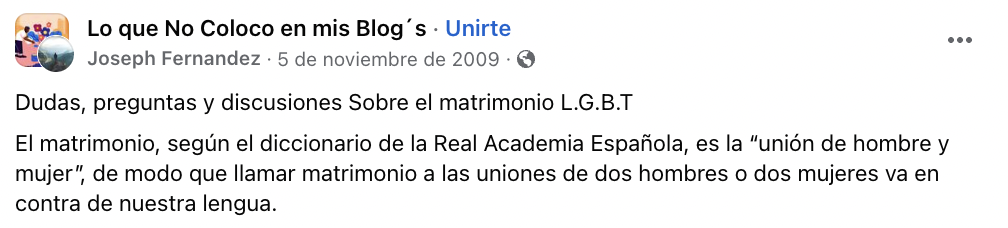
On June 30, 2005 , Spain became the fourth country in the world to approve same-sex marriage, although it was not until June 22, 2012 that the RAE finally added a new meaning to the word marriage to recognize unions between homosexual couples.
A private institution that does not regulate language
Contrary to the misinformation spread on social media, the RAE is a private institution that does not regulate the language, but rather registers it, and therefore has no power to add or remove words from Spanish.
The same organization has even acknowledged that "languages do not change at will, but through natural evolution based on the use that their speakers make of them."
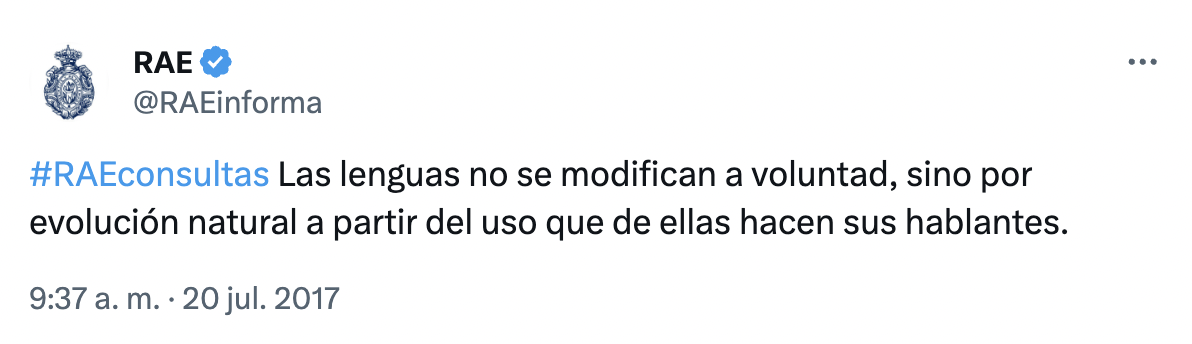
Regarding inclusive language, although the RAE insists that the -e ending cannot be made official until the general population uses it, the decision of how to name non-binary people rests with the speakers of the language, individually first and as a group as a consensus is reached.
The Royal Spanish Academy (RAE) has just publicly acknowledged not only the existence of the -e ending but also its specific use to refer to non-binary people. It rejects proposing an official alternative to the -ey ending and explains why it has not officially incorporated it into the Spanish language. 🧵 pic.twitter.com/eWLBk4T9t1
— Guille Jiménez 🏳️⚧️ (@GuilleJiCan) January 5, 2023
This article was produced as part of a partnership between Agencia Presentes and Verificado. We aim to combat disinformation and hate speech related to gender and diversity.
We are present
We are committed to journalism that delves into the territories and conducts thorough investigations, combined with new technologies and narrative formats. We want the protagonists, their stories, and their struggles to be present.
SUPPORT US

FOLLOW US
Related notes
We are present
This and other stories are not usually on the media agenda. Together we can bring them to light.