

Ociel Baena: Why it is false to speak of a “crime of passion”
Following the deaths of judge and non-binary activist Ociel Baena and their partner, Dorian Herrera, a series of disinformation stories have been circulating on social media and in the press. These stories are being promoted by some media outlets and sectors of the judiciary, thereby obstructing access to investigations with a gender and human rights perspective regarding violence against LGBTQ+ people.



Share

On November 13, the couple Ociel Baena, a magistrate of the Electoral Court of Aguascalientes (Mexico), and Dorian Herrera, a lawyer and model, were found dead inside their home . Since then, the local Prosecutor's Office has maintained one version of events: "everything indicates that it could be a personal matter."
Prosecutor Jesús Figueroa Ortega states that “there is no evidence to suggest that a third person other than the deceased was present at the scene.” He adds that the injuries caused by sharp objects “are the injuries that resulted in the deaths of these two individuals.”
The families reject the prosecution's version of events and ask the public " not to believe them ." Activists are demanding that the justice system investigate with a gender perspective and that the media respect the dignity of the couple and Ociel Baena's gender identity.
The version reported by the media is the same as that of the Aguascalientes Prosecutor's Office—as explained in this statement . They claim that Herrera allegedly attacked Baena until he died, which is why activists and LGBT+ people in Mexico reject the narrative of a 'crime of passion,' a prejudiced definition with no legal basis.
Why should the violent death of an LGBT person be investigated as a hate crime? Why does fueling the 'crime of passion' narrative misinform and run counter to the human rights approach? Presentes and Verificado explain.
Hate crimes against LGBT people do exist in Mexico.
Ciro Gomez Leyva, on his program —one of the most watched in Mexico—stated that it is supposedly “false” that there is hatred towards LGBT+ people, and supported the version of the authorities despite the documented threats that the magistrate received months before the event.
In Latin America and the world, the most visible form of violence against LGBT+ people is hate crimes, a form of gender violence with patriarchal roots.
Situations of discrimination, marginalization and violence, as well as hate speech, occur in varying intensities and are present in people's daily lives.
The Inter-American Commission on Human Rights (IACHR) also speaks of prejudice-motivated violence in these crimes.
What is prejudice violence?
The IACHR noted in its 2015 report on violence against LGBT people in the Americas that “the concept of bias-motivated violence is useful to understand that violence against LGBT people is the result of negative perceptions based on false generalizations […]. And the common denominator of this violence is the perpetrator’s desire to 'punish' identities, behaviors or bodies that differ from traditional social norms and gender roles, or that are contrary to the binary male/female system .
international , regional , and national observatories on hate crimes against LGBT+ people, driven by activist groups, compile this data. Based on these statistical analyses, we know that Mexico is the second country in the world, after Brazil, with the highest number of hate-related deaths against LGBT+ people.
The information gathered in the observatories also coincides in that trans people, especially women and those with feminine gender expression in precarious contexts, are the largest number of victims of hate crimes .

According to the organization Letra S , so far this year, at least 50 LGBT people have been murdered in Mexico, and in the last five years at least 453 people have been victims of hate crimes, although the real number is higher given that there is an underreporting of LGBTI+ people.
In only 79 of these cases was at least one person arrested, but it is unknown how many are serving a sentence.
The INEGI reports that since 2017, discrimination has increased in 14 federal entities, and LGBTIQ+ people, Afro-descendants and domestic workers have been the most affected, data that also reflect the high levels of discrimination that persist in Mexico.
According to ENADIS 2022, 37.3% of the population aged 18 and over of sexual and gender diversity reported having been discriminated against, with their way of dressing or personal grooming being the main reason.
Why should the violent deaths of LGBT people be investigated as hate crimes?
The Aguascalientes Prosecutor's Office has not mentioned Baena's gender identity, nor the sexual orientation of her and her partner, Dorian Herrera. For this reason, activists are demanding that the case be investigated in accordance with human rights and from a gender and sexual diversity perspective. They are also requesting that the Attorney General's Office of the Republic (FGR) take over the investigation.
Despite the existence of a National Protocol for the Investigation of Crimes against LGBT People, the local Prosecutor's Office has not implemented it. According to the principles of this protocol, public officials within the Mexican justice system must act with respect for human dignity, adhering to the principles of equality and non-discrimination; investigate crimes with a differentiated and specialized approach , considering the victim's context and respecting human rights; and guarantee that victims will not be revictimized or criminalized.
The same Protocol mentions that it adheres to what is established by the IACHR in relation to due diligence on preventing, investigating and punishing violence against LGBTI+ people.
Among the guiding principles of due diligence, it is established that “when a crime is committed against LGBT persons, States must ensure from the beginning of the investigation that an examination of the motives is carried out, and that in this examination the relevance of the sexual orientation or gender identity, real or perceived, of the victim is considered. In this way, the hypothesis that the crime was motivated by prejudice can be confirmed or ruled out during the course of the investigation .
The false narrative of 'crime of passion' violates human rights.

According to the Aguascalientes prosecutor, Jesús Figueroa Ortega, Dorian Herrera attacked Ociel Baena, killing him. This single version of events has been denounced by activists under the slogan: “crime of passion, national lie,” and for this reason, they are demanding an investigation that adheres to human rights and incorporates a gender and sexual diversity perspective.
“The concept of a crime of passion is riddled with prejudice because it asserts that LGBTI people are more passionate than the rest of the population. Because they are more passionate, they are supposedly more violent, and because they are more violent, they kill each other. That is the underlying prejudice, which blames the victim for their own death. It is a completely biased concept that has no legal basis and violates human rights,” says Alejandro Brito, founder of Letra S , an organization that has been documenting hate crimes in Mexico for over a decade.
And he adds, “The intention to establish the narrative of 'crime of passion' not only strengthens existing prejudices, but also silences protest, the demand for justice and for an investigation that adheres to human rights and due diligence,” Brito reflects.

Letra S has documented that the Mexican press has been labeling violent deaths of LGBT people as "crimes of passion" for at least five decades. Even in their 2022 report , they recorded a case that was categorized under this label without legal basis as part of their line of investigation.
Misgendering is also violence
Ociel Baena was a person who defended her pronoun, elle, in all spaces.
When his death was announced, the media decided not to respect his pronoun.
Addressing someone with a pronoun they don't identify with is called misgendering. Non-binary people pronoun exclusively .
Here is a guide on the use of inclusive language and pronouns that can be useful to avoid misgendering or making non-binary people invisible through language.
In addition to the symbolic violence of the press, there were tweets from right-wing congressmen, businessmen, communicators, influencers and journalists such as René Franco, Ricardo Salinas Pliego, Eduardo Verástegui, Lilly Tellez, Teresa Castell.
Although some media outlets and social media users also insist on putting the word magistrate in quotation marks as a nickname, the reality is that the Electoral Tribunal of Aguascalientes confirms that Magistrate in Functions by Ministry of Law was Baena's position and therefore, it does not go in quotation marks.
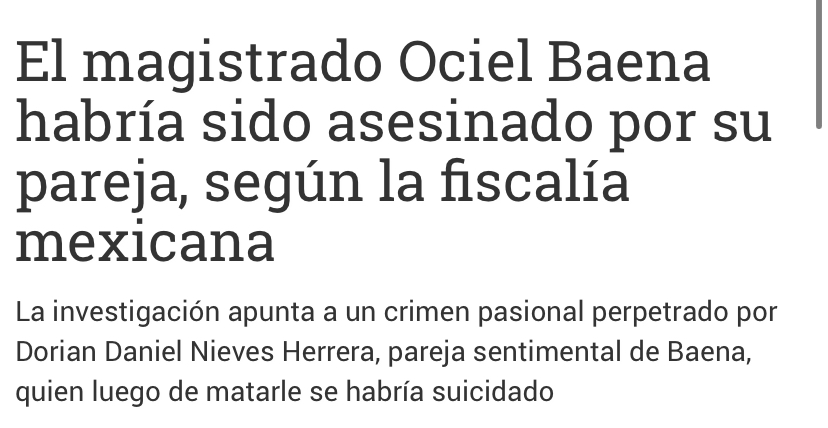
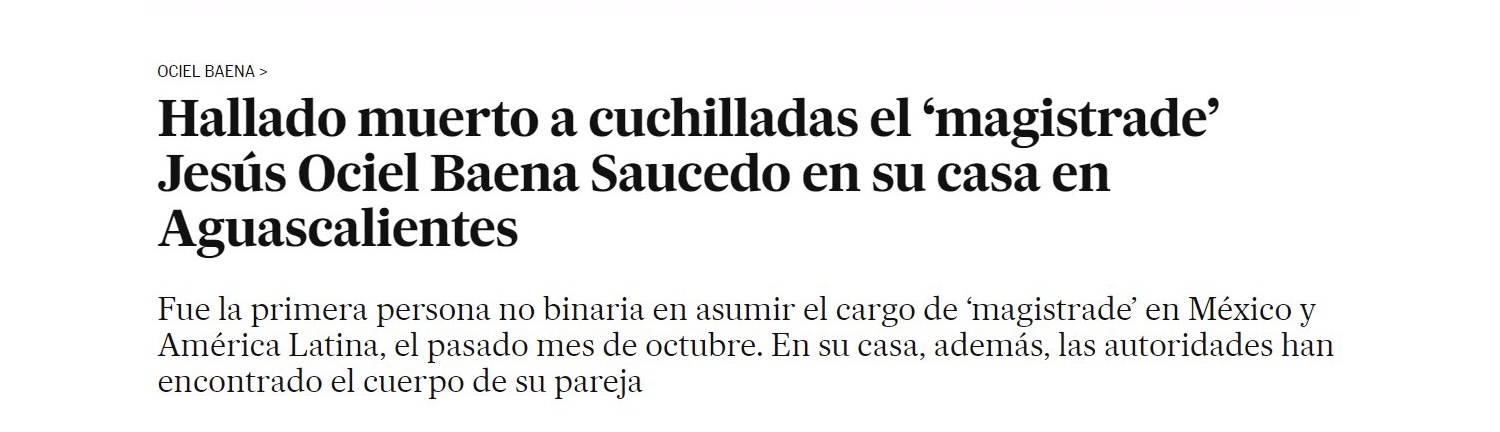
In addition to misgendering the magistrate, it has been denied that hate speech has consequences in people's lives.
“The discussion has focused on the use of the letter 'e' instead of addressing the core issue, which is violence against LGBT people, and in this case, against a non-binary person. Educational measures are urgently needed to dismantle prejudices because this hate speech does have consequences in people's lives, and we are witnessing it. But I also believe that the massive mobilization this event sparked within the LGBTQ+ community demonstrates a different level of organization and response, and we must draw strength from that to demand justice,” concludes Alejandro Brito.
The covers that make up the illustration for this article were digitally modified because they were highly revictimizing..
We are present
We are committed to journalism that delves into the territories and conducts thorough investigations, combined with new technologies and narrative formats. We want the protagonists, their stories, and their struggles to be present.
SUPPORT US

FOLLOW US
Related notes


We are present
This and other stories are not usually on the media agenda. Together we can bring them to light.