

Indigenous women in northern Salta denounce the constant lack of water
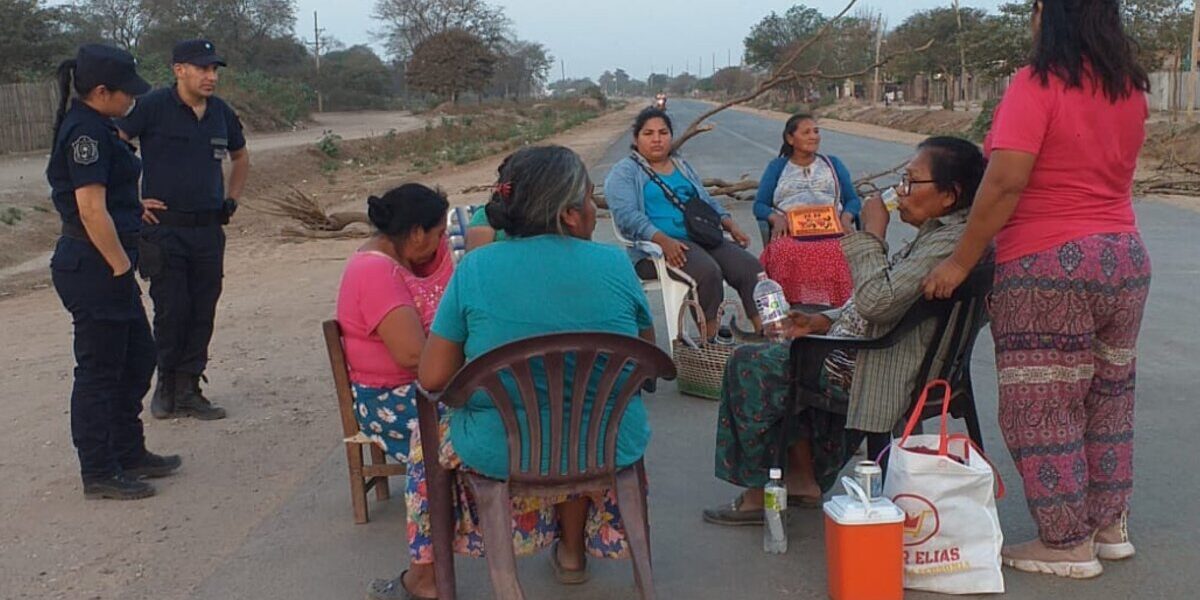
These women are leaders in the Wichí communities of Tartagal, Salta. Between road blockades and meetings, they denounce the government for failing to keep its promises.


Share

SALTA, Argentina. Women leaders from Indigenous communities located near National Route 86, in the municipality of Tartagal —more than 355 kilometers north of the capital of the province of Salta—have been carrying out various public actions to highlight the lack of water they have suffered for years, a situation exacerbated by the drought that has plagued the area since last year.
In the last week of September, this group blocked the road, a measure that was suspended after an agreement was signed with officials from the Salta government. But now they claim that this commitment was not honored and are considering further action.
The water service provider, Aguas del Norte , attributed the shortage to a lack of water due to the prolonged drought, which reduced the flow of the Ituyuro dam, the source of water for this area. They also provided a list of projects underway to address the crisis.
These communities have been demanding water for some time. Among other actions, last summer a group of women and their children walked from Tartagal to the city of Salta to petition for an adequate water supply.
Presentes spoke with three women leaders from their communities who have been spearheading the demand for water provision. These communities are supplied by tanker trucks, but all complain about the lack of regularity in this service, which is the responsibility of the Indigenous Affairs department of the province of Salta.
“I have to beg them to bring me water”
Francisca Sarmiento explained that in her Wichí Sarmiento community, five kilometers from Tartagal, they have three water tanks, each with a capacity of one thousand liters. Between refills, they often have to endure days without water. “I have to beg for them to bring me water ,” she lamented. Because these tanks are near the road, the more distant families “have to come from there with buckets to carry water, when they have any,” she said.
Sarmiento said that the water they receive is barely enough for human consumption. And, like the other community leaders, she complained about what she perceives as neglect. A pipeline belonging to the Aguas del Norte company runs along Route 86, carrying water to the Tonono , where the most remote community is located. She explained that there is a shut-off valve near her community, but the company closes it to prevent the water pressure from dropping even further.
Sarmiento said that for this reason they were “requesting (the construction of) water wells.” The water company has been constructing wells to try to address the water shortage that particularly affects the entire San Martín department , but the pace of construction is not keeping up with the demand.
One single water tank for the entire community
Closer to the city of Tartagal, 3 kilometers away, still along Route 86, lies Lapacho 3, the community of Mónica Celina Pérez. About 150 families reside there.
“We were given only one water tank, and we have to share it with the whole community. It’s not enough for everyone,” she began the conversation with Presentes . She said the water truck comes to her community “every three months, sometimes six.” That’s why they have to buy water: “What if we don’t have the money to buy it? That 1,000-liter tank only lasts one or two days,” she maintained.
As is common in places without a piped water supply, and especially during times of scarcity, some individuals sell water drawn from private wells. Pérez said that a 1,000-liter load can cost up to 30,000 pesos. “Everyone here in the community has to chip in to pay for that load. Even then, we have to wait about two or three days before they deliver it, because there’s a lot of demand,” he explained.
Buying water is not easy for these communities. Most of them make a living selling handicrafts and working in low-paying jobs such as domestic service, in the case of the women, and as smugglers or cross-border workers, in the case of the men.
Mónica Pérez said that the water distribution network reaches Lapacho 3 by pipe, but the service provider closes the main valve, "so that the water goes to the neighborhoods" of the city, due to the low pressure of the distribution.
The right to water
Marcela Calermo, from the Wichí community of La Mora, 5 kilometers from Tartagal, began her conversation with Presentes by questioning the Salta government because every time they carry out a protest, they are accused of exposing their children to a vulnerable situation. “If the government truly cares about Wichí children, then where are the children’s rights? Why can’t they drink water?” she retorted.
She added that mothers choose to bring their children to the protests because at home they would go hungry and thirsty. Instead, when they participate in demonstrations, they receive the solidarity of the people.
Northern Salta is characterized by high temperatures. Calermo emphasized that with "such intense heat," they have to "conserve a little water for many families." He added that "in the center (of the city of Tartagal) water is available." "We are concerned about the situation because it's about to get hotter, and I don't know what will happen," he insisted.
Furthermore, she said that Indigenous Affairs office hadn't sent the water truck even though they were already without water. “It's like they're waiting until October to send the water. And that's not how it works, the children can't wait. The children need water. There's no water at the school either, but the water truck does come to the school,” she said.
At kilometer 5 from Tartagal, the La Mora Community is directly across the road from the Sarmiento Community. The presence of Indigenous communities along the road extends to Tonono, the furthest from the city, almost 40 kilometers away. Some are even further from Route 86 (which connects Salta with the province of Formosa), kilometers into the forest, as is the case with Lapacho 1.
There's money but there's no water
Calermo, an active community organizer, pointed out that despite the large number of residents in these towns, “few people are fighting for their rights.” There are 35 communities in the area. Calermo believes La Mora is one of the smallest, while the Kilometer 6 Community has about 600 families, more than 2,000 people.
The spokesperson emphasized that “even with a job” and the money to buy water, “there’s still no water.” This is because private providers are also overwhelmed with demand. Regarding the water situation, she said, “it’s not about having a job. I can buy bottled water, but only for drinking. For washing, for everything—for washing dishes, for bathing—where are we supposed to get it? And people simply don’t have enough to drink, to wash, or for anything, and that’s the problem.”
“And I get sad and powerless at the same time, because I don’t know what I’m going to do anymore. I don’t know what to do with this government that lies to us. They gave us a commitment agreement and they haven’t kept their word.” She stated that they also failed to keep their promises and clarified that they don’t like going out to protest, being outside their homes, under the sun, enduring the heat during the day and the cold at night. “I don’t think anyone likes it. I don’t like being there lying on the ground; you want to be at home, sleeping in your own bed. We do it because we desperately need water, which is essential for life, but I think the government doesn’t care.”
In their community there are 120 families, “and each family has six or eight children.” The Aguas del Norte water line runs through the La Mora community, but the houses aren't connected to the network. They get their water by buying it in the city. Representatives from the Indigenous Affairs office came to deliver water, but it's all gone now. About ten families have 1,000-liter water tanks, “but the rest have those little 5- or 10-liter jugs.”
Marcela Calermo was particularly concerned with proving she wasn't lying. She requested a video conference call to show the dry containers. She also wanted to show the small house of her neighbor, an elderly man over 80 years old who lives in a structure made of a wooden frame and plastic walls. "There are many houses like that in the communities in the area," she stated.
The situation and the solutions
Presentes ' inquiry . They explained that the communities located along Route 86 are supplied by the aqueduct that carries water from Itiyuro to Tartagal, but their residents "are affected by the same situation as Tartagal, Mosconi, and Aguaray (the latter two towns being in the same San Martín department), which have water on a rotating basis due to low production. It's not just them who are cut off; when the aqueduct is shut off, they also stop receiving water," the company stated.
Regarding the solutions being implemented by the water provider, he explained that “there are two fronts of attack.” On the one hand, there are the works being carried out to address the emergency. New wells are being drilled in Salvador Mazza and Aguaray “to make the two towns independent from the Itiyuro system.” In Salvador Mazza, these wells meant that last year it experienced virtually none of the problems faced by the other towns in the area.

The company calculated that it will be able to do the same in Aguaray this summer with the provision of two new wells. One is already finished and another is expected to be completed in October. “That way, the Itiyuro production would go only to Tartagal and Mosconi, plus the communities along the highway.” In addition, another well is being drilled in Mosconi. And in Tartagal, three wells were inaugurated in the last year, with at least two more under construction.
The company added that they are also drilling wells in Salvador Mazza, “which has good aquifers. The water from these wells is sent via an aqueduct and connected to the Itiyuro system aqueduct that runs to Tartagal and Mosconi. This way, production is reinforced so that it doesn't depend solely on the dam.” In addition, two new wells have been completed and a third is under construction in the Yacuy area , 19 kilometers from Tartagal. Here too, the water will be sent to the aqueduct that runs from Itiyuro to Mosconi and Tartagal.
Work was also done to improve the capacity of the Itiyuro plant. Last year, during the summer crisis, “the plant only had two filters operating. Today it has eight active filters and two additional ones that are exclusively for algae treatment using an air dissolution system.” A new reservoir is also under construction in Tartagal, which will double the storage capacity for treated water transported for distribution within the city.
Long-term measures
On the other hand, long-term measures are being implemented, aimed at “achieving a change in the water supply matrix in the department. That is, balancing the supply sources between surface and groundwater. Today, the supply is 80% surface water (from the Itiyuro dam) and 20% groundwater (from wells). In cases like last year's drought and so far this year, there are many problems because the level of the Itiyuro dam drops, as does that of the Caraparí River, which supplies it.”
Another long-term measure is raising the level of the El Limón reservoir, located in Salvador Mazza on the banks of the Caraparí River, which also supplies the system.
This project, designed to double storage capacity, is not expected to be completed until next summer. The company operating the water system indicated that currently, “the reservoir's reserves last six months, but because the dam is small, the heat and sun cause algae to form, which are difficult to treat. By doubling the capacity, a system will also be built to recirculate the water using the Itiyuro dam, which helps prevent algae growth. The goal is to increase the reservoir's capacity to a full year, so we don't have water shortages again, even during droughts.”
We are present
We are committed to journalism that delves into the territories and conducts thorough investigations, combined with new technologies and narrative formats. We want the protagonists, their stories, and their struggles to be present.
SUPPORT US

FOLLOW US
Related notes



We are present
This and other stories are not usually on the media agenda. Together we can bring them to light.