

Attacks on Manu Mireles: More violence against LGBT+ people in Argentina
The teacher and leader of the Mocha Celis High School denounced the serious attacks she suffered last week. "Violence can be resolved with education, dialogue, and rights," she said.


Share

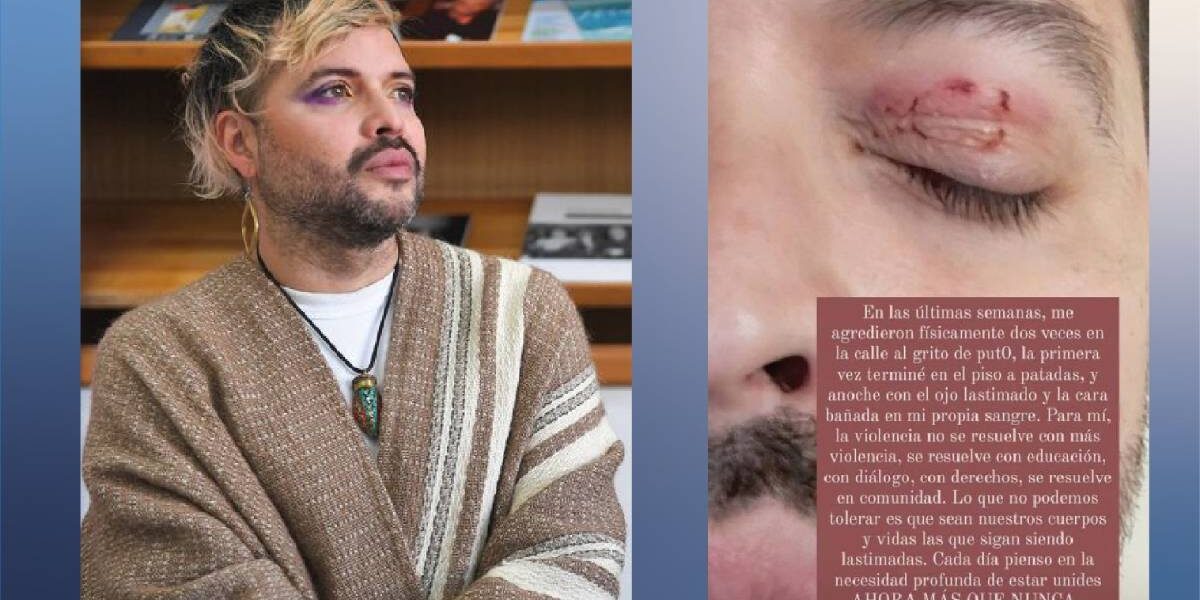
BUENOS AIRES, Argentina. Manu Mireles, academic secretary of the Mocha Celis High School , a non-binary trans activist and human rights defender, was walking through the Caballito neighborhood in Buenos Aires on her way to a meeting when a group of men began shouting at her. She didn't respond and kept walking. They continued shouting until they caught up with her and beat her, kicking her repeatedly while she was on the ground.
“They hurt me badly and left. No one intervened, no one helped me get up from the floor,” Manu Mireles told Agencia Presentes , after recounting what happened.
A few days later, in the Tribunales neighborhood, also in Buenos Aires, Manu was arriving home when someone yelled "faggot" at her. As in the previous incident, she didn't turn around, but felt something being thrown at her. This time she turned around and felt a kick to her face, her eye injured and bleeding. The aggressor ran off, continuing to yell.
“This is an expression of terror and control imposed on our identities,” says Manu, who denounced these attacks on social media on Thursday. The day after the latest attack, she had to work and then travel to the province of Chaco for the Third Latin American Trans Education Forum . She spoke with Presentes .
The repudiations
She has not yet been able to file a complaint with the prosecutor's office, the police, or the National Institute Against Discrimination, Xenophobia, and Racism (INADI) regarding the trip: “I didn't stop working, and I still hadn't resolved the issue until I decided to make it public and share it on social media. Then, very early the next morning, I had to come back to Chaco.”
Amnesty International has a complaints channel which he will also use once he returns to Buenos Aires.
Many organizations condemned the attacks suffered by the activist: the Mocha Celis Trans Popular High School, Amnesty International Argentina , the Equality Foundation , the Argentine Homosexual Community (CHA) and the Latin American Team for Justice and Gender (ELA) , and more leaders of the LGBTIQ+ community.
Hate messages on social media prior to the attack
In early August, Manu Mireles appeared on the public television program, Abro Hilo— hosted by Sol Despeinada and Leyla Becha—to discuss the health of transgender people. There, she explained: “What happens when I’m a trans man and I go to the gynecologist? What happens when I’m a trans woman and I go to the urologist? What happens is that there’s a lot of violence.” Afterward, a reel of the activist’s remarks was posted on Instagram, garnering over 12,000 likes and nearly 200 comments, most of which were hateful.
Some of the messages specifically attacked Manu. Others offered a supposed scientific or religious explanation: “I think he should start by going to a psychiatrist”; “To the gynecologist for what? To have his testicles checked?”; “I identify as a dolphin and the same thing happens to me when I go to the vet…🤣”; “A doctor is trained to treat people: women or men. Should they be trained in your self-perception? Non-binary bodies don't exist. Your image, your appearance, or your performance is not scientific data for a professional to make a diagnosis. I can't believe this is happening on @tv_publica ”; “They don't need urologists or gynecologists. What they need are psychologists, psychiatrists, or God.”
In addition to those hateful comments, Manu also received threats via private message. "Those were also days of great anguish," he said.
“I am an institutional spokesperson for La Mocha, I am an activist, and I believe in the power of communication and education to guarantee rights. This means that being visible often implies a level of exposure that makes the violence focus on us,” Manu added.
According to data from the Argentine Federation of Lesbians, Gays, Bisexuals and Trans (FALGBT) , hate crimes in Argentina increased in 2022: there were 129, compared to 120 the previous year. This year's numbers have not yet been published.
“The rise of the far right and hate speech have a direct impact on our bodies.”
In recent months, around the time of the PASO (Primary, Open, Simultaneous, and Mandatory) elections, which took place on August 13 in Argentina, cases of violence, including street harassment, verbal abuse, and physical violence, have increased. "This is not an isolated incident," says Manu Mireles.
“Hate speech has such a significant and strong cultural impact and penetration that, regardless of the election results, it creates a framework in which violent people, including those of us who are quite conservative, feel justified in reproducing these levels of violence,” the activist explained.
In recent weeks, other people who attend Mocha Celis have also reported attacks on the street and on public transport.
Amnesty International Argentina post on its social media accounts, following the condemnation of the attack suffered by the activist, describing the same situation: “In recent weeks, there has been an increase in this type of aggression linked to sexual orientation and gender identity. This is further proof of the serious consequences of discourses that incite violence, and how they threaten the integrity and safety of the victims.”
Various social organizations have been warning about this very issue. “The rise of the far right and hate speech have a direct impact on our bodies and our lives, which translates into these levels of violence,” explained Manu Mireles.
“It is unacceptable that our legitimacy continues to be questioned.”
The Mocha Celis Popular High School also issued a statement condemning the incident, including the same warning: “We know this is not an isolated event. It is a product of the hate speech that is constantly circulating and endangering us. This is demonstrated by the increase in violence recorded in the last two weeks.”
“If every time there’s an election, a plebiscite is held on our rights, it’s unacceptable. It’s unacceptable that our legitimacy continues to be questioned. It’s unacceptable that they continue trying to negotiate away our rights ,” said Manu Mireles.
As she did in her post , she insisted that the answer to this violence is education, dialogue, and the guarantee of rights: “The answer is to think as a community, to work together collectively, and without a doubt, violence will never be greater than the love of our community, it will never be greater than our tireless struggle and with the conviction that we need a State with a much deeper democracy that guarantees life, equity, and justice for all people.”
We are present
We are committed to journalism that delves into the territories and conducts thorough investigations, combined with new technologies and narrative formats. We want the protagonists, their stories, and their struggles to be present.
SUPPORT US

FOLLOW US
Related notes


We are present
This and other stories are not usually on the media agenda. Together we can bring them to light.