

“Oriana”: a film-tribute to Monique Wittig 30 years after her death
Based on the book "Las guerrilleras", the film is about a group of feminist warriors who take refuge in a Puerto Rican landscape and shows their daily survival through collective inventions.


Share

“They say that at first they appear pressed tightly together.” With this choral phrase, borrowed from Monique Wittig , begins the film Oriana by Puerto Rican director Beatriz Santiago Muñoz, which will premiere next Friday at the San Martín Cultural Center as part of the Migrant Film Festival . We know as little about that beginning as we do about those who speak on screen. It’s not necessary to know. This is how “speculative fabulation” works, a term Donna Haraway uses to describe the acts of world-building . An act of creative rebellion to imagine new futures.
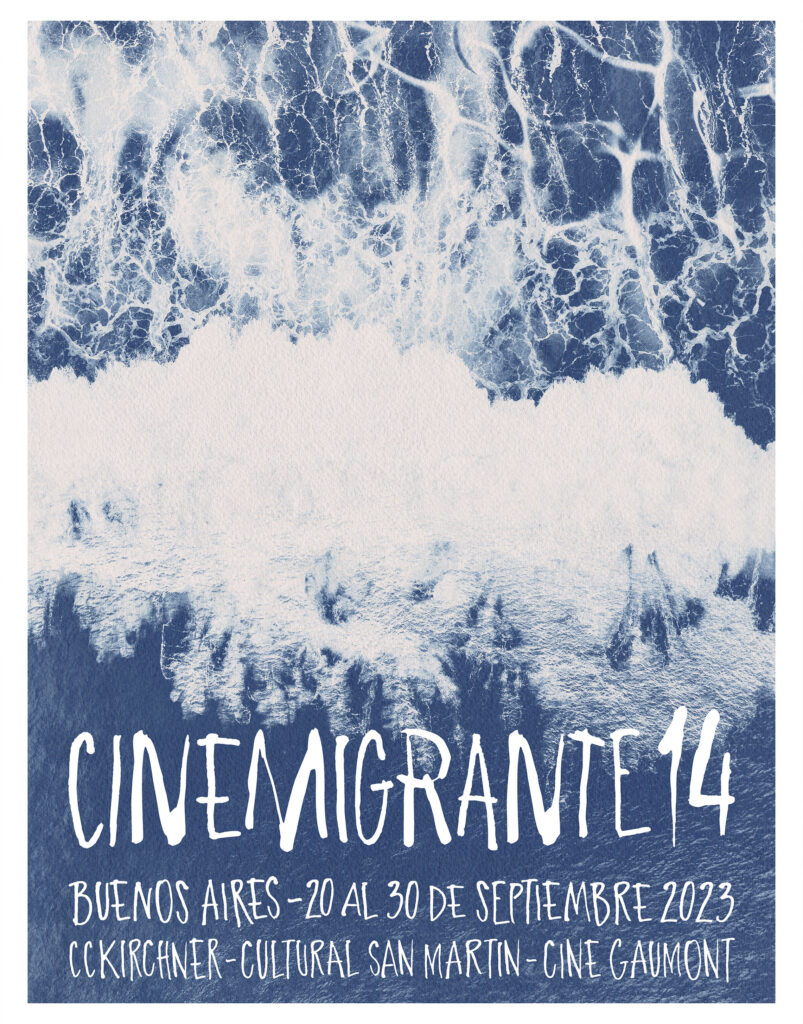
“It’s how young people from the so-called ‘peripheries of the world’ can enter the narrative of History from a place of power,” explains Florencia Mazzadi, director and curator of the Festival along with Almudena Escobar López (Spain) and Olivier Marbouef (France). “That’s what’s so wonderful about Wittig’s material, which Beatriz captures perfectly. These are the clues that we feminists bring when we propose a different way of inhabiting the world.” This year, the festival’s theme is: “On the edge of visibility. Clues of habitable spaces . For Mazzadi, the curation of CineMigrante has a clear objective: to gather the concrete experiences of those peripheries in the Global South that resist participating in the capitalist, heterosexual, and patriarchal forms of our time, and where new narratives for a potential future are being rehearsed .
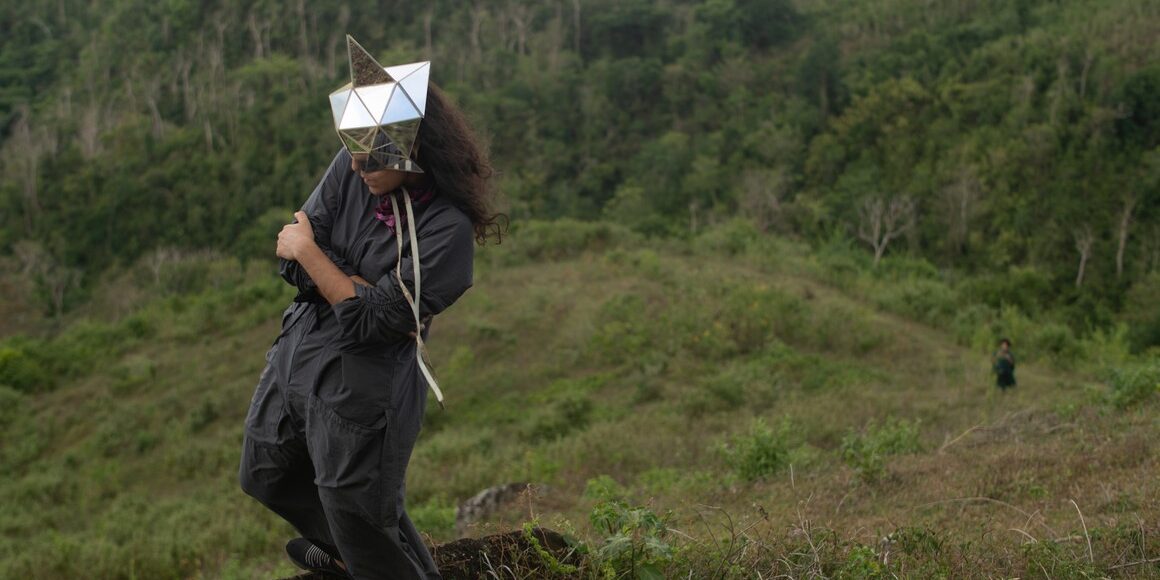
And indeed, towards the end of the 1960s, Wittig was already daring to challenge the norms imposed by a binary sex-gender system through experimental language: linguistic inventions, the destruction of the mother tongue, a verbal challenge launched against all established categories. Mutating from book to screen, becoming a new work, Oriana remains true to its creator and proposes an experimental cinematography that unfolds in an undefined space-time: forests, caves, rivers, cables. The ruins left by Hurricane Maria after its passage through San Juan, Puerto Rico. There, the protagonists speak a powerful, sorcerous language, calling us to be part of the spell.

An instruction manual for organizing your thoughts
Beatriz Santiago Muñoz was 19 years old the first time she read Monique Wittig. The author was a founder of the Women's Liberation movement in post-May '68 France. She would be remembered for her famous phrase, "Lesbians are not women." It was in a class taught by Lauren Berlant at the University of Chicago, where they read a lot of material from the 1960s and 70s, from materialist Marxism and early feminism.
“My experience was one of feeling a different relationship forming with the text, a sensory experience of being affected, but without understanding how Wittig made it happen,” recalls Santiago Muñoz. Since then, The Guerrillas has become a kind of external instruction manual for reorganizing one's own thinking. “It helped me think about the importance of the form of works, not only the what, but the how.” This year, 2023, marks the 30th anniversary of the death of the French activist and theorist.
Just like in the book, the film doesn't have a single central figure, but rather many, all connected through a collective, almost magical language. “There isn't a protagonist in the nineteenth-century novel sense, but rather the construction of a collective and constantly evolving female subject. Wittig has a political vision of the category of woman. That's what she brings us: a complex way of seeing the relationship between language and political categories, and the possibility of rearranging them for radical change.” This is how Santiago Muñoz invites us to delve into a film that promises endless adaptations. The director assures us that this is just one of the many possibilities the text offers. “Last summer I filmed two other short films that could be appendices, epilogues, or prologues to Oriana. It's a project that will never end.”
Uncensored Guerrillas
The Guerrillas was first published in France in 1969. Two years later, in 1971, it was translated into Spanish in a context marked by the conservative, fascist morality of the Franco regime, which censored entire passages of the book. In 2019, in Argentina, the publishing house Hekht decided to publish the book including these lost passages and translated the title as Guerrillas, without the article "las." "Wittig proposed that gender roles, binary language, are constructed not only through pronouns but through the entire grammar of language, through everything that is named as well as everything that is not. This is what makes her work so relevant today," says Santiago Muñoz.
Literature, film and performance in the new edition of the CineMigrante Festival
“ They say that because they have vulvas, they already know what characterizes them. They know the mons pubis, the pubis, the clitoris, the nymphs, the bodies, and the bulbs of the vagina .” In Wittig’s fictional world, the guerrillas participate in bloody and victorious battles, use knives and rocket launchers, and make weapons with whatever they have. How do you show this in a film? “Cinema places the eye in a central position, and the eye is traversed by the entire sociocultural fabric that inhabits us. The eye sublimates discrimination and xenophobia. What Beatriz does is deceive that oculocentrism,” explains Florencia Mazzadi.
Santiago Muñoz had to return to the book several times, reading it alone and with others. He had to discover the formal methods Wittig uses and what happens when those methods are translated into the language of film. “Working with the word ' ellas, ' with the written text, is not the same as showing a body marked as feminine on a screen. We have many ideas about how to read that body; there's a constructed gaze. I had to learn that the grammar of cinema is designed to imitate the novel, the plot that unfolds within a character. In other words, I had to understand that the language I was using is designed for a particular form and a particular way of imagining the world. And from there, I had to experiment to propose other possible forms.”
This is how she came up with the idea of a close-up of an eye , a cinematic technique that involves a tight frame showing only a fragment of the filmed subject. And from that eye, the camera leads us directly to the cosmos, to the stars, to the external world as the possibility of everything. “When we filmed, there weren't many more people than you see in the film. In 2020, in the midst of the pandemic, we locked ourselves away in a country house near San Juan. My productions, out of necessity—and I like it that way—don't allow me to be with 60 people filming for four weeks. Instead, we do a little bit one week here, then work on something else there, and it builds little by little. The women in the film are people close to me, and only two of them have experience in performance art,” the filmmaker explains.
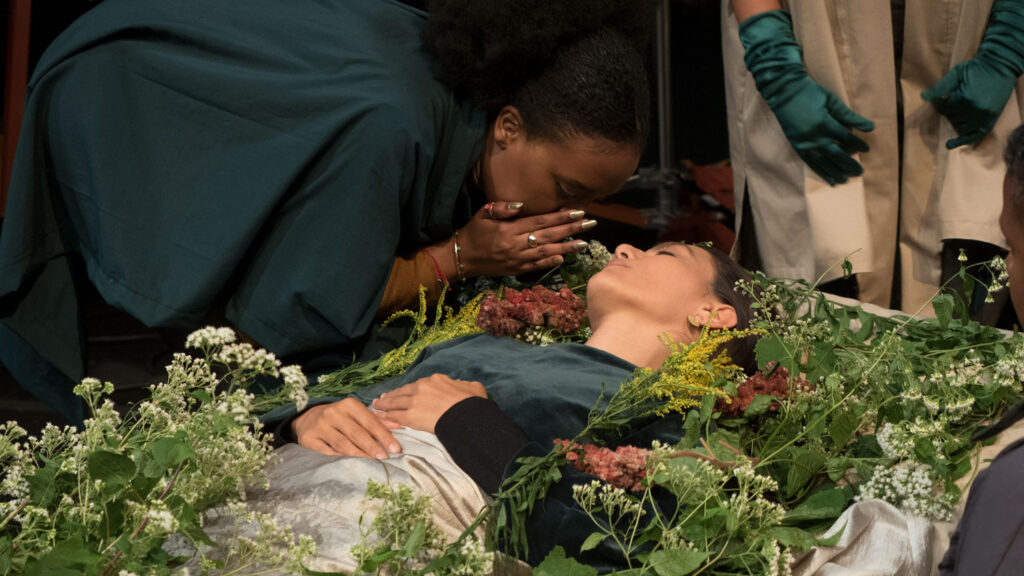
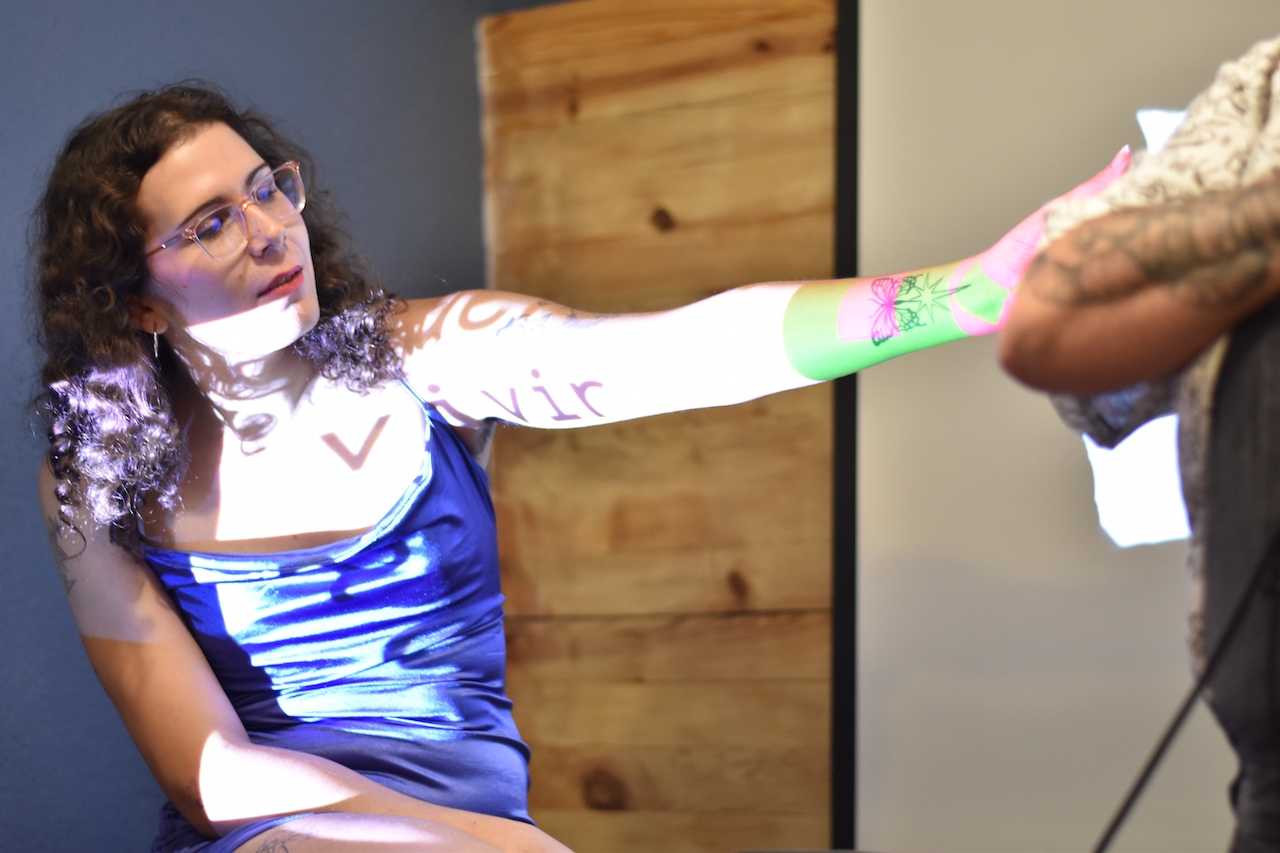
The image demands something of us. As an audience, as viewers, the film compels us to watch collectively. And as we watch, a chorus speaks to us, opening the doors to its world. The curators of CineMigrante propose that this overwhelming experience offered by the film should evolve into another kind of activity. This led them to the idea of a collective performance of readings and reverberations of fragments from Wittig's *Las Guerrilleras* , as a way of performing a collective ritual to welcome Oriana. This performance will feature Val Flores and will take place during the film screening at the San Martín Cultural Center. A second screening will follow on September 30th at 7 pm at the Kirchner Cultural Center.
The film will be screened on September 22nd and 30th as part of the 14th CineMigrante International Film Festival
We are present
We are committed to journalism that delves into the territories and conducts thorough investigations, combined with new technologies and narrative formats. We want the protagonists, their stories, and their struggles to be present.
SUPPORT US

FOLLOW US
Related notes


We are present
This and other stories are not usually on the media agenda. Together we can bring them to light.