

The first mausoleum for transgender people in Mexico is inaugurated.
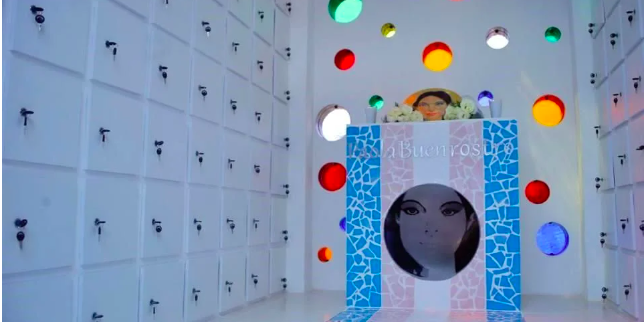
It is a space to recover the memory and dignify the death of those trans women whose bodies are not claimed by their biological relatives but are claimed by their chosen family —friends and sisters of sexual diversity—, and to prevent them from ending up in a mass grave.


Share

“Seven years ago, in this very cemetery, I promised Paola that I wouldn’t rest until I achieved a change in the system,” says trans activist Kenya Cuevas on a platform alongside Mexico City officials. At the San Lorenzo Tezonco Civil Cemetery in Iztapalapa, Cuevas receives the keys to the first mausoleum for transgender people in the country.
It is a space to recover the memory and dignify the death of those trans women whose bodies are not claimed by their biological relatives but are claimed by their chosen family —friends and sisters of sexual diversity—, and to prevent them from ending up in a common grave and unidentified.
The mausoleum has a visible face: that of Paola Buenrostro , whose tomb is a few meters from the Mausoleum.
Buenrostro was murdered in 2016 while working as a sex worker . She was 25 years old and originally from Chiapas. After the Mexico City authorities released her killer, Kenya has fought to raise awareness of the violence faced by the trans community . She also seeks to ensure that her murdered colleagues have a dignified resting place.
“Paola, thank you because through your name we have managed to open an important chapter in the history of the trans community,” says a moved Kenya Cuevas. The mausoleum is a reinforced concrete structure that houses 142 niches, space for six coffins, and an altar . It was built with support from the Attorney General's Office of Mexico City and on land donated by Mayor Clara Brugada, who attended the inauguration.
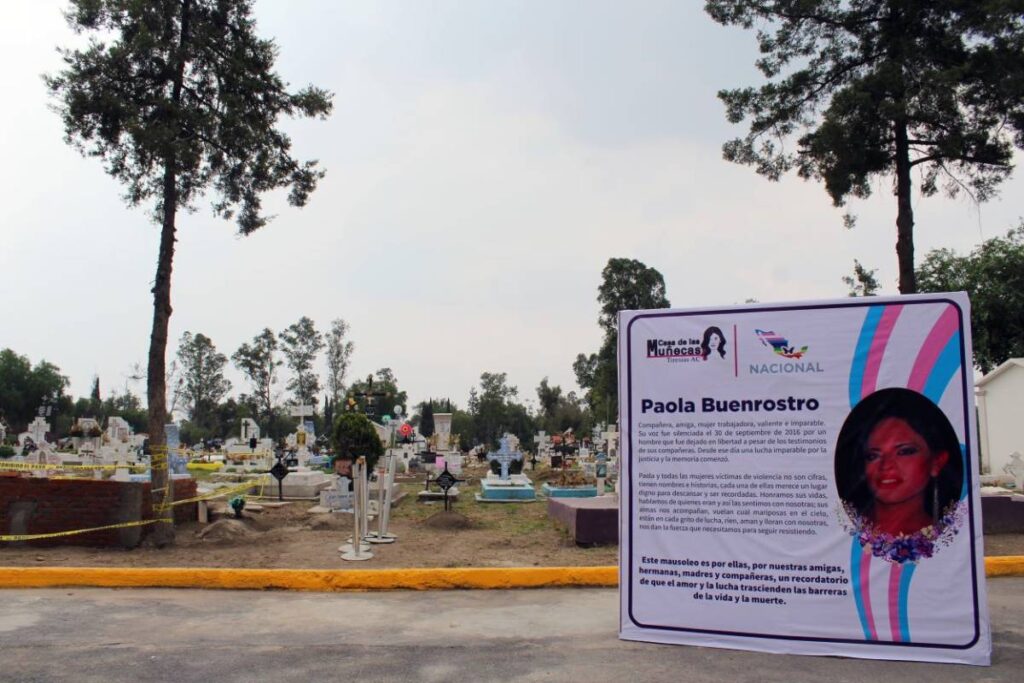
“True death is oblivion, and there is no oblivion here. There is struggle, there is resistance, and a lot of work to end discrimination and violence,” Brugada said. As of September 16, the mayor will leave her post to compete for the Morena party's nomination for head of government of Mexico City.
The foundation stone of the site was laid on May 22nd , and it was inaugurated on September 14th. In the coming days, a process will begin to exhume the remains of transgender women, which will be transferred to the mausoleum.
The right to die with dignity is also a subject of debate.
“We only recognize certain lives as human and as real. And this happens because there are conceptual frameworks that determine what we are capable of recognizing,” she explained. She quoted philosopher Judith Butler—Nashieli Ramírez Hernández, head of the National Human Rights Commission of Mexico City.
“Butler calls for a critical examination of the conceptual framework that dictates which lives should be mourned and which should not . All lives, everyone, and all genders deserve to be mourned ,” Ramírez Hernández continued. She also noted that the Mexico City Attorney General's Office—according to information requests—has opened 133 preliminary investigations for the crime of transfemicide.
For her part, Geraldina de la Vega, head of the Commission to Prevent and Eradicate Discrimination (Copred), said that trans women continue to be at the center of violence. But there must be no backsliding on the advancement of their human rights. At the national level, and especially in Mexico City, the local Constitution recognizes them.
“Trans women have the right to occupy all spaces and also a dignified space for death,” she said in her speech.
Also present at the Mausoleum's handover were Jaime Morales, director of sexual diversity and Human Rights at the Secretariat of Inclusion and Social Welfare of Mexico City; Oyuki Martinez, coordinator of the Comprehensive Health Unit for Trans People (USIPT); and trans activist Andrea Luna, from the collective For the freedom to say and decide.
We are present
We are committed to journalism that delves into the territories and conducts thorough investigations, combined with new technologies and narrative formats. We want the protagonists, their stories, and their struggles to be present.
SUPPORT US

FOLLOW US
Related notes


We are present
This and other stories are not usually on the media agenda. Together we can bring them to light.