

Myrian Villalba: “We are fighting for the Paraguayan state to recognize this double infanticide.”
The mother and aunt of the two girls murdered by the Paraguayan armed forces continues her search for justice and her plea for the safe return of her niece Lichita.


Share

BUENOS AIRES, Argentina. On September 2, 2020, the then-President of Paraguay, Mario Abdo Benítez, spoke triumphantly at a press conference about the operation carried out by the Paraguayan Joint Task Force in the vicinity of Cerro Guazú, Concepción , celebrating the deaths of two girls. He described it as a confrontation with members of the Paraguayan People's Army. However, it was an operation in which they kidnapped, tortured, and killed María Carmen and Lilian Mariana Villalba , two eleven-year-old Argentine girls who were visiting their parents in the area, exercising their right to identity.
In the operation, the girls' aunt and mother, Laura Villalba, along with her 14-year-old niece, Carmen "Lichita" Villalba, witnessed the events that the Paraguayan government, through the Public Prosecutor's Office, attempted to cover up. Laura, a nurse who graduated in Paraguay, was working at a clinic in Argentina. Today, she is imprisoned on two charges, one of which lacks legal basis, and the other entangled in traps set by the justice system itself. Lichita is missing.
The Villalba family has suffered persecution at the hands of the Paraguayan government for over 20 years, where the practices of the military dictatorship (which ended there in 1989) persist within the security forces and in the close relationship and intervention of the state in the judiciary. With one of their sisters imprisoned since 2003 ( Carmen Villalba , Lichita's mother, who completed her sentence two years ago but remains in prison), the family was forced to move to Argentina. They first arrived in Clorinda, where the police chased Carmen's 12-year-old son, doused him with poison, and killed him. This prompted the family to move to Puerto Rico, Misiones, from where they had to leave in early 2022 because their lives were in danger—a danger institutionalized by the Paraguayan government.
Arrested for searching for her niece
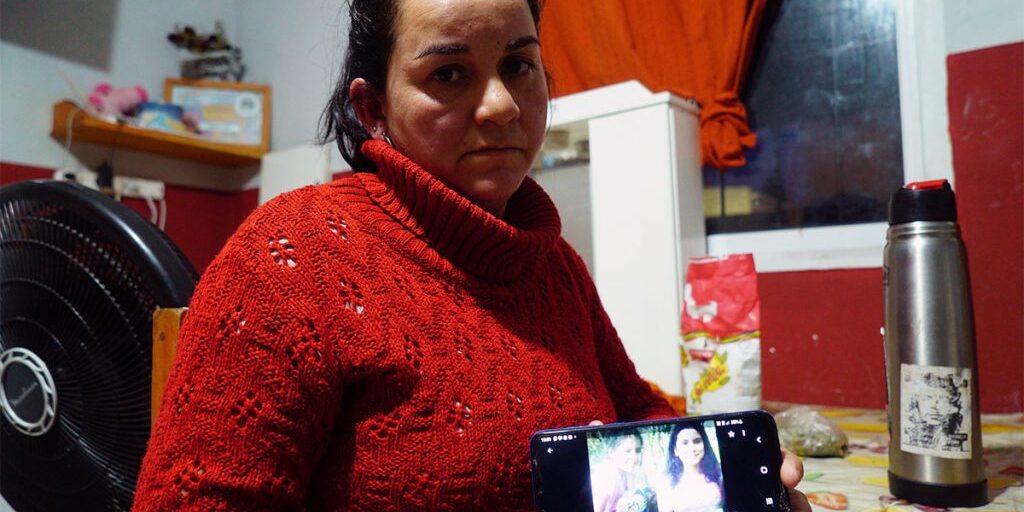
Saturday, September 2nd, marked three years since the girls' murder. Myrian Villalba, mother of Lilian Mariana and aunt of María Carmen and Lichita, now lives with her children and her sisters' children. Her life changed drastically on that September 2nd when the girls were killed. She is leading the campaign demanding Lichita's safe return and Laura's release, and there is an arrest warrant out for her for "breach of duty of care and domestic violence," one of the charges for which Laura is being held.
–What is Laura's current situation?
Laura faces two charges. Her trial for breach of duty of care, education, and domestic violence was scheduled for August 23rd and 24th, but this is the third time it has been postponed at the prosecution's request. The Paraguayan state claims she is responsible for our girls being in that place on September 2nd. This is absurd, because the military and police captured our girls alive. That is the trial Laura should have faced. It was postponed because one of the three prosecutors "wasn't feeling well." At the preliminary hearing, the defense was not allowed to present evidence, even though our new Criminal Procedure Code and the National Constitution guarantee the full scope of evidence. One piece of evidence is the case file investigating the double infanticide of Lilian and María Carmen.

–How was Laura's arrest?
23rd while searching for Lichita, who was last seen on November 30th. She was arrested without a warrant or criminal record. Her transfer and pretrial detention were immediately ordered. There is no precedent in Paraguay for a civilian woman being held in a military barracks. Laura was kept under 24-hour surveillance, allowed out of her cell for one hour, but alone and without contact. This continued until the National Mechanism for the Prevention of Torture and a request was made to the United Nations. Once the request was made, they decided to transfer her to the San Juan Bautista Regional Penitentiary in Misiones, where access to care is extremely difficult. In Paraguay, incarcerated individuals have to cook for themselves if they want to eat. There is no state assistance for each prisoner there; their families are the ones who worry about keeping them alive and feeding them. If they get sick, they also have to provide medication.
–How long had the girls been there?
"She took a vacation and went to Paraguay to take the girls with her. We always try to ensure they know their father, that they have that family relationship, even if it's sporadic. We didn't realize what could happen, because Paraguayan intelligence, in a subsequent press conference, admitted that as soon as they arrived in Encarnación, they began following her and the girls . In other words, they always knew where they were. They took advantage of this to mount that operation on September 2nd and attack the place. They took them alive; one was wounded, but the other wasn't. We know they were taken alive. Later, we received photos of the girls in uniforms (that they had put on them) with cuts and signs of torture."

The army's lies
The Covid pandemic was the perfect excuse for the Paraguayan armed forces. They burned the uniforms and threw the small bodies of Lilian and María Carmen into mass graves as part of an anti-Covid “protocol.” From there, they managed to recover the girls' remains to conduct at least a preliminary examination. Two forensic doctors saw them. The first didn't even examine them and said the girls were between 17 and 18 years old. The second barely looked at them and had to acknowledge that the victims murdered by the Paraguayan government were children.
Lichita, one of the girls, aged 14, was also wounded in the operation. She managed to escape along with her aunt, another cousin, and her twin sister, who has already testified before the Geneva Children's Committee. After her disappearance, her aunt Laura began searching desperately for her until she was imprisoned on December 23.
Twenty days earlier, Human Rights Watch (HRW) had asserted that Paraguayan authorities " destroyed crucial evidence and committed other serious irregularities " in the investigation. In that report, the organization maintains that the deaths of the two 11-year-old girls were caused by state security forces. It also stated that Paraguayan authorities violated both their own investigative protocols and international human rights standards. HRW recommended an independent investigation, which has yet to take place.
–What were you able to reconstruct about Lichita?
–Nothing. We know nothing about her until November 30th. She was injured because she was grazed on the head and had another wound on her leg. She and Laura were trying to get out of there, but they were cornered. Lichita's twin sister and her other cousin did manage to escape, but we don't know anything about her. Her sister and cousin later found little letters and notes that Lichita had written to her mother in the area where she was last seen. But nothing more than that.
–What is the work of the armed forces like in that area?
"It's an area of indigenous communities that have been forgotten and historically neglected by the state. There's a lot of fear because the area is militarized. They've tried to help the girls who were traveling through there, but it's difficult because drug trafficking is also very strong. We're talking about a border with Peru, Brazil, and Paraguay; it's an area heavily harassed by the military and drug traffickers."
–What's striking is that they are women and they are girls, what is the relationship?
“I’d say they have something against children. At one point, our houses were raided at least once a month. During those early raids, the first thing they looked for were photos of the children, not ours. It’s the same now; there were men and women in this camp, but they decided to grab the two girls. That’s why we keep fighting for this double infanticide to be recognized. ”

Accompaniment
Despite the fact that it has been proven that the government killed the two 11-year-old Argentine girls, the Villalba family received no institutional support.
“It’s a top-down system. Everyone follows orders from above, so they have no intention of actually investigating,” Myrian says. “Or in the case of the Children’s Ombudsman, they’re not going to file a formal complaint against the military either. There are many things we don’t know; for example, they may have even abused our girls, but we don’t know because there was no investigation. I’m sure there isn’t even a case file in that case. We demand that file be released, but so far, nothing has been heard.”
This isn't the only case in Paraguay recently, Myrian says. She recalls that just a few years ago, a teenage boy was killed by the security forces, and the crime was never reported. She also remembers a peasant leader who was shot 50 times at his doorstep. The situation in the country also puts a damper on civil society organizations.
“On September 2nd, when our girls were killed, there was a spontaneous demonstration in front of the Pantheon of Heroes. The next day, everyone who participated in that demonstration was prosecuted. Some even had to request political asylum. And we're talking about 20 or 30 people. With the fear that exists in Paraguay, they can fabricate a case against you without any evidence and frame you or label you under the Anti-Terrorism Law,” he says.
In the case of Argentina, she received support in requesting the bodies of the girls and also in obtaining political asylum in the country.
This article was originally published in Tiempo Argentino .
We are present
We are committed to journalism that delves into the territories and conducts thorough investigations, combined with new technologies and narrative formats. We want the protagonists, their stories, and their struggles to be present.
SUPPORT US

FOLLOW US
Related notes



We are present
This and other stories are not usually on the media agenda. Together we can bring them to light.