

Guatemala: Social movements on alert over the suspension of Semilla, the progressive party that won the elections
The OAS also spoke out to denounce the violation of the electoral law and constitutional principles.


Share

GUATEMALA CITY, Guatemala. The Citizens Registry of the Supreme Electoral Tribunal suspended the Semilla Movement yesterday, minutes before the official results of the runoff election were announced, declaring progressive candidate Bernardo Arévalo the winner. He obtained 60.9% of the vote against Sandra Torres of the National Union of Hope (UNE).
This sparked local and international condemnation. The Organization of American States (OAS) stated that it constitutes a violation of the law and constitutional principles.
The decision to suspend the Semilla Movement “was made without any basis or duly demonstrated reason.” Its general secretary, Luis Almagro, asserted that it is “an abusive interpretation of the law.” “ They intend to suspend its rights after the election in which it enjoyed broad popular support for the political party of the president-elect.”
At a press conference, Arévalo and Herrera said they would file an appeal against the decision of the Registry of Citizens. Arévalo explained: “This is a historic moment for a people who turned out in droves to the polls and then took to the streets and squares throughout the country to celebrate the beginning of a new democratic spring.”
The Semilla Movement is being politically persecuted by the Special Prosecutor's Office Against Corruption, a section of the Public Ministry that has no jurisdiction over electoral matters. They allege that signatures were forged as early as 2018 to register the party. However, the case remains sealed, and the party has not had access to the court file to properly defend itself.
Ancestral authorities speak out
The board of directors of ancestral authorities of the Department of Totonicapán expressed its deep concern about the serious social and institutional crisis caused by the actions of the Public Ministry, the Special Prosecutor's Office Against Impunity and the Seventh Criminal Court.
"We express our deep concern regarding the serious political and social crisis caused by the judicialization of the electoral process, which includes the criminalization of members of the Supreme Electoral Tribunal and the Semilla Party. This is contrary to the Guatemalan Constitution and human rights. We call on the central government to cease deploying the Army in the streets, where it poses a threat to the civilian population who are peacefully protesting. We also call on the Constitutional Court to act as a true guarantor of the rule of law."
“Both the registrar and the prosecutor’s office overstepped constitutional norms. We are talking about a crime against the Constitution itself and the rule of law. The only thing left to do is for the Supreme Electoral Tribunal (TSE) to step up and set things right,” Marisa Batres, a lawyer and human rights advocate, told Presentes.
Persecution of journalists and human rights defenders
"The situation is quite worrying because three elements have recently intertwined, and all three violate basic rights. First, there is a lack of respect for fundamental electoral principles such as the popular will and the integrity of the electoral process. The principle of popular will is being violated because the people's decision at the ballot box is not being respected."
The second factor that has converged at this moment is the desire to silence and suppress the voices of dissidents, including communicators, journalists, activists, and human rights defenders, who speak out primarily on Twitter, or what used to be called Twitter and is now X, through a writ of protection filed by the Attorney General because she feels that the principles of the Public Ministry of objective and autonomous criminal prosecution are being violated, and that the fact that Twitter users are demanding her resignation puts the administration of justice at risk.
"And the third point is the continued and sustained trend of criminalizing human rights defenders, the excessive and unresolved preventive detentions, and in this case I am referring not only to the case of lawyer Claudia González, which has been an alarming case, but also to that of the former assistant prosecutors," Flor de María Salazar, national coordinator of the Cristosal organization in Guatemala, told Presentes.
The outgoing president accepted Arévalo's victory.
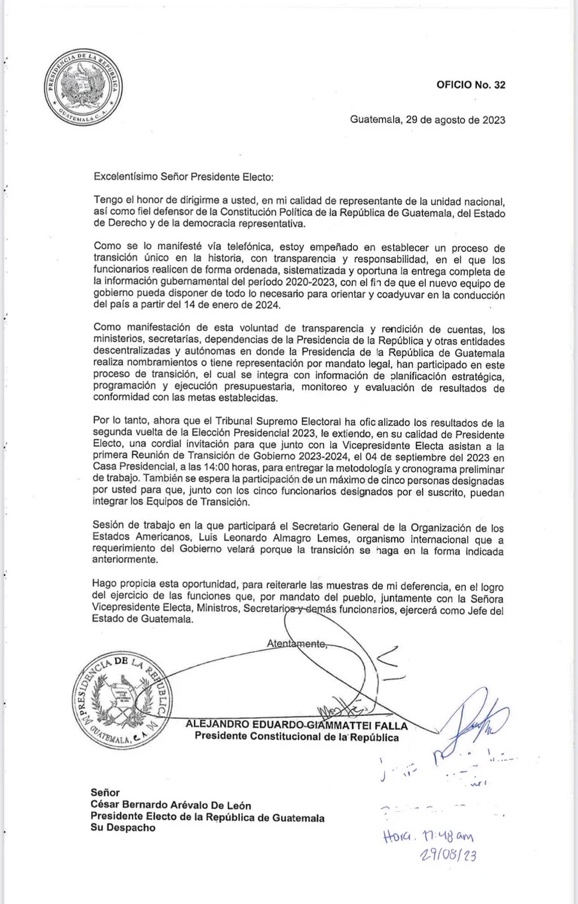
In a parallel action, outgoing President Alejandro Giammattei has accepted Arévalo's victory and extended a letter of invitation to him to officially begin the government transition.
A progressive party
The Semilla movement emerged in 2015 as a result of the citizen protests that ousted then-President Otto Pérez Molina, who was accused of corruption. It originated within social movements as a progressive party that identifies as social democratic. On August 20, in a runoff election, the presidential ticket of Arévalo and Herrera won, defeating the UNE, a party accused of illicit financing and distributing money and food in exchange for votes. The social organizations and citizens who voted for them had hoped for a new " democratic spring " in Guatemala.
Although a work agenda with the LGBTQ+ community is not explicitly mentioned in the government program, sexual diversity organizations have given their support to the party and have expectations since the president-elect has publicly stated that his government will not allow discrimination and will fight for the rights of all people.
We are present
We are committed to journalism that delves into the territories and conducts thorough investigations, combined with new technologies and narrative formats. We want the protagonists, their stories, and their struggles to be present.
SUPPORT US

FOLLOW US
Related notes


We are present
This and other stories are not usually on the media agenda. Together we can bring them to light.