

2000 complaints filed with the Ombudsman's Office against Fabián Doman's program for mocking Kantuta Killa and Wari Rimachi
The harassment of two members of the Ayllu Mayo Wasi Community took place in a subway and was broadcast by channel 13.


Share

[UPDATE Tuesday 29/8]
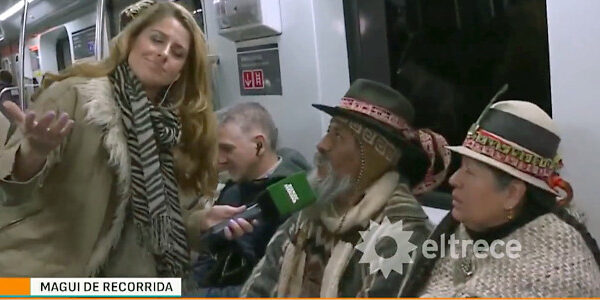
Channel 13 program "Bien de Mañana" and journalist Fabián Doman became trending topics on social media this weekend for their mockery of Kantuta Killa and Wari Rimachi, a couple from the Ayllu Mayo Wasi community. Reporter Maggie Vigil approached the couple while interviewing them on the subway, and when the man responded in his native language, she mocked him. The panelists on the show and host Doman then joined in the mockery. The ridicule and harassment continued when the reporter asked the woman who she had voted for. Several media outlets condemned the journalists' actions on social media, and since then, the Ombudsman for the Public, the agency responsible for protecting audience rights, has received over 2,000 complaints since Friday the 25th and has contacted the program's production company.
The Ombudsman's Office's Directorate of Analysis, Research and Monitoring defined the communicative approach developed by the journalists of the program as "disrespectful, mocking and ridiculing".
For its part, the National Institute against Discrimination, Xenophobia and Racism (INADI) is working together with the Ombudsman's Office and will receive the couple at noon today to follow up on their complaint.
Trivialization of the native culture
The Ombudsman for the Public, Miriam Lewin, speaking from the city of Salta, where she coordinated a workshop today with journalists on the responsible media coverage of issues related to Indigenous peoples, stated that the Ombudsman's technical teams are working on the matter. “Indigenous communities expressed their concern about the content of a television program that trivializes their culture and language. At the Ombudsman's office, we also work to promote media outlets managed by the communities themselves, so they can have their own voice. This also guarantees democratic communication for the entire population, not just for Indigenous peoples,” Lewin explained .
She also noted that the Ombudsman's office has prepared Recommendations for Media Coverage of Indigenous Peoples, which can be consulted here .
The couple
According to the Télam news agency, the couple consists of Kantuta Killa and Wari Rimachi, "elders" of the Ayllu Mayu Wasi indigenous community , located in the Buenos Aires town of Villa Martelli. Kantuta Killa is a lawyer by profession and retired from her position as an officer of a national court, where she worked for 30 years.
Both were approached by the reporter while traveling on Line D of the Buenos Aires subway. They were going to the courthouse to show their support for the Third Peace March, which has been waiting outdoors for 25 days to be heard by the Supreme Court of Justice of the Nation. This delegation, representing dozens of Indigenous communities, traveled from Jujuy to ask the courts to declare Governor Gerardo Morales's reform unconstitutional and to request federal intervention in the province due to human rights violations against all those protesting the government.
The couple told Télam: "It's not just the reporter who acts this way, but a segment of the population that unfortunately doesn't understand that there are others who are different , that there are pre-existing peoples with different codes, different ways of being, and different interests. Even so, although we have different values and principles, beliefs, or interests, we respect them and at no time do we speak to them in that way, nor are we laughing at them as they laugh at us."
According to Télam , Kantuta and Wari are members of the Council of Indigenous Amautas of Tawantinsuyu in Argentina and Cosindia (Council of Indigenous Healers of Argentina), among other organizations. They are also part of the Waka Luna cultural center in Villa Martelli, where they offer workshops on the Quechua language, Andean instruments, and ancestral Indigenous medicine, and officiate ancestral ceremonies.
*To file a complaint with the Ombudsman's Office, you can fill out this form.
Recommendations from the Ombudsman's Office for addressing indigenous issues
Use respectful and precise language and avoid derogatory terms in your coverage.
Avoid folklorization and paternalistic or patriarchal discourses .
"Folklorization in audiovisual media is a reductionist approach that highlights the artistic and cultural virtues of Indigenous peoples from an external perspective ."
The Ombudsman's Office suggests " not sensationalizing their ancestral practices or associating them with backwardness or reducing them to mere aestheticization. Indigenous peoples are dynamic cultures that, since time immemorial, have contributed innovations in knowledge."
They recommend "encouraging representations that do not exclusively glorify conditions of poverty, precariousness, and other forms of social and economic vulnerability ."
"Responsible coverage means addressing Indigenous issues from a framework that considers their rights and interests ."
We are present
We are committed to journalism that delves into the territories and conducts thorough investigations, combined with new technologies and narrative formats. We want the protagonists, their stories, and their struggles to be present.
SUPPORT US

FOLLOW US
Related notes


We are present
This and other stories are not usually on the media agenda. Together we can bring them to light.