

The odyssey of non-binary people to obtain their identification documents in Mexico
Non-binary activists denounce that they were not consulted about the changes to recognize their identity in documents.



Share

MEXICO CITY, Mexico. In Mexico, various identification documents are issued that express the gender identity of non-binary people with an 'X' in the "sex" section. Activists denounce that these decisions were made without prior consultation with the non-binary population, but there are also non-binary people who see this as progress toward having their identity recognized.
Several documents exist in Mexico to verify a person's identity. These include the voter ID card, issued by the National Electoral Institute (INE) ; the birth certificate, issued by the Civil Registry; the passport, issued by the Ministry of Foreign Affairs (SRE) ; and the Unique Population Registry Code (CURP) , issued by the Ministry of the Interior , among others. Each of these documents uses a specific language and format.
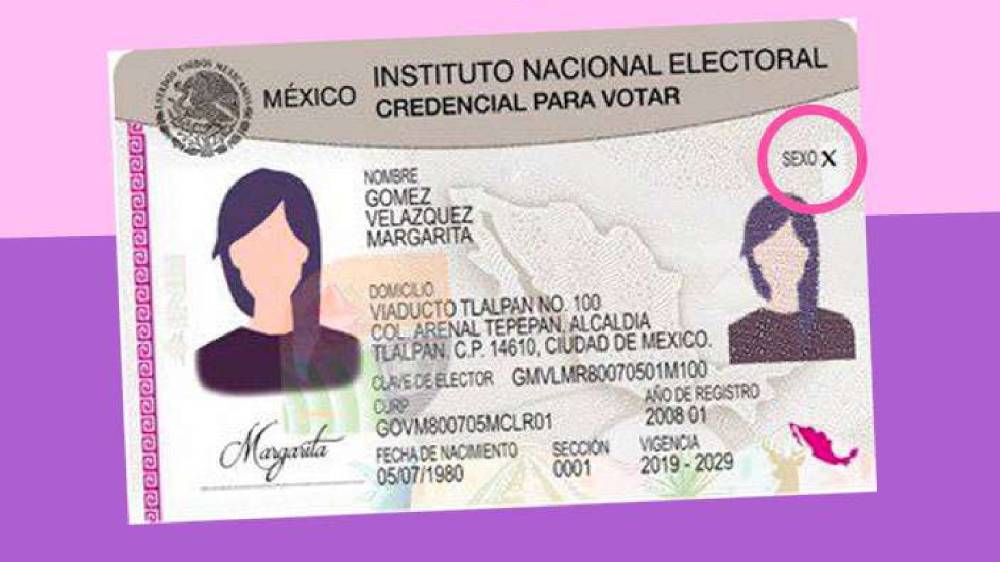
Recently, the INE and the SRE issued the voter ID and passport, respectively, that recognize non-binary identity with an X´' in the "sex" section.
These affirmative actions aimed at inclusion, as the institutions have called them, have generated mixed opinions among non-binary people. They have also sparked complaints that the institutions failed to create spaces for listening to this population and understanding their needs.
“The first thing that bothered us was, why mark our identity in the sex box? It’s a problem because non-binary identity is a gender identity. During the discussion, some INE officials kept confusing sex with gender. It’s serious,” says Alex Argüelles, a non-binary person and technologist at Comun.al .
Presentes consulted trans and non-binary people located in different states of the country to learn their perspective on these measures.
The State generates identification documents but does not guarantee their validation.
Ten years have passed since the first gender identity law for transgender people in Mexico was enacted. While progress has been made in this area, it is still not guaranteed throughout the country. Transgender adults are recognized in 18 of the 32 states, and only 3 states recognize transgender children and adolescents .
For non-binary people, the path to having their identity recognized on official documents is relatively new. Only the state of Hidalgo legally recognizes non-binary people , but this only applies to those born there ; therefore, most obtain their birth certificate through strategic litigation and legal injunctions.
Despite this decade of progress, trans and non-binary people still face obstacles in having their gender identity fully recognized by state institutions. The biggest obstacle is the state's failure to provide accessible pathways for legal recognition.
“The Mexican state generates a lot of identification documents that, in theory, speak to your identity, but they aren't consistent with each other. And in the end, it's the individuals and civil society organizations that support them who bear the burden of resolving the standardization process . The state isn't capable of providing a clear path on how to standardize your documents,” Argüelles explains in an interview with Presentes.
“This credential doesn’t make me visible, it doesn’t name me; and what isn’t named doesn’t exist.”
Non-binary people seeking these documents are facing obstacles in the homologation process.
Edie Blue, a non-binary person from Nuevo León, told Presentes that having their birth certificate, which they obtained after an injunction, and their CURP, which took a year to obtain, had a significant impact, especially when accessing health services.
Edie's birth certificate was issued with the notation "Non-Binary" in the sex field. When her CURP (Unique Population Registry Code) was updated, this information was classified with an X instead of M or M. Because the two documents did not match in the "sex" field, Edie had to wait longer for the Civil Registry to issue a new birth certificate with the corrected information.
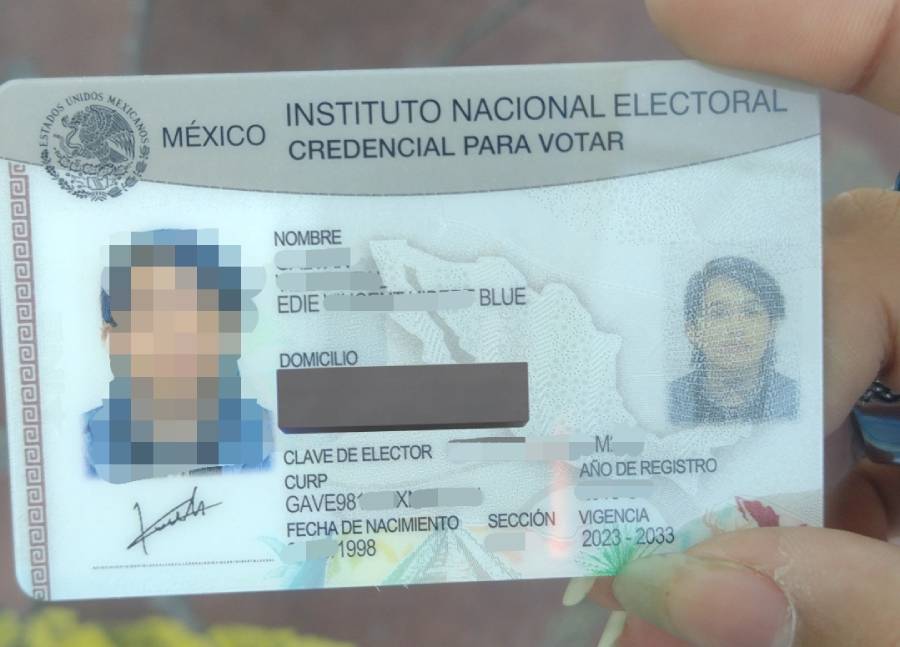
Her birth certificate and CURP now say 'X'. But with the new INE regulation, even though Edie presented these documents, the information about her gender identity in the four boxes where "sex" appears does not match on her voter ID card.
“I requested that the X be visible in the sex field on my voter ID card. For me, that’s important because it’s a way of reclaiming my identity. When they gave me the card, I noticed that the voter ID number still shows the letter corresponding to my sex assigned at birth, not the X. It bothers me because I can’t wait any longer for this process; they ask for the voter ID card for everything. My voter ID card doesn’t represent me; this card doesn’t make me visible. It doesn’t name me, and what isn’t named doesn’t exist,” Edie adds.
The INE voter ID card has four gender markers. How does this affect non-binary people?
In May, the INE reported that it had issued 58 "non-binary voter ID cards" up to that month. Sixty-three applications were submitted, 14 with a birth certificate and 49 without.
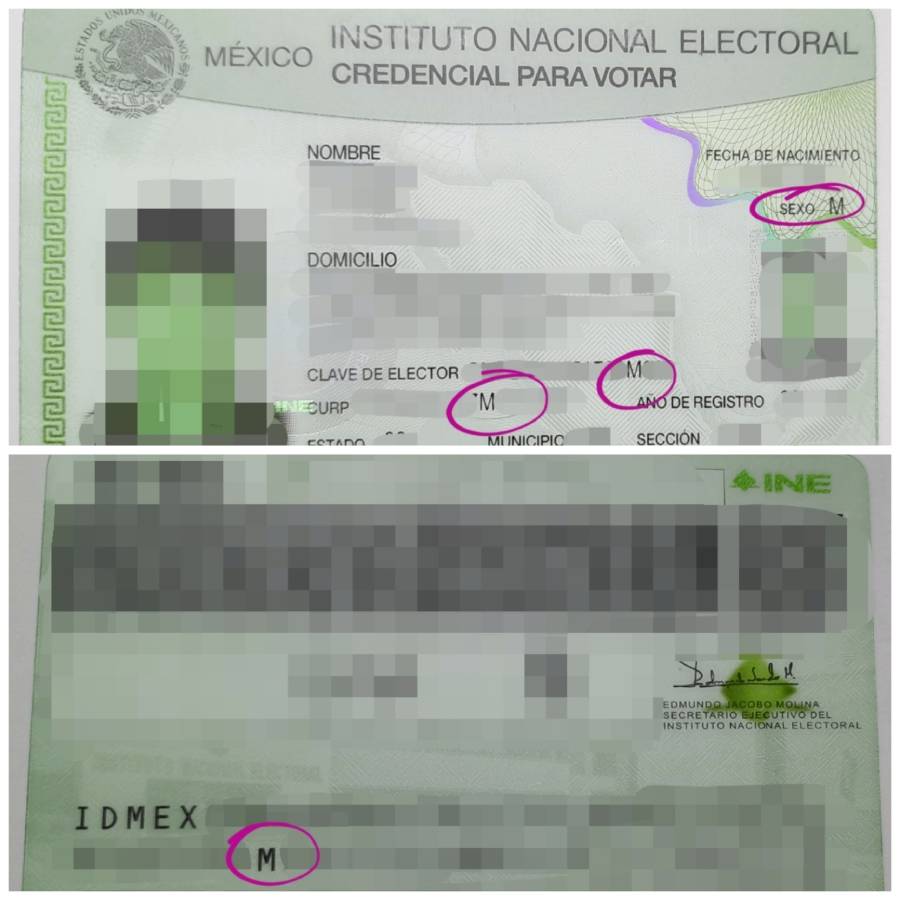
The voter ID card has four sex markers: in the "sex" box —which any person, regardless of their gender identity, can decide whether or not to make visible—; in the voter ID number; the CURP; and in the Optical Character Recognition (OCR) code.
Although the Electoral Council determined that the identity recognition process at its INE is guaranteed without presenting documents that support their gender identity; this measure has different effects, depending on what other identification documents they present at the service module.
- If you don't have a birth certificate or CURP (Mexican national ID number): your non-binary identity will only be reflected with an 'X' in the sex field. However, the other gender markers on the INE (Mexican National Electoral Institute) form will show M or H, depending on the gender identity you were assigned at birth; the same applies to your name.
- Procedure with rectified birth certificate and CURP: the INE must necessarily standardize this data on your voter ID: your name, the 'X' must appear in the four gender markers: in the sex box; the voter ID, CURP and OCR code (the numbers on the back of your ID).
The INE and the NB Passport did not arise from a demand from the non-binary population
On February 27, the General Council of the National Electoral Institute (INE) approved by majority vote the incorporation of the letter 'X' in the "sex" section of the voter ID card "that recognizes non-binary people."
The INE's decision to issue these credentials stemmed from the challenge to the lawsuit for the protection of political-electoral rights issued by Ociel Baena, an electoral magistrate of the state of Aguascalientes, known for being the first non-binary person to hold a magistracy.
Three months later, on the International Day Against LGBTI-Hate , Marcelo Ebrard, still serving as Mexico's foreign minister - and who today seeks to be a presidential candidate for the Morena party - delivered the first Mexican passport with an 'X' marker for people who identify as non-binary.
The Ministry of Foreign Affairs celebrated that Mexico “joins the list of 16 countries in the world that allow people to have a passport with the option of not identifying with the binary gender.”
A partial inclusion
When this news broke, opinions were mixed. Some non-binary people commented that they felt this was a case of "false inclusion" because no institution had engaged in dialogue with non-binary individuals. Others celebrated it and saw it as an opportunity for their gender identity to be recognized.
“For me, it’s important that our country is opening up to this opportunity so that we can access certain documents with a non-binary identity. I think it’s very important that this exists because it shows that if these changes are already happening, it’s because we’ve made ourselves visible in the past. And that has impacted the present moment,” Peach, an artist from Guadalajara who already has her INE (National Electoral Institute ID) Presentes
Both the INE agreement non-binary passport arose from a judgment issued by Ociel Baena as a private citizen and after "a predatory electoral campaign by Marcelo Ebrard," according to Alex Argüelles.
The background
The first non-binary voter ID card and passport were delivered to Ociel Baena. They also have a birth certificate and CURP (Unique Population Registry Code) that validate their gender identity. Presentes asked the magistrate their impressions regarding the obstacles that most trans and non-binary people in Mexico face when trying to obtain and validate these documents.
“ We are living in times of firsts, and it is very unfortunate that we are only now receiving these documents that recognize our non-conventional gender identity. Not everyone can access these documents, which are also expensive and time-consuming. I acknowledge the progress made by the INE (National Electoral Institute) after an appeal I filed two years ago. The progress regarding passports must also be recognized. It wasn't achieved through a court ruling, but rather, to sum it up in two words: the political will of Marcelo Ebrard.”
She was also asked whether, as a public official, she felt obligated to open spaces for dialogue with non-binary people to learn about their urgent needs and concerns.
“My role as a judge is to issue rulings on political and electoral matters affecting the general public . The lawsuits that have had repercussions and changed the paradigm for the recognition of our non-binary identity stemmed from personal disputes that are intertwined with my non-binary identity . My comment may sound harsh when I say that I was not obligated to consult any non-binary community. These are issues on which we are making progress. I have always said that: an achievement for one is an achievement for all,” the judge responded in an interview with this publication.
Experiences of non-binary people
“I’m so glad to have her, she makes me feel more secure,” Peach
“I was nervous about saying what I was there for, but they helped me and were very kind. The whole process took a month and two weeks. I feel that having this ID card makes me feel more secure, especially in situations where it's required, like at the doctor's office. But it's also made me think a lot about the situations in which I want to use it . Overall, I'm very happy to have it; it makes me feel comfortable, and I appreciate that it doesn't show M or H, and I happily accept X. I think this contributes to other processes that benefit the visibility of non-binary people.”
Peach is an artist and processed her voter registration card in Guadalajara at the INE module in the Moderna neighborhood.
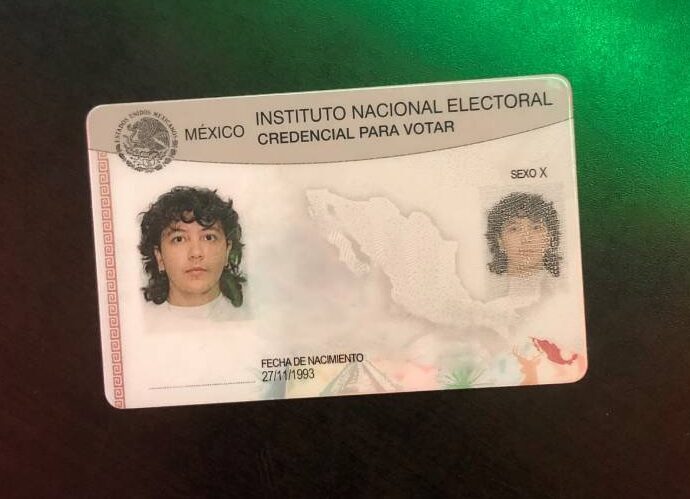
“They took credit for affirmative action and played with our hopes,” Paline
Paline is an LGBT activist. She says that when the INE (National Electoral Institute) announced the ID card, she didn't hesitate to apply for it. "I see it as useful in cases of discrimination where our identity is denied. With the ID card, I might be able to navigate those conversations, which are often very difficult, more easily. For example, so they don't give me any trouble when I'm trying to get admitted to a gynecology program," she says.
When he went to process his credential, they told him, " We don't have that option yet ."
“I waited about a month after the INE (National Electoral Institute) launched its non-binary registration campaign. When I went to the office, they told me, ‘That can’t be done. The only thing you can do is leave the sex field blank.’ That response left a very bad taste in my mouth because it’s exactly what systematic invisibility looks like. It saddened me that the staff wasn’t trained. And I think, if this happened to me in Mexico City, what will happen in other states? With the INE and the passport program, they took credit for affirmative action at the expense of our hopes. Many of us were really excited about this.”
“Having an INE (National Electoral Institute) card that verifies my identity would mean not having to explain who I am all the time,” Sussy
“I went to the nearest module here in Puerto (de Veracruz) and they told me that this procedure 'did not exist'. I showed them articles on my cell phone that said it did exist, that the INE said it could be done without the birth certificate and they replied no.”
Sussy, a dancer and pole dance , lives in Veracruz. She says that having an ID that "verifies" her identity would mean "not having to explain who I am all the time."
“My gender expression fluctuates a lot between masculine and feminine. I’ve already been attacked in bars, misgendered in dance studios and places where I go to look for work. I truly believe that, until I can have a birth certificate that says I’m neither a man nor a woman, the INE (National Electoral Institute) could more or less help prevent me from being discriminated against so much. Especially when it comes to work.”
“Not consulting the NB population was a mistake.”
For her part, Rebeca Garza, a trans activist, co-founder of Queretrans and former electoral official, told Presentes that "these measures are not benefiting precarious non-binary people."
“Not consulting the non-binary population was a mistake on the part of the National Electoral Institute (INE), the Ministry of Foreign Affairs, and also Ociel Baena. I believe that when working at a public level and carrying your identity with you everywhere, as you do, it is necessary to reach out to these communities and engage with them. Failing to do so is to benefit from manipulation and a hermeneutical illusion,” Garza concluded.
We are present
We are committed to journalism that delves into the territories and conducts thorough investigations, combined with new technologies and narrative formats. We want the protagonists, their stories, and their struggles to be present.
SUPPORT US

FOLLOW US
Related notes
We are present
This and other stories are not usually on the media agenda. Together we can bring them to light.