

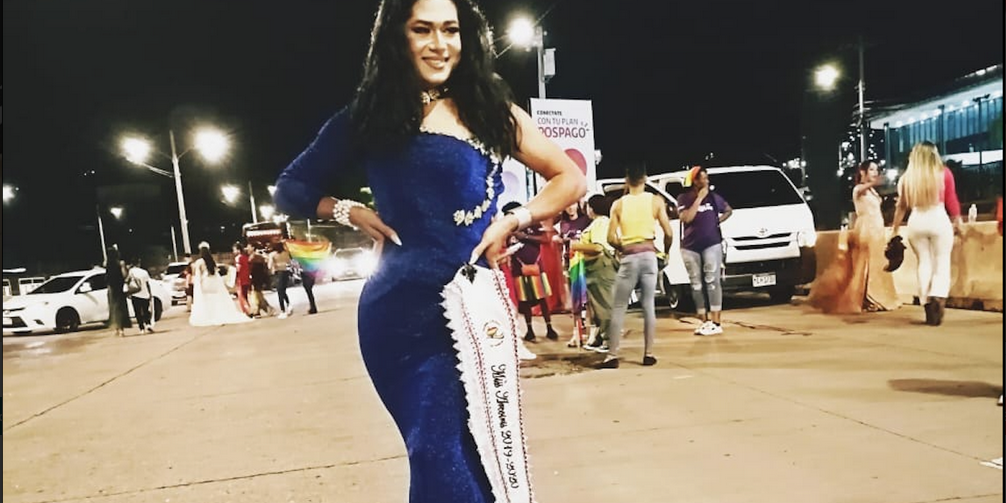
Trans activist Megan Kerr, run over at Pride Parade in Tegucigalpa
“I was inches away from that car running me over and breaking my legs,” said Megan Kerr, from Arcoíris Honduras.


Share

Kate Orellana, Eva Galeas, Amílcar Cárcamo, Daniela Palma and José Manuel Serén contributed to this report
TEGUCIGALPA, Honduras. “Watch out!” they shouted. Those attending the 2023 LGBTIQ+ Pride March in Tegucigalpa, central Honduras, watched as the silver Honda sedan accelerated down the wet street, kicking up a spray of rainwater. They continued screaming as the car struck Megan Kerr and came to a stop a few meters ahead. For a few seconds, they thought the violent impact had ended in tragedy.
It was 7:40 p.m. on Saturday, July 29. The driver took the main road instead of the alternate route on Suyapa Boulevard, near the National Autonomous University of Honduras, and collided with a motorcyclist before hitting Megan. “The guy accelerated the car and ran her over,” added a witness shortly after the accident that nearly caused a tragedy at the end of Pride 2023 .
Megan's dress was caught under the car's wheels. She couldn't move. She was trapped beneath the heavy vehicle. People at the march immediately threw themselves onto the silver Honda to prevent the driver from escaping. "Let's push the car back. Don't let him get away!" they shouted.
The driver, a bearded man wearing an ochre t-shirt and green pants, whom many people on social media identified as “Barba Juca,” got out of the car when he found himself surrounded by protesters. “He was drunk,” many of those present later confirmed.
Reportar Sin Miedo has not yet been able to independently identify the identity or social media of the person who ran over Megan, who is a member of the Arcoíris Honduras .
We requested information from the Traffic Police regarding the accident, but there is still no official report on the case. The first hearing is expected to take place this week.
While preventing the attacker from escaping, Pride participants tried to push the silver Honda to free Megan. Despite the shouts of outraged onlookers and the trans activist's cries, the driver refused to move the car . Instead, he began behaving erratically and took off his shirt while arguing with the people surrounding his vehicle.
"I was inches away from being run over."
“By a miracle, the car didn’t hit my feet or run over me,” Megan told Reportar sin Miedo exclusively after the accident. “People started moving the car backward and managed to pull me out. It hit my knee and hip.”
Paramedics arrived shortly after and told Megan she didn't need to be hospitalized, but that she would have physical problems due to the accident. "I've been having pain in my hip and knee," she said. "I was inches away from that car running me over and breaking my legs."
For Esdra Sosa, director of Arcoíris, the attack on Megan was more than just an “act of transphobia.” Meanwhile, for Angie Orellana, leader of AFET and Frida Trans, participating in Pride in Tegucigalpa meant exposing herself to danger. “We were afraid they would run us over with a car or shoot us. We know about the hatred fueled by anti-rights groups against our orientations, expressions, and identities.”
“It took forever for the traffic police to arrive,” Megan Kerr added. When authorities arrived at the scene of the accident at 9:00 p.m., the person responsible for the hit-and-run “started harassing the officers. So they arrested him and put him in the patrol car.”
However, the hatred that almost ended Megan's life had only just begun.
Threats and hate speech
Less than two hours had passed since Megan Kerr was run over during the LGBTIQ+ Pride parade when the attacks on social media against the life of the trans activist and the journalistic team of Reportar sin Miedo began.
The reason? Having reported the hate messages after Megan's hit-and-run.
The hateful attitudes of the owners of several accounts flooded Twitter with more than 50 comments that included insults, death threats , and pornography directed against journalists from the inclusive digital media outlet.
Some of the comments threatened the journalistic team and sexual dissidents with running them over, hanging them from a bridge, or planting a bomb.
Consequently, Reportar Sin Miedo issued an alert condemning the attacks against Kate Orellana, Eva Galeas, Amílcar Cárcamo and Dunia Orellana, who on Friday and Saturday provided collective coverage of Pride week in the company of human rights defenders Daniela Palma, from the collective Nosotras la Preferimos Sencilla, and lawyer Dixi Ponce.
On Friday, July 28, a car followed two colleagues from Reportar Sin Miedo while they were covering the LGBTIQ+ forum event organized by the Sexual Diversity Committee of Honduras and USAID Honduras, where the Amapala seeking to protect rights was presented.
“This is not the first time our team has been the victim of assaults, threats, hacking, and persecution by officials, companies, and extremist individuals,” the announcement stated.
“Being a woman, an LGBTQ+ person, and doing independent journalism in Honduras means putting our lives in danger. At Reportar Sin Miedo, we focus our coverage on the struggles for women's rights, dissidents, and the defense of our land. They want to silence us, but they won't,” they stated on social media.
On the other hand, Víctor Grajeda , a member of the Honduran National Congress, also received threats and a barrage of hateful comments. Grajeda, the first openly gay member of Congress, told Reportar Sin Miedo that he fears for the safety of his family, as his aggressors threatened to harm him and his parents.
Victor was threatened last April when he suffered a series of attacks after participating in the demonstrations against Roberto Contreras , mayor of San Pedro Sula, for his hateful and racist LGBTIQ+ comments.
On Saturday, July 29, it wasn't just LGBTQ+ individuals who were beaten and threatened. Girls, teenagers, and young women also suffered attacks after President Xiomara Castro vetoed the law on preventing teenage pregnancy in Honduras.
The veto was issued three hours before the start of the pride march on Suyapa Boulevard in Tegucigalpa, near the Central American Bank for Economic Integration (CABEI).
The president's decision was like a bombshell for groups that defend the sexual and reproductive rights of women and gender dissidents.
On the same day as the Pride March, President Xiomara Castro posted a tweet that divided public opinion . On one side were the organizations of the coalition in defense of comprehensive sex education, and on the other, the anti-rights groups.
These latter, with the support of fundamentalist churches and political leaders, took to the streets on Saturday, July 22, to demand that the president not allow “ gender ideology ” to reach the classrooms of public and private schools.
Those for and against the presidential veto were quick to voice their opinions. An openly gay official who participated in the 2023 Pride march told Reportar Sin Miedo that he was a person first and a partisan second, and that he deeply regretted Castro's decision to veto the law.
“I believe this is a significant setback. Conservative groups are making key decisions within the government,” he asserted.
For his part, Fredy Fúnez, from the Iguales association, emphasized that the veto turned the law into a broken promise of the Castro government. “They continue to disrespect the secular state, they continue to let themselves be guided by fundamentalist groups. We cannot live in a country where religion makes the decisions or decides what can and cannot be done in the country,” he stated.
“Things haven’t changed,” said Ramón Valladares. The legendary activist ran for shelter from the rain along with a small group during Pride 2023.
Valladares, founder of the Sampedrana Gay Community, the first organization along with Kukulcán to receive legal status in 2004, hoped that the march would continue after the storm that forced the groups to disperse into small groups to seek refuge under vinyl banners or umbrellas.
While waiting for the rain to stop, Ramón recalled the struggles of more than 40 years. “Before, we marched in San Pedro Sula against Pastor Misael Argeñal and cartoonist Darío Banegas for hate speech. Now we march against other fundamentalist groups.”
Banegas had already been publicly denounced by the Center for Education and Prevention in Health, Sexuality and AIDS (Cepres) in 2017 and the Cattrachas Lesbian Network due to his hate speech against sexual diversity.
Cattrachas was also one of the first LGBTI+ organizations to denounce the hate attacks sparked by the veto of the law to prevent teenage pregnancies. The network called on diverse communities to remain vigilant against physical attacks by religious fundamentalists in the context of the presidential veto.
Although it was still raining at 5:00 pm on July 29, more than 500 participants in Pride 2023 didn't want to wait and began marching toward UNAH (National Autonomous University of Honduras). A week earlier, another group of parents, religious leaders, and politicians marched along the same streets, but in the opposite direction, asking Xiomara Castro to protect the traditional family made up of "a man and a woman."
A platoon of police and military personnel guarded the anti-rights protest. In contrast, only a single police patrol and about 10 officers protected the demonstrators at the Pride March.
Although the police could be counted on one hand, Pride 2023 did receive support from international observers such as the Office of the United Nations High Commissioner for Human Rights ( OHCHR ), Peace Brigades International (PBI), Pasmo and members of the Casa Frida shelter in Mexico.
After the storm comes the rainbow
Amid the lingering effects of violence and hate speech, there was always room for expressions of hope. LGBTI+ leaders present at Pride 2023 also spoke about how these spaces allow them to demonstrate in support of their rights and struggles.
One of those leaders is José Zambrano . Covered from head to toe in a suit made of newspaper and leaflets about Comprehensive Sexuality Education (CSE) and HIV/AIDS, Zambrano protested against the intolerance of anti-rights groups that have promoted campaigns of fear and hatred against sexual minorities in the last nine months.
“ The LGBTIQ+ population in Honduras, which is practically excluded and isolated , survives because it is resilient, but we are also people and we have rights, and here we have to claim our rights in our country,” said the member of the Association for a Better Life (Apuvimeh).
On the other hand, youth leader Néstor Hernández, of Honduras Diversa , said he feels disappointed and “manipulated” by the Castro government. “They use our struggle, they use our bodies and the statistics of violent deaths against the LGBTI+ population, and currently they are doing absolutely nothing.”
Obrayan Robison, from Negritudes Trans, also points out the outstanding debt of the Honduran state, as it has not complied with the Inter-American Court of Human Rights ruling in the case of Vicky Hernández et al. v. Honduras. The ruling in that case should have granted transgender people the right to change their name on their national identity document (DNI) for the first time. However, this has not happened.
“So far, we have not received a genuine response that guarantees the recognition of our existence and our rights. Our peoples continue to be exterminated, erased from this system, from this existence,” Robinson said.
“We feel committed to continue fighting for our Black identity, for our sexuality. It is not a separate struggle. We are here as Black, Garifuna people, living our identities and sexualities. We will continue fighting and resisting against this system,” he added.
Meanwhile, for Osman Lara, of the Sula Valley LGBTIQ+ Committee, Xiomara Castro's veto "coincided" with Pride Day. "This march is no longer so much about pride and celebration, but rather it has become a protest against this veto of the law," he noted.
Reporting Without Fear observed that very few non-binary people participated in the march. Following the hate attacks, some posted on social media that they were afraid to attend public events because someone might attack them.
“We, as majorettes, gave it our all,” said JLo Córdova of Muñecas de Arcoíris (Rainbow Dolls). The leader attended the march accompanied by her niece, Bexara. “Some people shouted that we looked beautiful, and others insulted us, but we never stopped dancing,” recounted the trans rights advocate.
Despite the hate messages and threats, Grecia O'Hara of Somos CDC stated that Honduras is at a historic moment where LGBTIQ+ people and organizations are proudly taking to the streets to demand their rights and speak out for those whose voices have been silenced. “We demand that the State guarantee all our rights,” she asserted.
The offender did not appear at the hearing
Reportar Sin Miedo was present today at the hearing in the Transit offices in Tegucigalpa, where the person responsible for the hit-and-run against Megan Kerr had an appointment to be heard about the case.
However, the offender did not arrive at the appointment where he would explain the hit-and-run that occurred on the night of July 29 at Pride 2023.
Megan Kerr did attend this afternoon's meeting at the Transit Authority. The trans activist gave further statements to Reportar Sin Miedo regarding her health and other details related to the events at the Pride March, where she nearly suffered serious fractures due to the driver's negligence.
We are present
We are committed to journalism that delves into the territories and conducts thorough investigations, combined with new technologies and narrative formats. We want the protagonists, their stories, and their struggles to be present.
SUPPORT US

FOLLOW US
Related notes


We are present
This and other stories are not usually on the media agenda. Together we can bring them to light.