

Prepaid health insurance companies deny treatment to transvestite and trans people, and cancel their memberships.
In Argentina, at least three people were rejected by their private health insurance companies when requesting surgeries under the gender identity law, in force since 2012.


Share

BUENOS AIRES, Argentina. Quimey Ramos, Nina Pizzi, and NM are transgender and transvestite individuals. In 2022, they requested surgical procedures under the Gender Identity Law, but their private health insurance companies presented them with obstacles: increasing the monthly fee and, if the increase was not accepted, canceling their coverage. Rejecting certain providers is another common practice among these companies when faced with requests for these procedures.
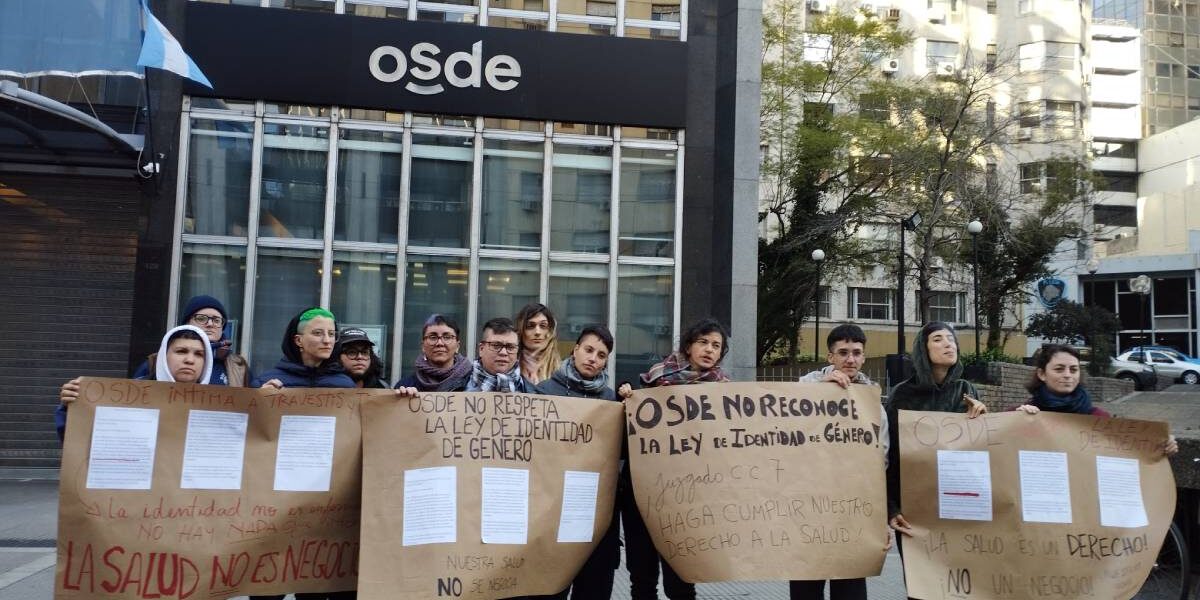
In response, LGBTIQ+ activists will protest today at one of the headquarters of Osde, the largest private health insurance company in Argentina, that "health is not a business."
“Trans and transvestite people are systematically discriminated against. Not only by Osde, but by the vast majority of social security and private health insurance companies. Despite the fact that we have had a national law for 11 years establishing that gender identity is a human right,” Quimey Ramos told Presentes .
Health is not a business
The 28-year-old teacher and activist requested intervention from the Organización de Servicios Directos Empresarios (Osde) , the country's largest private health insurance provider—with over 2 million members—to which she was affiliated. In response, she received a formal letter in March of last year. It informed her that her premium would be increased. Osde justified this increase by citing a "pre-existing condition" that Quimey allegedly had not disclosed in the sworn statement she submitted before enrolling in the plan. However, they did not clarify what pre-existing condition they were referring to. This term is commonly used to describe "pre-existing illnesses."
“Osde told me I hadn’t declared my ‘true state of health.’ And that to remain a member, I had to pay an 800% increase,” Ramos explained. When she refused to pay the new amount, they canceled her membership. In response, she filed a legal action against Osde. She requested that they respect “the plan that corresponds to her age and health condition, preventing the charging of a discriminatory differential rate based on her gender identity.”
“There is a violation of a lot of rights,” lawyer Verónica Fuente Kleiner told Presentes . The lawyer has represented clients in several cases against private health insurance companies for alleged “pre-existing conditions.”

Rights violated
Fuentes Kleiner states that Osde's actions violate the Patient Rights Law (dignified and respectful treatment), the Consumer Protection Law (dignified treatment: "they must refrain from engaging in conduct that places consumers in shameful, humiliating or intimidating situations") and the Gender Identity Law in its articles 1, 2, 11 (free personal development) and 12 (dignified treatment).
Furthermore, in June 2018, the World Health Organization updated its International Classification of Diseases (ICD) . It removed transsexuality from the list of “mental disorders,” meaning it ceased to be considered an illness by the organization when the new ICD came into effect. This exclusion was based on persistent demands from the LGBTIQ+ community. Since gender identity is not an illness, Quimey questions what Osde means by “preexisting condition.”
“I deny that charging a differential value is based on discrimination due to gender identity, since it is based on the pre-existing situation of the member before requesting her registration with OSDE,” argued lawyer María Cecilia Florio, legal representative of Osde.
He did so by presenting a “Detailed Report” in the case “Ramos Quimey Sol v. OSDE s/Health Protection” (File No. 9903/2022), which is being processed in the Federal Civil and Commercial Court No. 7.

The role of the Judiciary
He also argued that Quimey "did not report the surgery she intended to undergo, which was her true reason for joining," without any evidence to support this claim, and despite the fact that the request for the procedure was made after she had been a member for six months.
Furthermore, he demanded that Quimey undergo an endocrinological examination to determine if she was receiving hormone therapy at the time of her enrollment. This request was granted by the judge in charge of the case.
“This demonstrates the moral and ideological role of the judiciary. It shows that they are upholding a medieval perspective on health and life,” Quimey stated. He also considered that “this regression at this time is not a coincidence: it is in line with how Argentine political leaders and elites are radicalizing to the right,” he said.
Another person, same health insurance provider
NM, who prefers not to reveal his identity, experienced a similar situation to Quimey's. “Almost a year ago, Osde removed me from their health insurance plan and canceled my surgery days before it was scheduled. I received a formal legal notice, the dreaded notice that many of us received. This represents one of the many attempts to cancel our coverage that we endure. It's a cowardly, systematic, shameful, opportunistic, and intimidating act,” the young trans man stated.
He, too, was asked to pay an 800% increase in his monthly fee. “I refused to pay the unfair and outrageous increase, and I was disenrolled, but my contributions continued. In other words, they left me without health coverage, but I kept getting paid,” he explained.
Meanwhile, Nina Rizzi, a 29-year-old trans woman, had other problems, in her case with the private health insurance company Sancor Salud , to which she has been affiliated since March 2022. Nina requested a facial feminization procedure, but was rejected twice.
“They told me that the surgeon specializing in this isn’t a provider, so it can’t be done. That was the excuse they gave me at the time. I looked for a provider that could sign off on this operation properly. And now they’re rejecting me because this surgery isn’t covered by the gender identity law,” she said, referring to the response she received from the health insurance company.
However, Law No. 27,743 on Gender Identity states in its article 11 that all persons over 18 years of age may “access total and partial surgical interventions and/or comprehensive hormonal treatments to adapt their body, including their genitalia, to their self-perceived gender identity.”
Furthermore, it emphasizes that “providers within the public health system, whether state-run, private, or part of the social security system, must permanently guarantee the rights recognized by this law.” It also establishes that “all health services covered in this article are included in the Mandatory Medical Plan.”
Currently, Rizzi is pursuing his case through the Superintendency of Health and the Ombudsman's Office .
A call for everyone
In response to the actions of private health insurance companies, transgender and transvestite individuals experiencing these situations can file a health protection lawsuit. They can also use other legal tools.
“In cases like this, in addition to the Superintendency of Health and the Ombudsman's Office (as a human rights organization), the Consumer Protection Agency and even INADI Ombudsman's Office of the City of Buenos Aires explained to this agency .
NM pursued his case by filing a complaint with the National Consumer Protection Agency. “People don’t know we have this tool. Since we contract services through our social security or private health insurance, we are consumers. We have the right to civil defense,” NM shared. He was supported by the AboSex and also by a lawyer he contacted through LGBTIQ+ activism, Natalia Echegoyemberry.
“From a consumer rights perspective, there would clearly be undignified treatment in these cases. Furthermore, we would be talking about highly vulnerable consumers according to Resolution 139/20 ,” Gullelmotti stated.
The Secretariat of Domestic Trade established, based on this resolution sanctioned in May 2020, that hyper-vulnerable consumers are those who find themselves "in other situations of vulnerability due to their age, gender, physical or mental condition, or due to social, economic, ethnic and/or cultural circumstances, which cause special difficulties in fully exercising their rights as consumers."
Thus, those elderly people, people with disabilities, migrants, ex-combatants, people in situations of socio-economic vulnerability, tourists, indigenous people, LGBT+ people, or people from low-income neighborhoods or rural areas who initiate a claim have access to support and guidance from the National Consumer Protection Directorate to address their claim.

Gender discrimination
the National Institute Against Discrimination, Xenophobia and Racism (Inadi) informed Presentes that "discrimination based on gender identity is most prevalent in the health sector."
If a complaint is filed with this agency, INADI initially undertakes "good offices to resolve the issue." If a solution cannot be found through this channel, they "provide legal support to the person to initiate legal action," this agency was informed.
LGBTIQ+ activists gathered last Friday in front of the Osde headquarters located at 420 Corrientes Avenue. They will do so again today at that location, starting at 3 PM and continuing into the assembly at 5 PM.
This problem doesn't only affect the trans community. “It affects other parts of the population, such as people with chronic illnesses, people living with HIV, and obese people. And of course, it also affects healthcare workers. In general, these companies pay late and pay poorly,” Quimey said at last week's rally. In this regard, she considered it necessary for the “struggle to be cross-sectoral.”
“It is unacceptable that this system charges the most people who need it the most. (…) Our lives are worth more than their businesses. We will not allow them to continue subjecting life to the logic of the market,” he lashed out.
We are present
We are committed to journalism that delves into the territories and conducts thorough investigations, combined with new technologies and narrative formats. We want the protagonists, their stories, and their struggles to be present.
SUPPORT US

FOLLOW US
Related notes


We are present
This and other stories are not usually on the media agenda. Together we can bring them to light.
1 Comment