

Kolla, feminist and defender of sexual and cultural diversity: Adriana González Burgos and the resistance in Jujuy
Adriana González Burgos is a leading figure in the indigenous community of Jujuy. She analyzes the situation within the context of the social protests.


Share

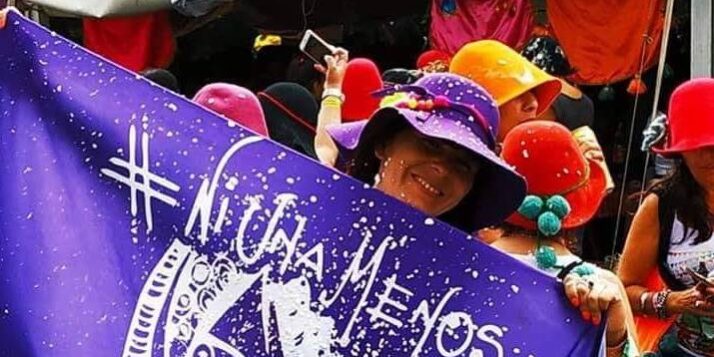
Community, peasant, and grassroots feminist. That's how Adriana González Burgos defines herself. For the Western world, the definition is completed by saying that she is an epistemologist. She also teaches at the National University of Jujuy (UNJu) and coordinates the Diploma Program in Community, Peasant, and Grassroots Feminisms in Abya Yala at the Rodolfo Kusch Institute of UNJu. She heads Casa Mama Quilla , which helps women and LGBTQ+ people in situations of gender-based violence.
But fundamentally, Adriana González Burgos is Kolla. Her family “is originally from the Rodero Community, Humahuaca ,” and as such, she is one of the active participants in the ongoing protests in Jujuy , rejecting the reformed Constitution that curtails rights.
She does so convinced that “the people’s struggle will prevail,” because the people of Jujuy have stood up for themselves. As the chant repeated at every road blockade says: “They say we Kollas are quiet, but when they mess with us, we rebel.”
The fighting brothers
Presentes spoke with González Burgos to reflect on the “struggle process” that has been taking place in Jujuy for a month, framed within a dispute centered on public assets, which the provincial State intends to advance in order to allow the exploitation of lithium.
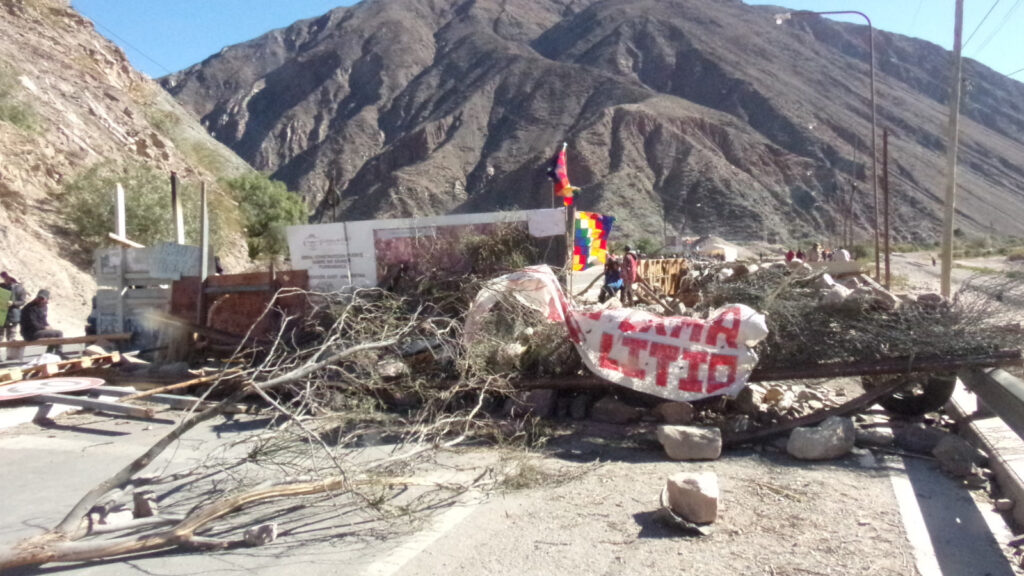
The community of Rodero, in the Quebrada region of Jujuy province, is one of those maintaining the blockade at the intersection of National Routes 9 and 52 in Purmamarca. “I have a large family. All of Rodero is practically my family,” laughs González Burgos, adding that in reality, all the families, all the surnames, are linked.
“I think that’s what happens in the Quebrada, in the communities,” there’s a web of relationships and bonds that unite them. “That’s where the term we use in the Andes comes from, which is brother, sister. We all have kinship, not only by choice but I could even say by blood.”
Road blockades in the province have been ongoing since mid-June, when the Third Peace March reached the provincial capital, San Salvador de Jujuy.
Indigenous communities reject this exploitation because they believe it will deplete the scarce drinking water available in the Puna region. The rejection of the reformed Constitution is another chapter in this tension. The modifications promoted by Governor Gerardo Morales facilitate the encroachment of the State, and of corporations, onto ancestral lands where lithium and other valuable metals, such as silver, cadmium, and now, coltan, are found.
Down with the reform
González Burgos lives in Tilcara, in the heart of the Quebrada, less than 30 kilometers from Purmamarca. As a participant and observer, she analyzes some aspects of this process.
“Fundamentally, the struggle of Indigenous peoples is communal and collective. It is a struggle born of joy; that's why the sikuriadas, the musical bands, the food. It would be morally impossible for our peoples to sustain a struggle from any other perspective. So this is our anchor,” he explained. “All of Jujuy is in a critical process. People are demanding the governor's resignation, but above all, and fundamentally, we are demanding that the reform be overturned.”
When asked why he participates in this struggle, González Burgos responds: “My family has lived in the Quebrada de Jujuy for over 300 years. We believe our family originated in Bolivia. That is to say, we are an ancestral family that has inhabited this territory. Therefore, I have a commitment, and I almost feel a moral and political obligation, to defend my brothers, my sisters, my land. In the name of my grandfathers and grandmothers, in the name of my ancestors.”
Neoneo-extractivism
González Burgos added that the resistance of the Indigenous peoples of Jujuy stems from the fact that “this reform liberalizes the market. It is a neo-extractivist reform that gives away mineral resources, that grants itself political and governmental authority to seize Indigenous territories and water, clearly driven by the exploitation of lithium and other minerals that we know are linked to new technologies. Mining has always been a means of conquest and colonization in our territories. And this reform is a colonialist reform. It is a reform of death, a reform of hunger.”
“What is happening is the consequence of a neo-neoliberal, neo-extractivist policy in our territories. An autocratic policy on the part of the despotic provincial governor, whose tool and mechanism is the persecution of all thought, all politics, all social organization that does not respond to him.”
A reform for private property
The reform of the Jujuy Constitution eliminates the prior, free and informed consultation to which the Argentine State, and its provincial states, are obligated, because it adopted ILO Convention 169 as part of its regulations, even above the National Constitution .
That Agreement, González Burgos recalled, guarantees consultation with indigenous communities and also "that they participate in decisions about their territories, about natural resources, of course, giving their consent."
In contrast, “the new Constitution provides mechanisms, devices that are quick, that violate this Convention, that violate the law. But they also prioritize private property over any kind of possession of the territory, over any kind of right of indigenous peoples over their lands.”
A latent repression
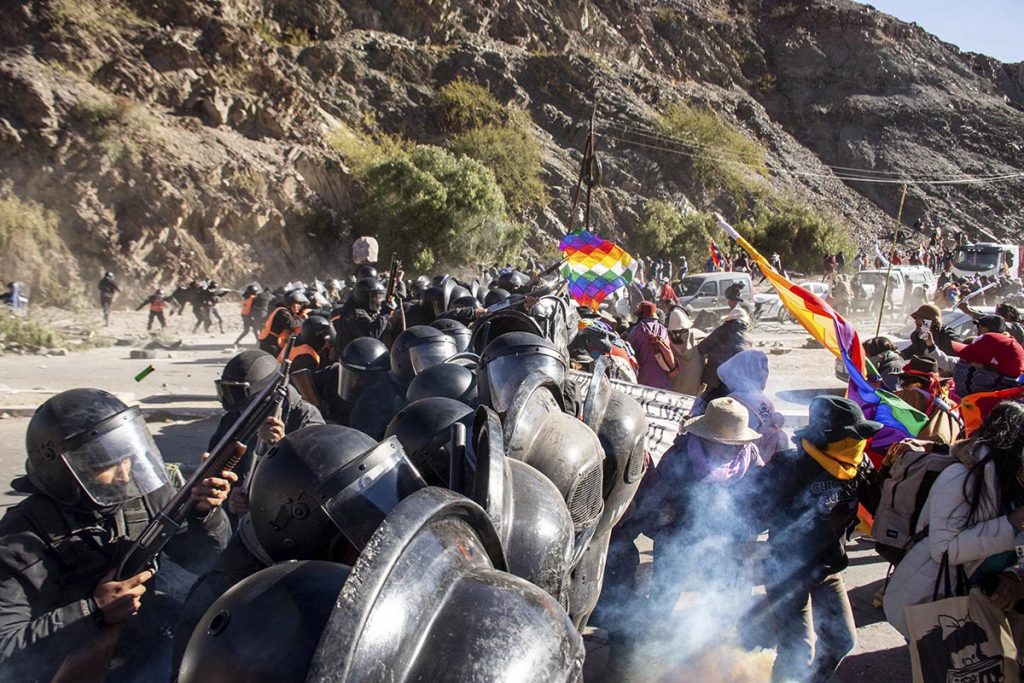
Adriana's account repeatedly mentions the repression suffered on June 17th and 20th in Purmamarca and the city of San Salvador, the two most brutal incidents. Although there were also acts of police violence in other towns in the province, such as Humahuaca, La Quiaca, and Perico.
The first road blockade was on June 17th in Purmamarca. “It was a peaceful blockade, like everything we do as Indigenous people, because that's what defines us. We were on the road and suddenly, between 3 and 4 p.m., the police shot our brothers and sisters in the face. They didn't warn us. The police didn't warn us. They just started repressing us,” even though there were families present. “There were grandmothers, grandfathers, babies playing in the middle of the road, and the police started shooting. It was criminal.”
Many people were injured, including a 17-year-old who lost an eye after being shot with a rubber bullet, as did a 19-year-old. Five more people are at risk of losing their sight. “We know this device; it has already been used by Bolsonaro and in Chile.”
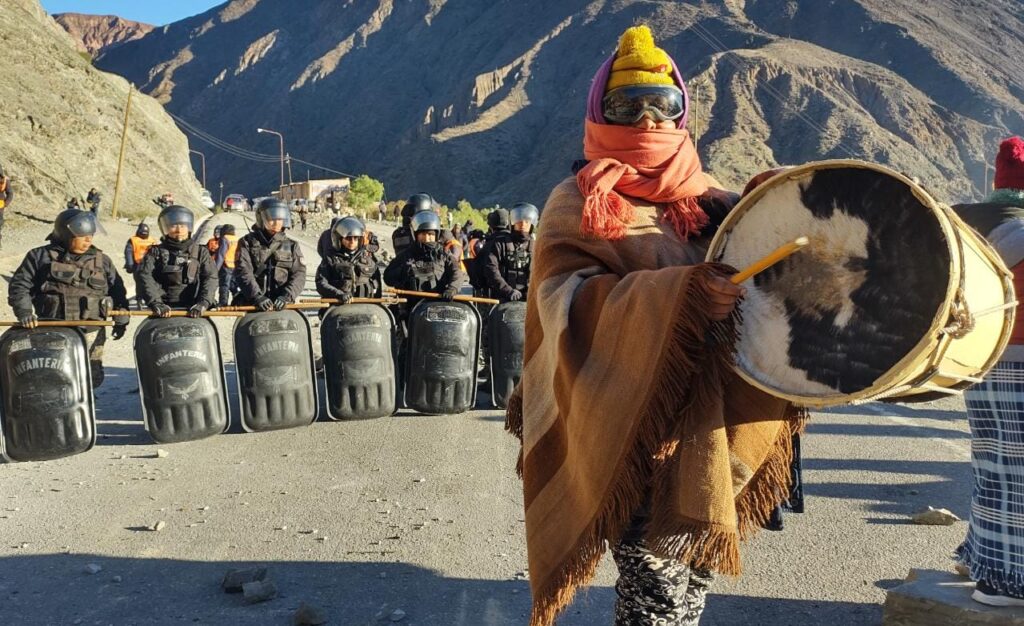
The police attack lasted about two hours. The protesters dispersed as best they could; some fled along the riverbed (almost dry at this time of year), and others ran through the mountains and hills. But they didn't abandon the protest. They reorganized and, from above, resisted by throwing whatever they could find at the patrol car that had been left stranded on the pavement below. Eventually, the police ran out of bullets and had to withdraw, and then the community members returned to the road and the blockade.
The violence they experienced was so intense, González Burgos said, that “to this day we still suffer from a kind of post-traumatic stress; we don’t sleep well.”
The persecution
González Burgos denounces: “There is constant persecution by the police against those of us who are, in some way, role models or leaders in certain circles. In my case, I have been harassed by the police, they call me on the phone, in short, countless situations.”
On June 20, the day the new constitution was sworn in, behind closed doors and amid widespread protests, the repression left more than 200 injured, “between 30 and 50 of them with serious injuries.” These figures, “of course,” are not being provided by the Jujuy provincial government, “because they are hiding them,” González Burgos stated. They are known thanks to the involvement of national and international organizations, such as the Center for Legal and Social Studies (CELS) , Amnesty International , the Coordinator Against Police and Institutional Repression (Correpi) , and Lawyers of Northwest Argentina (Andhes) , who traveled to the province to document human rights violations.
Also present was the National Secretary of Human Rights, Horacio Pietragalla. “The problem,” says González Burgos, “is that “they approach us, express solidarity, support us, accompany us, but they always tell us they can’t do more. And this is a people who are suffering, a people who are threatened, intimidated, but who continue to resist.”
A renovation in record time
González Burgos also emphasized the speed with which the Jujuy government addressed the proposed reform of the provincial constitution. It was announced by the governor on September 12, 2022, and approved that same month by the legislature.
"The ruling party, led by Governor Gerardo Morales, secured support in the provincial legislature to amend the province's constitution thanks to the vote of a Peronist deputy."
The 48 delegates were elected on May 7th, in the provincial general elections. The ruling party won a majority with 29 seats, although it also “had the complicity of the Jujuy Peronist Party.”
The Constitutional Convention “was already heavily criticized by the people of Jujuy. The meetings were not public, there was no stenographic record, there were no hearings with social representatives of the indigenous peoples or any other citizen who wanted to participate. In fact, the text was only made public after the reform had just been sworn in.”
While the reform was progressing, “the overall situation in Jujuy worsened in June.” Teachers' unions at all levels began a wage protest, which was joined by other sectors, such as municipal and healthcare workers.
In that context, on Thursday, June 15, after only 26 days of deliberation, the Constitutional Convention approved the reform, “with numerous procedural problems. Deadlines were not respected, participation was not allowed, and Indigenous peoples were not given the opportunity to participate in any kind of consultation. Furthermore, the governor resorted to deception and disinformation and wants to make society believe that he consulted with the people.”
"The reform is an insult to the people of Jujuy."
The reform, González Burgos warned, “modifies the entire institutional architecture of our provincial state. It openly breaks the separation of powers” and also “introduces a modification to the electoral system,” eliminating midterm elections.
“The worst thing for us as a people, for the Indigenous peoples, for all the people of Jujuy, for the teachers, the workers, is that it sets a limit. It almost takes us back to the dictatorship. And it curtails freedom of expression. The right we have to protest, the right to demonstrate. And paradoxically, it incorporates this article, which is Article 67, as the right to social peace and to democratic and peaceful coexistence. It is truly a disgrace, it is an insult to the people of Jujuy, to all of society, to all Indigenous peoples.”
Moreover, faced with public outcry, Morales "backtracks on two articles, 50 and 36," but without going through the Constitutional Convention. "Mr. Morales, just like that, overnight, holds a press conference and says I'm going to backtrack on these articles. So, where is the process of debate, of discussion, the legal process, which is also supposed to legitimize the text of the Constitution?"
However, “we know that the underlying problem is neither administrative nor bureaucratic.” “Of course, all the corresponding processes for legitimizing a constitution have been violated. What’s at the heart of the matter here is the defense of our territories,” in the face of the advance of mining operations, says González Burgos. He also noted that there are “two extremely important lithium deposits in Argentina.” One in Catamarca, in the Salar del Hombre Muerto, operated by the US-based company Livent, and the other in Jujuy, the producing deposit in the Salar de Olaroz, operated by the US-based multinational BlackRock.
“The struggle we indigenous peoples are waging is the defense of our territory, our natural resources, our Pachamama, Mother Earth, and our water, because we know that lithium production also involves the use of water,” he asserted.
Romantic Love and State
Adriana González Burgos is the coordinator of Casa Mama Quilla, inaugurated on October 22, 2022, following the first International Meeting of Community, Peasant, and Popular Feminisms in Abya Yala. More than 2,000 people from around the world participated.
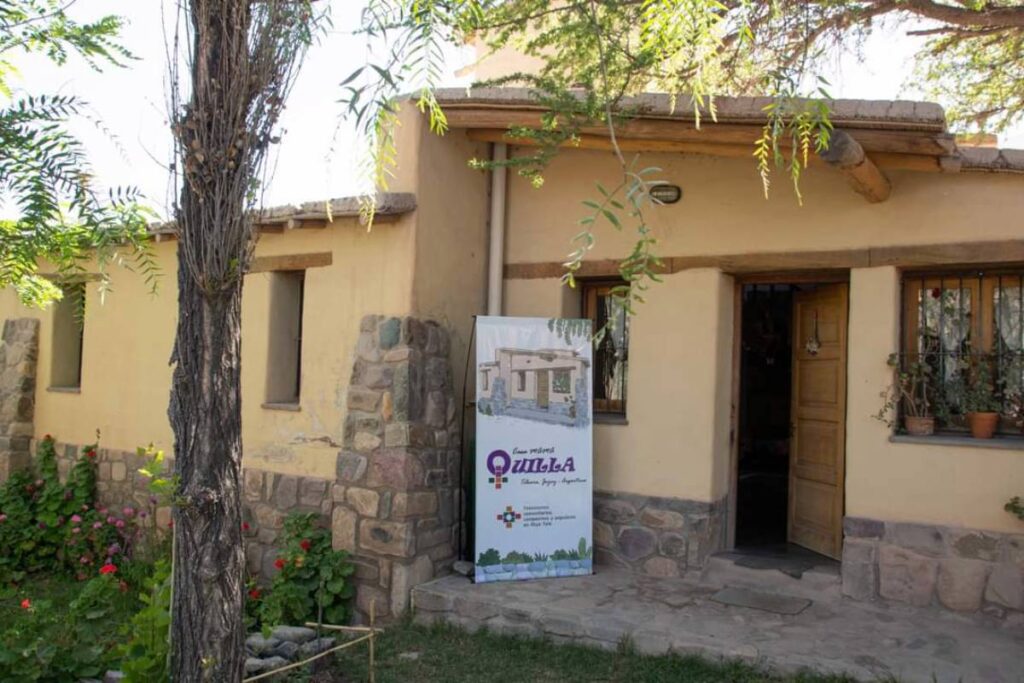
“It’s a house for women and the LGBT community. We don’t use the 'q' in queer, but rather binary and non-binary, because we feel that 'queer' is a northern term, so we prefer to call ourselves something else. Here, for example, they call themselves LGBT of the Quebrada or Andean LGBT,” she explained.
Casa Mama Quilla is now focused on organizing the Second International Gathering, which will be dedicated “to the struggle of Indigenous peoples, and especially to the struggle of the people of Jujuy and the role of women in defending their territory .” A struggle that, according to González Burgos, “is far from over, contrary to what many expected, that it was already over, that we would find a solution.”
At this point, she reflected on another aspect of the democratic system: “The people still trust. We naively trust the State, as if it had some kind of existence, because the State is us, the people. But we trust that those people who are the provincial State, the national State, will at some point reflect, become more sensitive, become more humane, and recognize the full extent of our rights. And that never happens; it's a constant disappointment. So the idea of romantic love that we feminists talk about in this case is transferred to our relationship with the State. The State constantly disappoints us, violates us, and here we are.”
“This reflection arises precisely from having repeatedly hoped that the governor would stop. And once again he attacks us, and the violence is increasing. First, we hoped the Constitution wouldn't be approved, then we hoped it wouldn't be sworn in. And not only was it approved, and not only was it sworn in, but we were also attacked, hence the comparison.”
A house of shelter and protest
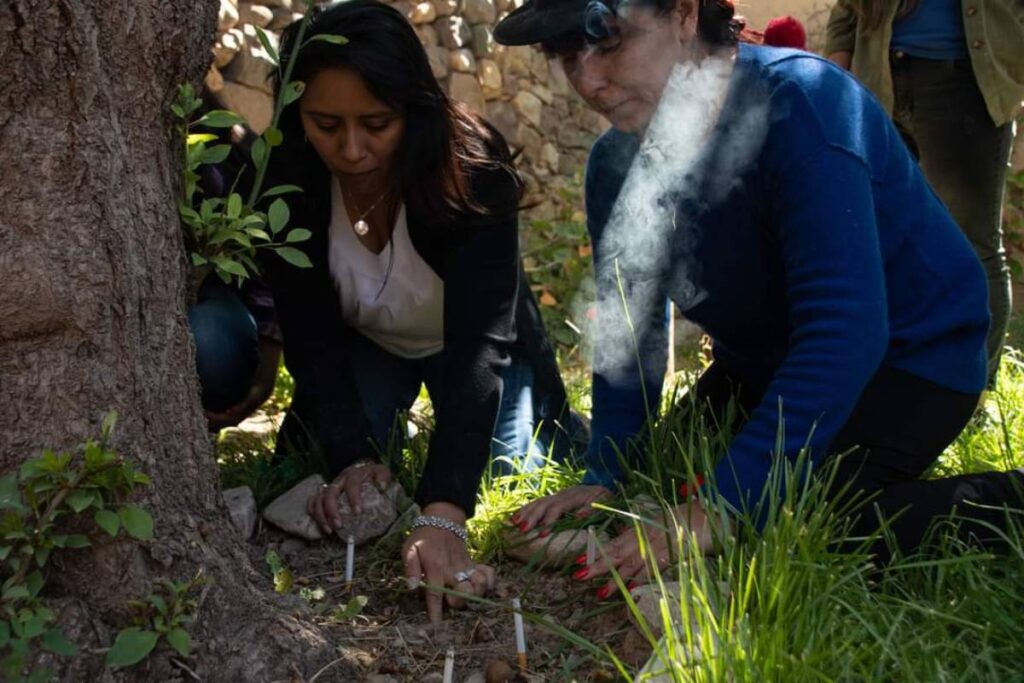
Casa Mama Quilla actively participates in the protests, primarily as a platform for disseminating information about their activities. “This has also brought us persecution,” which manifests as surveillance, monitoring, and even threats. Despite this, they continue to publicize the protests, “and we openly denounce the governor.”
One of the posts says 'Morales is racist'. "And we believe that's true, we believe that this policy being implemented by the provincial government is a racist policy that takes us back to colonial times, that sets us back centuries in terms of rights; it's not just a setback in the Constitution, it's a setback of centuries."
At this stage of the struggle, in addition to intensifying the road blockades, each community is going to its local council to request statements rejecting the reform. It is “another element of the struggle.”
“The struggle of the people will prevail.”
On the other hand, they believe the Supreme Court of Justice should declare the reform unconstitutional. Meanwhile, “what we can do is continue the struggle, the resistance, the roadblocks, and other actions.”
“Aren’t you afraid the Supreme Court will let you down?” Presentes asked. It’s possible, but “it’s all we have left,” González Burgos conceded. He did, however, mention that they had already filed complaints with international organizations, which had already ruled on their unconstitutionality. “The eyes of the world are on Jujuy.”
“If you ask me what will happen, what I have faith in: that the people's struggle will prevail. I don't think it will happen. They've tried to make Jujuy (and I agree with this interpretation) a test, a rehearsal for what the new neoliberalism and neo-extractivism will do, and the people have stood up and said: 'It won't happen.' They will not pass here. Free or dead, never slaves. I believe we will not return to colonial times, and this constitution is a constitution for the enslavement of the people of Jujuy. This provincial constitution, this reform, wants us enslaved—teachers, workers, the people, all Indigenous peoples.”
We are present
We are committed to journalism that delves into the territories and conducts thorough investigations, combined with new technologies and narrative formats. We want the protagonists, their stories, and their struggles to be present.
SUPPORT US

FOLLOW US
Related notes


We are present
This and other stories are not usually on the media agenda. Together we can bring them to light.