

Diversities as a focus of institutional violence and racism
The repression in Jujuy demonstrated that the violence of right-wing sectors today has one objective: indigenous peoples, workers, women and diverse groups.


Share

BUENOS AIRES, Argentina. In recent years, the transvestite and trans movement has succeeded in giving voice to the invisibility and repression they have historically suffered. “Our democracy began with the gender identity law,” they affirm.
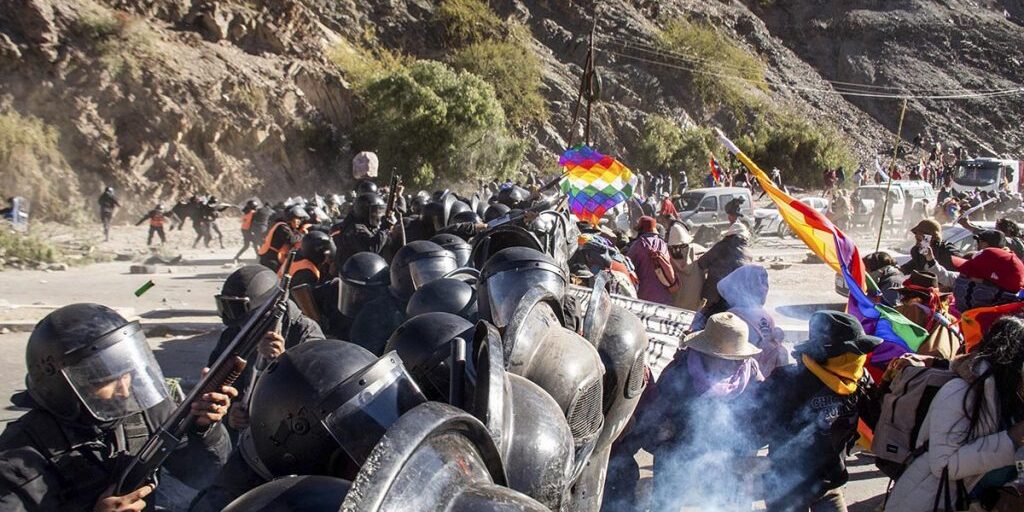
The concept is both organizing and unifying in the struggle of a vulnerable group, which, through political activism, has achieved some victories. However, hate speech and the rise of political groups with reactionary ideologies are reinstating excessive violence against diversity. A clear example was the repression that intensified in Jujuy—where Indigenous people are the main protagonists—starting on June 17, reaching its peak three days later.
But that Saturday, June 17th, was symbolic in terms of violence. While in Jujuy the police were deploying their forces throughout the province , in the Almagro neighborhood of the Autonomous City of Buenos Aires, the police were doing exactly the same thing. Three hundred officers repressed women with their children, as well as an LGBT person, who were resisting the eviction from Casa Pringles.
Women, sexual diversity and cultural diversity, all violated by the same security force, under the order of the same political force.
How to talk about diversity?
Alejandro Mamamí is a lawyer and a member of Identidad Marron. “Talking about institutional violence and racism is a line or intersection that is very difficult for us in Spanish-speaking Latin America,” he says.
But in Argentina, "those identities, brown and indigenous, are the ones who led the trans and travesti movement in Argentina. I can name Lohana Berkins, Diana Sacayán, La Mocha Celis, and the historical ones, those who are alive today," she emphasizes.
“The big question is what the consequences of diversity are outside the world’s capital cities. In Argentina, we have a very inclusive legal framework for diversity, and yet the repression of trans women and transvestites in Argentina still involves mounted police and rubber bullets, as in Salta. Because what’s happening in Jujuy right now, which is one example, isn’t unique. It’s happening in Jujuy, it’s happening in Formosa, it’s happening in Tucumán, and it’s happening in much of the country outside of Buenos Aires, Córdoba, or Santa Fe,” Mamaní explains.
Jujuy, the same old violence
Sara Pérez is part of Identidad Marrón in Jujuy . On Tuesday, June 20, she was arrested during a crackdown by the provincial police. She is also a member of artistic collectives.
“There has never been social peace in Jujuy, which is this government’s slogan. Moreover, the precariousness that we’ve been suffering since Macri’s administration has worsened,” says the young woman. “Jujuy society is racist; it has always been conceived from the perspective of whiteness as a system, and this criminalization of faces and features is part of the foreignization of the Argentine body, which is also Indigenous and brown. And which is part of an impoverished social class,” says Sara. “This has been going on for many years, but now it’s more visible; it’s nothing new.”
Mamaní agrees. “In Jujuy, this is clearly visible. Because a large part of the activism belongs to the working class and is brown, racialized. A significant portion of the people who take to the streets are lesbian, gay, and trans teachers, who are present in the activism because perhaps they have a much closer history to diversity activism.”
The brown ones, the most punished
For Sara, there are two more important points to consider when thinking about conflicts in Jujuy: centralism and institutional violence.
“There is a lack of implementation of certain anti-poverty policies by the national government. There is a right-wing sector that has the resources to capitalize on the discourse in the mainstream media and that prevents us from thinking about another way of life. That is why there is no in-depth discussion about what lithium and mining entail,” he states.
And she adds, “Institutional violence is always directed by social organizations against anything related to Tupac Amaru. Anything associated with non-whiteness is directed against Indigenous people with brown bodies. The reform is conceived from a white perspective because it not only affects the rights of Indigenous communities, but also the territory of public lands and urban settlements, which will also be impacted. The fact that this isn't being explicitly mentioned is another issue. It will affect many settlements where people live in precarious conditions due to nonexistent or inaccessible housing policies.”

Racialized bodies
Daniela Ruiz is a trans actress and activist. She was part of the Arte Trans Cooperative and is now a member of 7 Colores Diversidad . Originally from Salta and identifying as brown, she analyzes the violence that state institutions unleash against diverse communities.
"What we need to understand is that we are in a cis-heteropatriarchal system. This system has been a consequence of systematic cultural coloniality, which is triggered by so-called institutional violence. It is no coincidence that the State still maintains hegemony over some bodies and not over others," Daniela states.
“The bodies that are outside this system are racialized bodies, racialized transvestite bodies, indigenous bodies, and bodies that do not fit into an established norm within these patterns. They are bodies that remain on the periphery, and these are processes of many years of systematically invisible cultural violence practices that no one has debated.”
In that sense, Daniela points out that while there is indeed a debate within institutions today, many practices still need to be deconstructed. “I think that to deconstruct this entire heterosexual process, the first step is to be able to talk about it and begin to understand the practices we have within the State and the collective, plurinational, and pluriversal participation of all bodies. It's not visible because we know very well that Indigenous and brown people still don't enter this broad system because we don't see them.”
"To move forward, we also need the empowerment of all people, so that they can build a cross-cutting, intersectional perspective, thinking about this structural racism."
A transvestite, brown, northern president
Spaces of power are still not in the hands of diverse groups; this is one reason why, the leaders insist, intersectionality must be addressed.
“There’s a line of reasoning to understand that racism and diversity are two intersecting issues, and that in Argentina, the visibility of racialized people, people in diverse groups, or institutions that showcase diversity is always focused on white people. So there’s also a line of debate there, which is whether racism can exist within diversity itself. And then, externally, how the lines of diversity and racism intersect with state power: whether it’s the judiciary or the police,” Mamani explains.
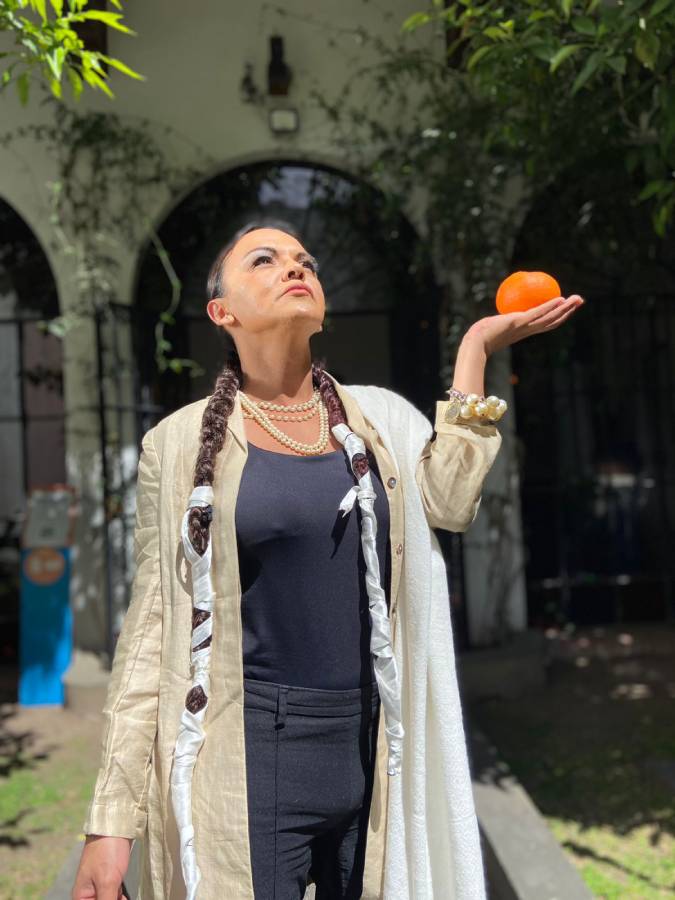
For her part, Daniela Ruiz states, “Today, trans women are the empowered ones who have come to debate this system. I would love to see a trans woman, an Indigenous woman from the north, as president. I want her to come and debate everything because it's also true that we need to occupy positions of power to change this paradigm.”
The place of activism
“We’ve made a lot of progress,” agree Ruiz, Mamani, and Pérez. And they emphasize that this progress is due to activism.
“The progress is the result of the struggle that historical activist movements have managed to connect with party politics to talk about diversity in terms of gender identity or sexual orientation and to remove the taboo surrounding it. That's why, perhaps as if it were a two-sided variable, we consider what LGBTIQ+ diversity activism looks like externally, but also what activism looks like internally,” she explains.
For activists, the primary form of institutional violence is the scarcity of women in positions of power. “I think society has made a lot of progress regarding diversity. As an activist, and as a legal activist, there’s always the question of how much further we have to go to achieve greater fulfillment and equality. We can list historical Argentine activists, but they are all white except for the trans women and transvestites who achieved visibility from a different perspective. That’s where we ask ourselves how anti-racism and diversity converge,” Mamani concludes.
We are present
We are committed to journalism that delves into the territories and conducts thorough investigations, combined with new technologies and narrative formats. We want the protagonists, their stories, and their struggles to be present.
SUPPORT US

FOLLOW US
Related notes

We are present
This and other stories are not usually on the media agenda. Together we can bring them to light.