

Jujuy: Women on the front lines of the fight against constitutional reform
Repressive incidents are on the rise, with women in Jujuy either as victims or as complainants. Whether at community road blockades or in the provincial capital, they resist and speak out.


Share

against the constitutional reform imposed by the government of Gerardo Morales continue unabated in the streets, highways, and schools of Jujuy . At the same time, repressive incidents are multiplying, with women in Jujuy either as victims or as those reporting them. Whether at community road blockades or in the provincial capital, San Salvador de Jujuy, they resist and tell their stories.
“It’s undeniable that women are on the front lines of the struggle, starting with the thousands of teachers who are continuing their protests. They are now maintaining not only their demand for higher wages but also their call to ‘down with the reform,’” Andrea D’Atri, from the Pan y Rosas group, told Presentes. She traveled to Jujuy to express solidarity with the struggle of the people of Jujuy, with its women: teachers and representatives of human rights organizations in San Salvador and of the Indigenous communities at the road blockade they are maintaining in Purmamarca.
“The majority of those at the road blockades are also women from Indigenous communities. And therefore, they too were targets of brutal repression, like our fellow constitutional delegate Natalia Morales. The whole country saw on television how she was dragged more than 200 meters along the road and taken into custody by plainclothes police officers on June 17, along with journalists and many Indigenous women,” she added.
D'Atri gathered testimonies at that picket line, which is still standing. “A Kolla woman told me how that day they decided to form a front line of women, believing that this might deter the police from advancing against the protesters. The women remained unfazed despite the rubber bullets and tear gas. They organized the resistance, especially with the young people of the community.”
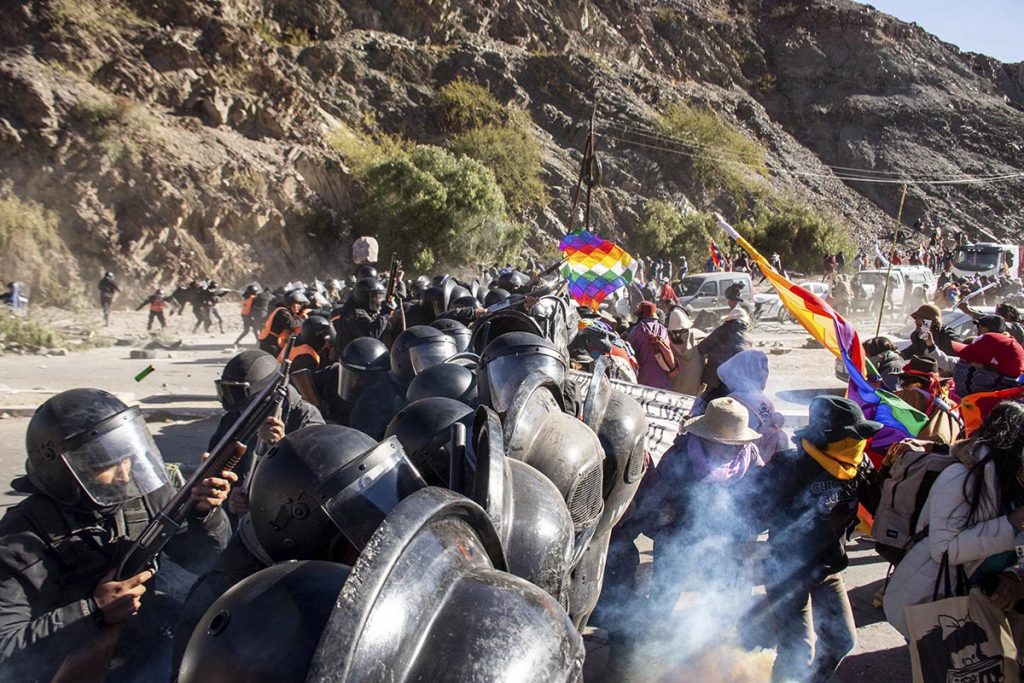
Defend the water, the land, the children
Beyond the brutal repression, on a daily basis, the women receive donations from the city and other communities. They organize the food pantry with supplies that they distribute to the various groups that take turns standing guard, and they also prepare food for everyone at the blockade.
“University students, along with doctors and nurses, set up first-aid stations to treat the wounded and handle other emergencies. For the vast majority of the population, this represents an attack on their most basic rights, particularly their right to water and a healthy environment due to lithium mining on their lands. Women are aware that they must defend the environment. Their lives and the lives of their children are at stake,” this feminist activist reflected in an interview with Presentes.
Repression in Humahuaca
The residents of Humahuaca demanded that the City Council issue a statement against the constitutional reform. “There was reluctance on the part of the councilors who answer to the governor. This unleashed the fury of the townspeople. A large number of them gathered in the Central Plaza to demand a special session, or to demand the resignation of the councilors who opposed the popular request,” Fabiola Suárez told Presentes. She is a representative of human rights organizations in Jujuy and a member of the Local Committee Against Torture.
Due to strong pressure from the protesters who set up camp in front of the Municipality, on Saturday, July 1st, at dawn, they unanimously voted for the declaration of rejection.
Six people injured by police were admitted to the local hospital. Among them was 28-year-old musician Joel Paredes, who suffered a rubber bullet wound to the eye. He joins three others who have already lost an eye, victims of the Jujuy police who shoot people in the face .
Teachers
At the start of the fifth week of the teachers' strike, this is how the teachers on hunger strike for higher wages and against the constitutional reform expressed themselves. "We want all our colleagues to come back and join us in this fight. Up with wages, down with the reform, always firm, always strong," said the five women from ADEP (Association of Provincial Educators), the largest union in the primary education sector, who are camped out in front of the Ministry.
“We are eager to return to school, but they aren't doing their part. On Friday (June 30th), Minister Carlos Sadir stood us up. It was very sad. Only when the media came did they call us again, but it was just a false hope; they continue to mock us and threaten to dock our pay. Teachers who have a presence on social media were directly attacked at their homes. We continue thanks to the support of the families,” said a teacher from Fuerte, Santa Bárbara.
Meanwhile, Edith, from Loma Larga, told the Anred website that “what they're offering us doesn't even cover the basic food basket. It's false that Morales reached an agreement with us. The reform he pushed through takes away rights from both teachers and Indigenous communities. The reform has to be overturned, salaries have to go up, that's why we're going to continue the hunger strike.”
Torture and threats against Camila Müller
“I saw a man wearing a face mask and a blue hood. They took off my shirt and put it over my eyes, and put a rag soaked in some kind of fuel, like turpentine, in my mouth. They put something like a belt around my throat; I felt like I couldn't breathe,” described Camila Müller, a teacher and dancer. She had expressed her outrage at the repressive actions carried out by the provincial government. Her attackers told her to stop “messing around” with that kind of behavior.
The following day, Müller filed the criminal complaint, accompanied by lawyer Lorena Mamani, from CEDEMS (a secondary school teachers' union), and by general secretary Mercedes Sosa. "It was necessary to take this action to guarantee and demand the teacher's freedom of movement and security; it was a step in the habeas corpus petition we had already filed," said the lawyer.
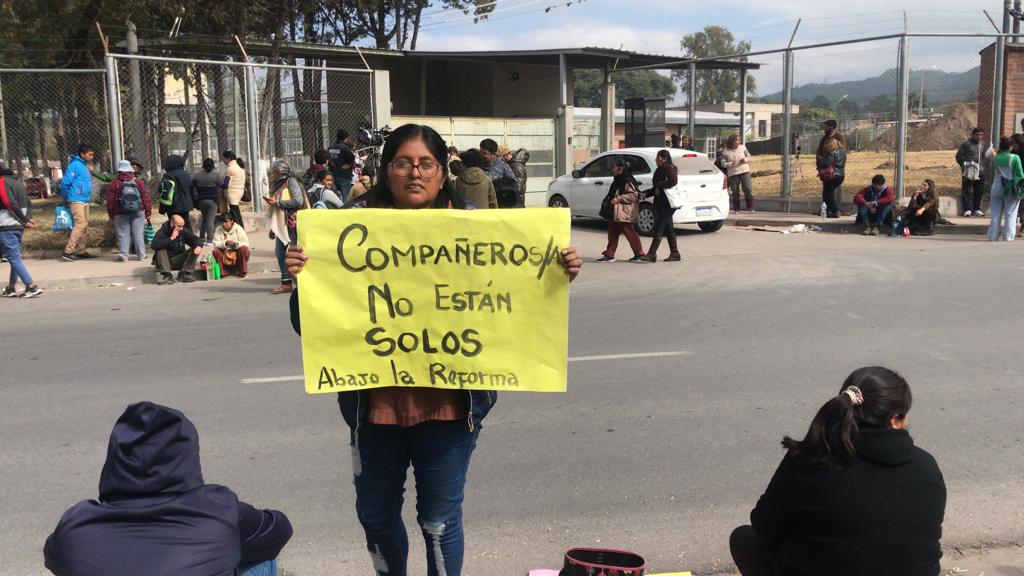
Police raids, illegal arrests
A group of plainclothes police officers without identification entered the Domínguez family home in the early hours of Tuesday, June 27. They took away one of the brothers who had been arrested during the repressive operation of June 20. Without a warrant and in the middle of the night, they took Marco Antonio Domínguez and his girlfriend, Belén Ontiveros, and opened a legal case against them. He has a physical disability in his legs, and his brother Raúl has autism spectrum disorder. Presentes had reported the torture and beatings they suffered during their first arrest.
In the style of the death squads that operated during the dictatorship (1976-1983), the police entered the Domínguez family home in Alto Gorriti violently and without a search warrant. They broke down the door, forced everyone to the floor, and demanded to know about the two boys. They pointed long guns at a six-year-old boy. They handcuffed all the adults except the father, who pleaded unsuccessfully for an explanation. One of the officers wore a vest that read "Investigations Brigade," while the others wore caps and face masks. While shouting "Where are they? Where are they?" they ransacked the place. After a while, finding nothing, they said to each other, "No, no."
In their escape, in addition to taking Marco and Belén, who is 17 years old, they stole 200,000 pesos that they had saved for a surgical intervention, two motorcycles, a car and all the cell phones.
“Marcos appeared 12 hours after his habeas corpus petition was filed, at a police station in Alto Comedero. The girl was released a short time earlier; she had been held at the Investigations Brigade. We also have a boy at the Chijra Brigade for filming police officers. There's also Müller, who wasn't arrested; she was beaten when they entered her house,” Fabiola Suárez summarized to Presentes. She added that Marco is now free, but he and his girlfriend were accused of “drug dealing” after allegedly planting drugs in their house during the arrest operation. They never returned any of the stolen goods to their family.
Always against Milagro Sala
A few hours later, the Jujuy police raided the home of Milagro Sala, the leader of the Tupac Amaru organization who has been detained, now under house arrest, for more than 2,700 days. She has been a political target since Morales assumed his first governorship in 2015. The search warrant was issued by Federal Judge Rodolfo Fernández, with the involvement of Prosecutor Diego Funes. It was issued "within the framework of the case investigating the commission of crimes related to the recent demonstrations in Jujuy." In other words, she is accused of having been part of an "organization" involved in the protest on the 20th in front of the Legislature.
Money, personal computers, and cell phones were seized. The violent raid took place in every room of the house, including the one where Sala's husband, Raúl Noro, is under strict bed rest due to a terminal illness.
According to Elizabeth Gómez Alcorta, former Minister of Gender and Diversity and part of Sala's legal team, the judge's decision was issued following testimony from an alleged suspect whose identity is being kept confidential. This individual reportedly mentioned Sala as having some "connection to the protests that the people of Jujuy are so honorably carrying out."
Gómez Alcorta pointed out that this incident “is just one more in the context of the terrible harassment and persecution against Milagro, seven and a half years after her arrest.” She also emphasized that the raid is part of “the electoral campaign being waged by Gerardo Morales and Horacio Rodríguez Larreta,” as one of the PRO party's internal candidates.
All of this is happening amidst approximately 18 road blockades maintained by Indigenous communities in 10 towns in Jujuy province, while supporters of Governor Morales are organizing a counter-protest. Meanwhile, the case against those arrested for the June 17th and 20th demonstrations against the reform is progressing. One of those summoned was Raúl Domínguez, the 21-year-old with autism.
We are present
We are committed to journalism that delves into the territories and conducts thorough investigations, combined with new technologies and narrative formats. We want the protagonists, their stories, and their struggles to be present.
SUPPORT US

FOLLOW US
Related notes


We are present
This and other stories are not usually on the media agenda. Together we can bring them to light.