

Honduras: More than 40 women and LGBT people died in a fire at a prison in Támara
It was a gang conflict. They allege it was an organized plan with prison complicity.


Share

TEGUCIGALPA, Honduras. “We don’t want to see those shitty bitches in the hallways.” With those derogatory words and insults, some members of the Barrio 18 gang referred to members of the Mara Salvatrucha MS-13 when speaking with security guards at the Women’s Social Adaptation Center (Cefas) in Támara .
For the past three months, the female members of the MS-13 gang had been self-isolating because they knew there was a plan to assassinate them. This information was confirmed to Investigative Reporters and Report Without Fear by several sources at the facility located a few blocks from the men's prison in Támara. Both prisons are located 30 kilometers northwest of the capital, Tegucigalpa.
Tensions between the two groups culminated yesterday in the murder of at least 46 women detained inside the Cefas prison, the Public Prosecutor's Office confirmed. An official list of the victims and the organizations to which they belonged has not yet been released.
“ Forty-six bodies were recovered, 23 from firearms and 23 burned, Proceso Digital on Tuesday night
The news immediately sparked outrage and condemnation from the Honduran population and the international community. It also led to the dismissal of Security Secretary Ramón Sabillón. Some people on social media are questioning why Sabillón was fired while Julissa Villanueva remains in her position.
According to journalist Telma Mejía, former minister Ramón Sabillón “will be remembered for the extradition of the Valle family (which caused discomfort); the arrest and extradition of Juan Orlando Hernández (which was highly applauded, almost a hero) and the capture and extradition of Midence Oquelí (which was not so applauded).”
No attack, no fight
The reports about what happened in the prison insisted on talking about "fights," however, everything indicates that it was something staged and that it was known that it could happen.
“There were already signs that they wanted to set the prison on fire. We made recommendations, but they didn't listen to us,” said Rihanna Ferrera of Cozumel Trans. The human rights defender has documented the situations faced by women in prison for years. “What happened yesterday at Cefas leaves us speechless. This wasn't a fight; this was an attack.”
Ferrera also confirmed that lesbian women were killed and some trans people were also injured.
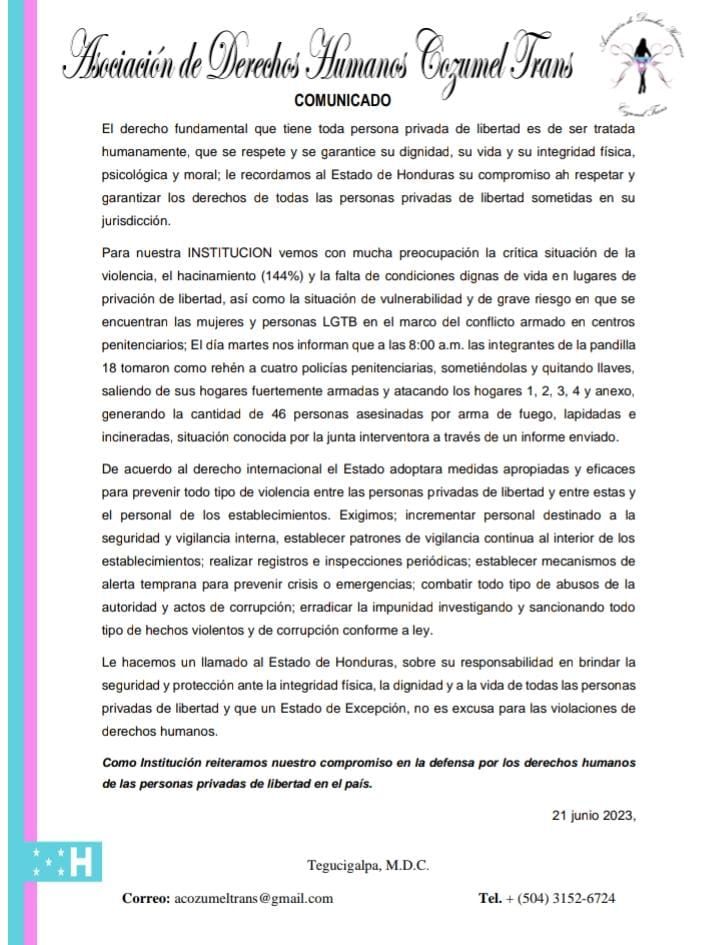
“We call on the State of Honduras to fulfill its responsibility to provide security and protection of the physical integrity, dignity and life of all persons deprived of liberty, and that a state of exception is not an excuse for human rights violations,” the Cozumel Trans in a statement.
Who gave them the keys?
The MS-13 inmates were housed in a high-security wing within the prison controlled by their rival gang. Access to them required passing through a series of bars. Furthermore, the module was secured with two locks.
“To get to where they are, someone had the keys. Who had them, or was there complicity from some people in the prison itself?” one of the sources consulted wondered.
On the other hand, the security of the MS women had been reinforced since 2020. The reason for this measure was that the authorities feared they would lose their lives in a massacre similar to those that occurred in the Honduran prisons of Comayagua , El Porvenir and San Pedro Sula .
Some of the MS-13 members had even forbidden their families from visiting them. They feared that the rival gang, which controls some neighborhoods and communities around and outside the prison, could silence them.
A massacre foretold but not anticipated
The actions that led to Tuesday's massacre began in March and April of 2023. In the latter month, Deputy Security Minister Julissa Villanueva ordered the confiscation of weapons when the Government declared a state of emergency in the national prison system.
Responsibility for the prisons was also delegated to the National Police. This action, which lasted for one year, was carried out through its Strategic Directorate acting as an oversight commission.
Following clashes between inmates from both gangs, the appointment of an intervention board was announced on April 10. According to PCM16-2023, the board was to be composed of a presiding commissioner and two deputies. All three were subject to the discretionary removal and appointment of the President of the Republic, Xiomara Castro.
The episodes of violence in Honduran prisons demonstrate “the structural deficiency in terms of overcrowding, prison management and guarantee of comprehensive security for persons deprived of liberty,” the Office of the United Nations High Commissioner for Human Rights (OHCHR) in a statement issued in April.
Among the deficiencies highlighted by the organization are overcrowding and overpopulation. The Office of the UN High Commissioner for Human Rights (OHCHR) also noted the lack of adequate and safe physical facilities for housing prisoners, as well as deplorable hygiene and sanitation conditions.
Although Honduras' prison system houses 19,658 inmates, its maximum capacity is 8,000. Even more concerning is that less than half of the prisoners have been sentenced, according to official figures.
Overcrowded and violent
"We will not tolerate acts of vandalism or irregularities within the country's prisons," assured Deputy Minister of Security Julissa Villanueva in statements to television media.
At the same time, Villanueva pointed out that the violence generated in the prisons is a product of the actions of organized crime in response to the intervention announced by the authorities in the prisons of Ilama, in Santa Bárbara, in the west of the country, and of La Ceiba, in the Honduran Caribbean.
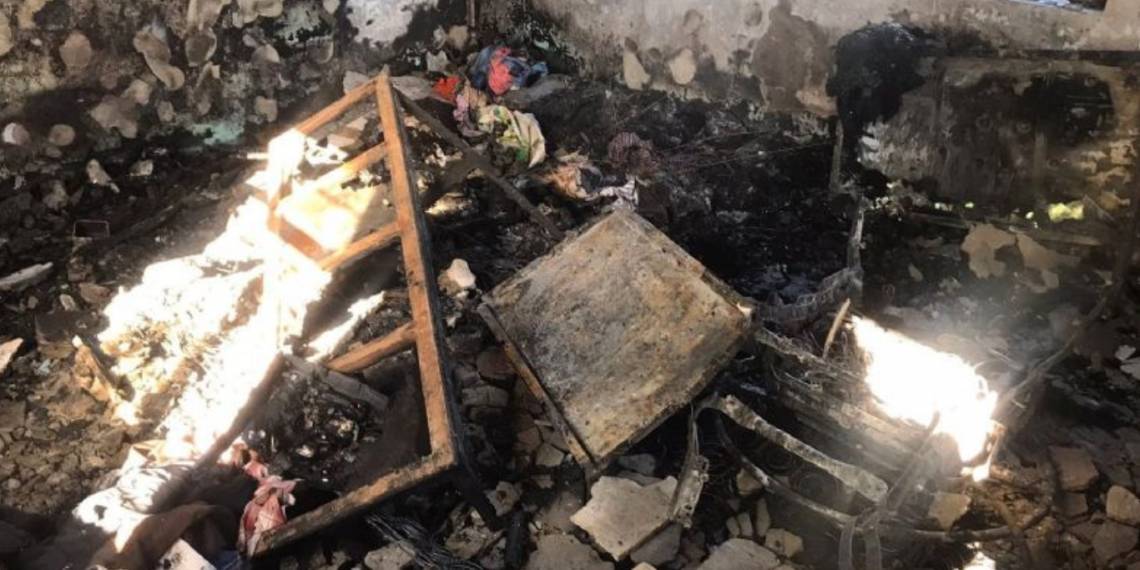
Vandalism broke out again yesterday at the Cefas prison. Women armed and wearing balaclavas started the fires, but they have since been brought under control by the Honduran Fire Department, the deputy minister confirmed.
For her part, Delma Ordóñez, director of the Association of Inmates, stated that the scenes at the women's prison in Támara were horrific, unlike anything ever seen before at that facility. She also clarified that there were no minors inside the prison.
Massacres like yesterday's at the Cefas prison are primarily triggered by overcrowding. The overcrowding of incarcerated individuals in detention centers nationwide is a long-standing problem that unleashes chaos.
However, to date there is no government or authority to stop the violence in these places where life is lost in a second, despite being under the protection of the State.
Prisons are considered time bombs because people deprived of their liberty have no guaranteed rights, even though by law and as a human right they only lost the right to freedom.
Violent acts like the one that plunged the country into mourning yesterday are, for some, acts of sabotage intended to destabilize the Castro government. However, criminal lawyer Salomón Amador Barrios asserts that the commission tasked with overseeing the prisons failed because it was not composed of experts in prison management.
Furthermore, the Inter-American Commission on Human Rights (IACHR), during a recent visit, learned about the situation of people deprived of their liberty in Honduras. Its assessment was alarming.
The Commission received alarming information that Honduran prisons are characterized by corruption. This has facilitated the entry of high-caliber weapons, self-governance by inmates, and a complete loss of state control.
This situation is especially prevalent in maximum security centers, mainly due to the insufficient number of guards and the limited security equipment.
“No more emissaries”
Following the massacre at the Cefas prison, President Xiomara Castro expressed her solidarity with the families. In a tweet, she stated that she was shocked by the monstrous murder of the women.
The president asserted that the attack was planned by gangs with the knowledge and acquiescence of security authorities. “My condolences to the families. I demand accountability from the Minister of Security and the president of the Intervention Commission. I will take drastic measures!” she warned.
Jessica Sánchez, from the Civil Society Group , responded to Xiomara Castro on social media. “President, we are pleased that you are committed to the investigation of the murders at Cefas. Now, we await your call to speak with women and feminists about our country having one of the highest rates of femicide in Latin America. No more emissaries; we demand direct dialogue with you, because what happens to one happens to all. It is time for violence against women to be a state priority. It is time to listen to each other,” Sánchez tweeted.
The UN Resident Coordinator in Honduras, Alice Shackelford, also sent her message of condolence. “My solidarity is with the women at the prison in Támara, and I strongly condemn the violence. On March 8, we celebrated International Women's Day there with some of the women, listening to their stories and dreams. My heart aches, and I share in the grief of their families.”
For her part, U.S. Ambassador Laura Dogu expressed her condolences to the loved ones of the women “senselessly murdered” at the National Women’s Penitentiary for Social Adaptation. “This tragedy exacerbates serious concerns about the safety and human rights of all persons deprived of their liberty,” she stated.
Jaume Segura, the European Union ambassador to Honduras, also stated that he was “deeply shocked by what happened at the women’s prison in Támara, which I visited on International Women’s Day. My condolences to the families of the victims. No form of violence that threatens the personal safety of individuals is justifiable.”
Meanwhile, Natalie Roque, Secretary of Human Rights, said that neither the nursery module nor the gymnasium nor modules six, seven and eight and the reflection module were affected by yesterday's violent events at Cefas.
According to lawyer Joaquín Mejía, it is essential to investigate and hold political accountable the authorities responsible for the prison system. He also demanded that criminal charges be brought against those who had direct custody of the women incarcerated who died violently.
Furthermore, the OHCHR called on the State to investigate the events, prevent their recurrence, and protect the lives of people deprived of their liberty.
Finally, the head of the Secretariat of Social Development (Sedesol), José Carlos Cardona, stated that, by order of the president, Proasol and Sedesol will take care of the funeral expenses of the murdered women.
We are present
We are committed to journalism that delves into the territories and conducts thorough investigations, combined with new technologies and narrative formats. We want the protagonists, their stories, and their struggles to be present.
SUPPORT US

FOLLOW US
Related notes



We are present
This and other stories are not usually on the media agenda. Together we can bring them to light.