

Cachitas Now!: The Argentine dissident cumbia band touring the United States
Touring the United States with Cachitas Now!, the Argentine tropical music band that carries its message of inclusion and resistance to sexual and gender minorities, in a complex scenario.


Share

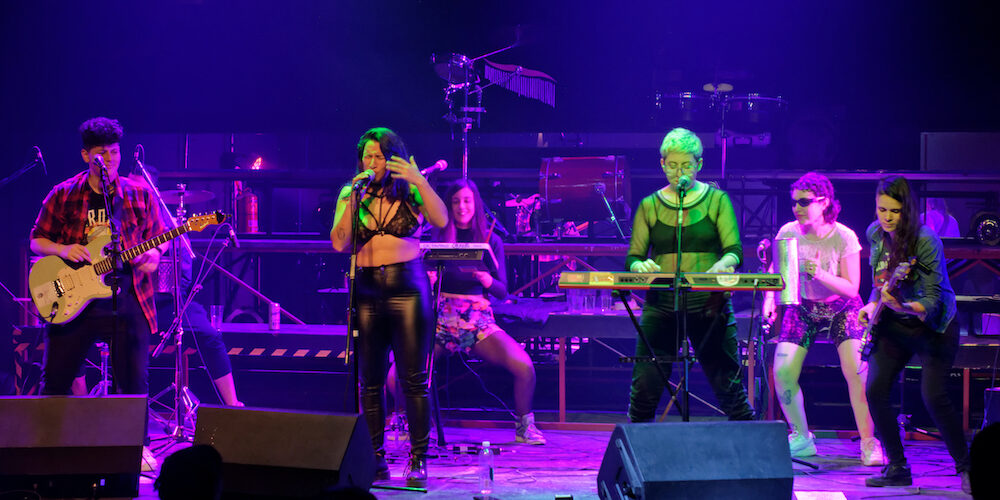
DAYTON, United States. Cumbia takes you everywhere. From Gobernador Costa to Buenos Aires, from Esquel to La Plata, from Berisso to New York, and from Tucumán to Norway. These are some of the life routes of Cachitas Now!, an Argentine dissident cumbia band that, for the first time, reunited all its members to tour the United States.
The term " dissident cumbia" is a bit of a stretch. If you ask them, Cachitas Now! prefer to identify as a collective of diverse identities that writes, produces, and sings cumbia . Their lyrics address their LGBT+ experiences in Argentina and the cultural crisis their identities face in the country. Their mission: to infuse cisheteropatriarchal culture with carnival , to invert power structures, to deconstruct gender roles, and to challenge heterosexist, binary, and romantic norms.
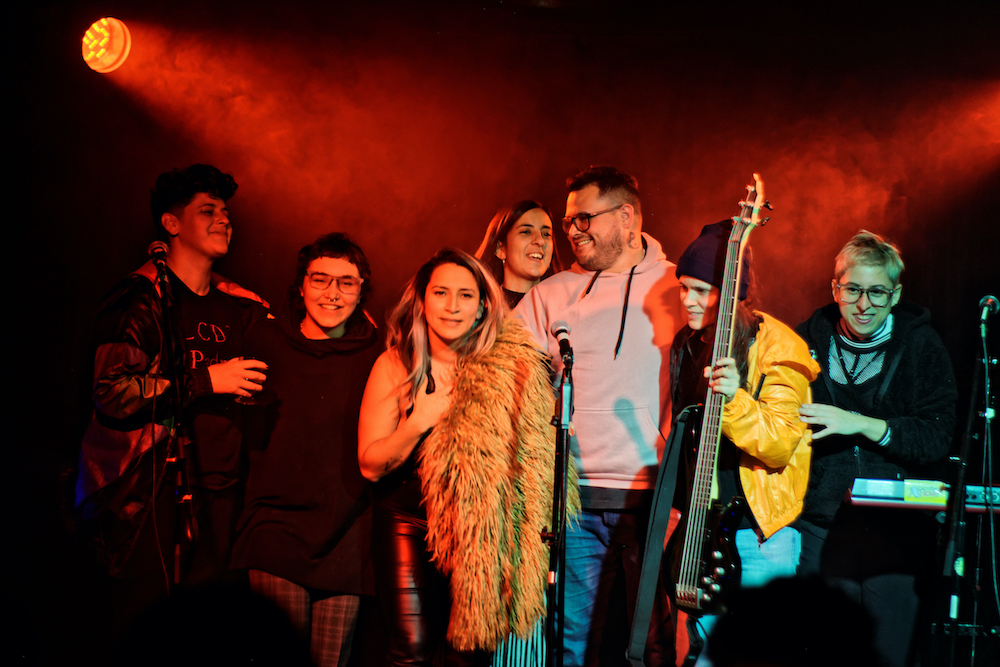
For all these reasons, among many other bands, Cachitas Now! was selected by the Center Stage to tour various cities in the United States: Dayton, Pittsburgh, New York, Washington, Baltimore, Greenfield, Barnard, and Hanover. This program (run by the U.S. State Department's Bureau of Cultural Affairs and administered by the New England Foundation for the Arts, under the direction of Lisa Booth Management, Inc.) aims to foster cultural exchanges to share the initiatives, experiences, and discussions of artists from different countries around the world.
Dissident and educational cumbia everywhere
“When they interviewed us, we explained why it was necessary for them to choose us for this tour. We made it clear that, in addition to being a dissident cumbia band, we are teachers and we carry tropical rhythms as our banner in many different spaces. We also work on Comprehensive Sexuality Education in schools . That's what Cachitas Now is all about!” explains Melisa Lobos (vocals).
I also went through a selection process to come here. “We want a journalist who can report on what happens with the band while they’re in the United States. Someone who can document the anecdotes, the bizarre moments, everything that might happen and that you think would be interesting to share with young people in Argentina,” they told me that day. My task is this: to witness what happens, observe everything, and write.
Cachitas Now! has cumbia in their veins. Born in 2011—in the context of an emerging Latin American music movement that sought to reinvent the tropical repertoire in Argentina— the group began as a band of women and lesbians . Many things have happened since then: the demonstrations under the slogan #NiUnaMenos (Not One Less), the passage of the Gender Identity Law and the Law on Voluntary Termination of Pregnancy, after years of struggle and trans-feminist visibility in the streets.
With no LGBT+ role models in the bands they listened to, the question of other identities and the need to learn about experiences outside of heteronormativity brought new questions to the band..
Let no one be left out
“We take our place on stage, we do what we love, and we don't offer explanations. Words often exclude , and we didn't want that to happen at our shows. There are sectors where the words 'patriarchy' or 'transfeminism' don't resonate , because they're words that circulate only in certain circles. Our music is designed so that everyone can access it, so that no one is left out because they don't understand,” explains Noelia Sinkuna (backing vocals and keyboards). Noelia was recently awarded the Gardel Prize for Best Alternative Folk Album for her solo project.
But does cumbia exist in the United States? “For us, cumbia is a popular genre; it permeates all aspects of life. Here, we're not sure how it will be received. We don't really understand what kind of music people dance to,” says Guadalupe Mambrin (octapad). “We receive a cultural education from the United States through the film and television industry. We know their humor, we know their food, but they don't know our culture.”
First stop: LGBT+ minorities in the USA today
Dayton is a small city in the United States, in southwest Ohio. What they call a really small town here. Paradoxically, it's also the largest city in Montgomery County. And, according to the 2020 census, its population is estimated at 138,000. Dayton has a growing LGBT community, an organization called the Greater Dayton LGBT Center that offers comprehensive services to sexual and gender minorities in the Dayton and Miami Valley area, and a vibrant cultural scene for members of the community. Perhaps that's why it was the first stop on the Cachitas Now! tour.
The fact that the tour was planned for June was no coincidence: in the United States and many parts of the world, this is LGBT+ Pride Month, commemorating the Stonewall riots . The goal of this cultural initiative is for the invited bands from other countries to contribute to current cultural debates, including the issues faced by the LGBTQ+ community, inclusion, and gender equality. “The main issue in the United States today is acceptance. Why do we need to create a culture of acceptance for the LGBTQ+ community?” explains Nycia Lattimore, president of the Greater Dayton LGBTQ+ Center.
So far in 2023, at least 422 bills are under review in the United States, and 26 anti-trans laws have been passed in states governed by the Republican party.
“ Equality is not within reach, and often not even in sight , for all people affected by violence and discrimination based on sexual orientation and gender identity in the United States,” said the Independent Expert on protection against violence and discrimination based on sexual orientation and gender identity in a UN statement . He added that some state governments deliberately undermine the human rights of the LGBT community, which also suffers disproportionate violence, particularly if it is people of color.

“Many times we have to go through a whole coming-out process. We have to keep our identities private or deny them in certain situations to preserve our lives, even prove that we are members of the community because we often hear the infamous 'you don't look gay or lesbian or trans.' What is someone from the LGBTQ+ community supposed to look like? We are all human, right?” Lattimore concludes.
Proud and resilient cumbia
For the president of Greater Dayton, the only way to fight the advance of anti-trans and anti-gender measures in the United States is to have allies. “Recently, Florida rolled back some of its inclusion and diversity laws in schools. We wrote to legislators, asking the entire community to call their friends to vote, because only they can change the current laws.”
“Having a band like Cachitas here is very important for exchanging experiences of diversity and inclusion in different countries. It’s incredible to see how, despite the distances and differences, there are similar situations we go through as a community . For example, that in smaller cities it’s much harder to be visible than in big cities ,” Lattimore explains.
According to the president of Greater Dayton, the current setback in LGBTQ+ rights is linked to the reemergence of certain stigmas that impact the lives of this population. How? By limiting sex and gender education, access to gender-affirming treatments, and participation in sports activities, among other things.
In this context, Cachitas Now! took to the stage at Levitt Pavilion, a free, open-door event in a Dayton city park. They sang their message: in Spanish, playing cumbia, and with pride. “It’s important for us to open our doors to bands from all over the world and promote cultural exchange. In the end, while different, music from all over the world speaks a common language. Dayton has a large LGBTQ+ community, and it’s good to learn from the experiences of bands from other places, to hear what they have to say, to see how LGBTQ+ issues are experienced here and there, what they have in common and what is different,” concludes Lisa Wagner, Executive Director of Levitt Pavilion in Dayton.

We are present
We are committed to journalism that delves into the territories and conducts thorough investigations, combined with new technologies and narrative formats. We want the protagonists, their stories, and their struggles to be present.
SUPPORT US

FOLLOW US
Related notes

We are present
This and other stories are not usually on the media agenda. Together we can bring them to light.