

They tried to assassinate trans activist Paulette Cárdenas in Mexico City
The assailant fled after hitting Paulette with his car on Tlalpan Avenue.


Share

On the night of May 25, Paulette Cárdenas, a trans activist and sex worker, survived an attempted femicide while working on Tlalpan Avenue in Mexico City. The assailant fled after hitting Paulette with his car. Ten hours after the incident was reported, an investigation was opened for attempted femicide.
Paulette is a member of Lleca , an organization that provides care to women and LGBT+ people who live on the streets; and she also works as a sex worker.
two attempted transfeminicides were recorded in Mexico City, including that of activist Natalia Lane .
The facts
Paulette was working in the Tlalpan area when a man under 30 years old parked his car and began taking photos and videos of the sex workers there. Paulette and other sex workers told the man to stop taking pictures and leave. The man, who was driving a white, four-door car with untinted windows, ran her over.
“I approached him to tell him to leave, and then the guy started arguing. He tried to punch me in the face, and that's when all the sex workers realized what was happening and came to our defense. The guy crossed the street, waited a few minutes, drove off in his car, and left,” Paulette recounted in an interview.
“Five or ten minutes passed when out of nowhere the car came up behind me and hit me. I went flying, I fell to the ground, my head hit the pavement. Thank God it didn't run me over, and I was conscious but in shock. The guy fled, and the only thing I heard were my friends screaming. You never imagine that a guy in a car is going to try to kill you,” Paulette adds.
Sex workers in the area called emergency services. Paulette alleges that the ambulance crew who arrived refused to treat her, and the police also failed to take action.
Paulette traveled to a hospital using her own resources, accompanied by Victoria Sámano, her friend and founder of Lleca.
Institutional violence: “the orthopedist refused to examine me”
Paulette arrived at the IMSS General Hospital of Xoco after 10 p.m., having been hit by a car. There, she was told she first had to file a report with the Public Prosecutor's Office so that a forensic doctor could examine her and document her injuries.
Upon arriving at the Public Prosecutor's Office to report the events, Paulette and Victoria Sámano were discriminated against by the staff, who, in addition to not respecting their gender identity, asked them to go to another Public Prosecutor's Office to file their complaint because they did not have a forensic doctor there.
Paulette returned to the Xoco Hospital and after more than two hours of waiting, she was finally seen.
“The radiology technician mistreated me and Victoria as well. The orthopedist mistreated me and refused to examine or touch me. Only one doctor in that hospital was genuinely empathetic and humane,” says Paulette.
The orthopedist's diagnosis was: "grade 3 sprain in the spine and neck."
According to the IMSS (Mexican Social Security Institute) "Care of the Patient with Cervical Sprain at the Primary Care Level ," the physician must clinically confirm the diagnosis of cervical sprain and classify it according to the Quebec Task Force, which comprises four diagnostic grades. Grade 3 indicates: "presence of cervical symptoms and neurological signs." According to this document, only in grade 1 is the use of a cervical collar not recommended.
Paulette left the hospital with only a prescription for anti-inflammatories and without a neck brace. At no point did they perform any tests on her skull, even though her head hit the pavement when she was run over by the assailant.
It is being investigated as attempted femicide
The next day, May 26, Paulette went to report the attack at the Prosecutor's Office for the Investigation of Crimes Committed Against Priority Attention Groups of the Attorney General's Office of Mexico City, where an investigation file was opened for attempted femicide.
The complaint process took 10 hours. Paulette was accompanied by Victoria Sámano and Frida Guerrera, an activist who has been denouncing femicides in Mexico since 2016 and has experience accompanying victims to prosecutor's offices.
Paulette says that unlike the MP, in that Prosecutor's Office they were treated with respect, but she notes that despite being a specialized prosecutor's office they lack training.
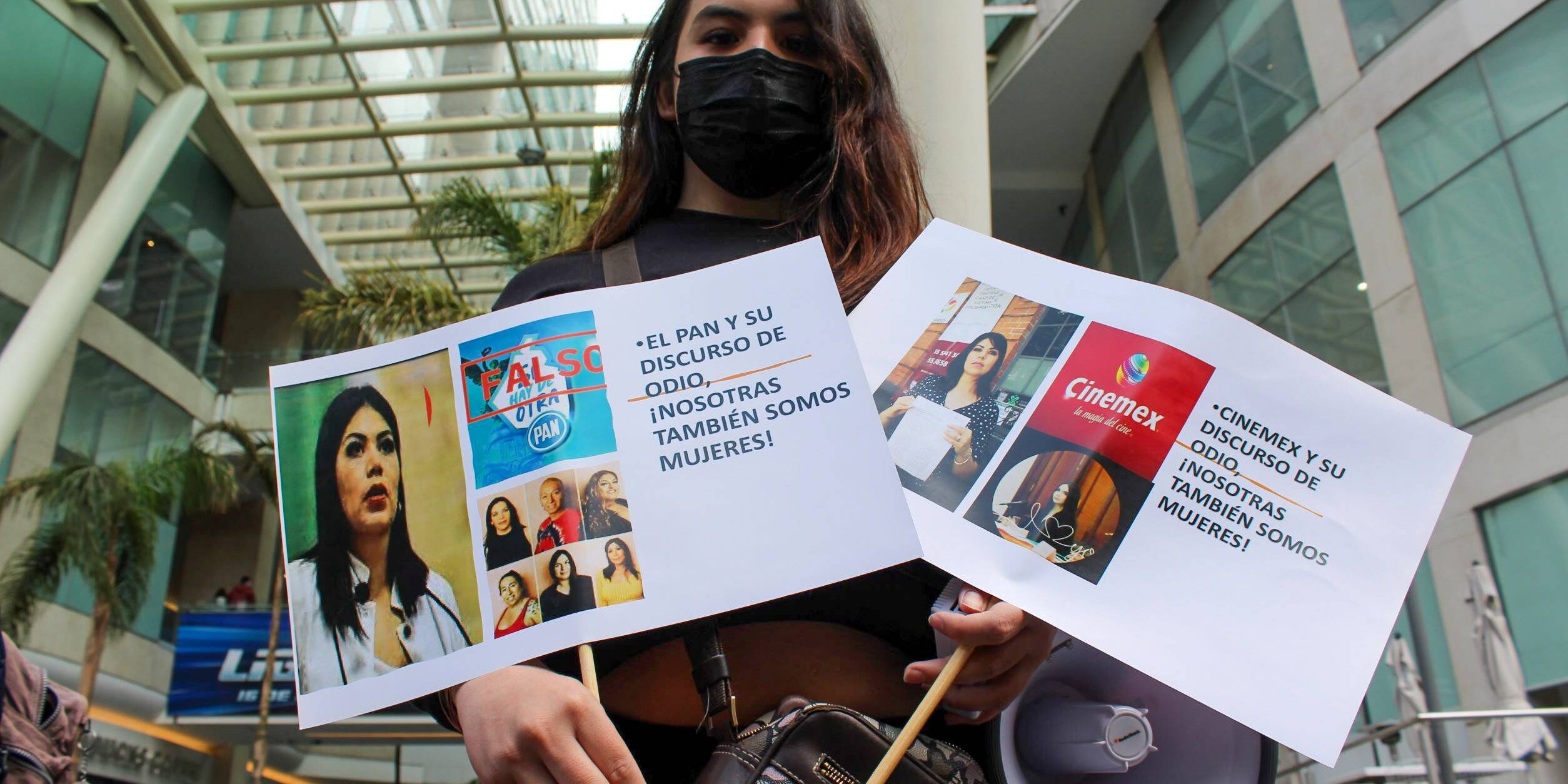
“An investigation was launched for the crime of attempted femicide. We presented the evidence, requested the preservation of the security cameras, and it was taken into account that I am a trans woman who works as a sex worker. Even my previous complaints against Cinemex , the online harassment I experienced from Congresswoman América Rangel , and the complaint regarding threats, discrimination, and physical assaults we suffered while Mexico City Congress
Paulette told Presentes that the complaints included in the investigation file for attempted femicide have resulted in threats and hate messages on her Twitter account for at least a year. Following this, Victoria Sámano , Alaín Pinzón , and other LGBT+ individuals and activists reported on social media that they received threats and hate messages in the days leading up to the attempted transfemicide she suffered.
This would be the second case in Mexico investigating the attempted femicide of a trans woman. The first case brought to justice, that of Natalia Lane, “has been slow, violent, and negligent,” according to a report published in Open Democracy Now by journalist Gabriela Mesones.
“Once again, the work of providing support falls to civil society.”
So far, no state institution or human rights organization has approached Paulette Cárdenas or any of the organizations that support her in order to provide support or advice.
“Once again, the work of supporting victims falls to organized civil society. Where are the state's sexual diversity institutions when this type of violence arises? We are the ones who step in to support our peers, our sisters; and it becomes even more complex when we have to support our colleagues in more precarious situations,” Victoria Sámano Presentes
She added, “Institutions and officials either turn a blind eye or refuse to see that trans women are living in conditions inferior to the rest of the population, and the hate messages we receive on social media are based on institutionalized transphobia.”
“Victoria and I are proof that the discourse on social media brings violence into the physical, the real, the everyday lives of trans people. I don’t know what people, what institutions, are waiting for. Do they expect someone to be almost dying for their complaint to be credible and for them to act?” Paulette concluded.
We are present
We are committed to journalism that delves into the territories and conducts thorough investigations, combined with new technologies and narrative formats. We want the protagonists, their stories, and their struggles to be present.
SUPPORT US

FOLLOW US
Related notes


We are present
This and other stories are not usually on the media agenda. Together we can bring them to light.