

Jewish and LGBT community lives: “You can’t be Jewish in isolation”
Stories and experiences about how sexual diversity is lived in the Jewish community of Argentina.


Share

BUENOS AIRES, Argentina. It could be said that the Jewish people are, above all else, the people of the Torah (the Old Testament of the Bible). Each scroll of this, the most sacred object of the religion, must be carefully handwritten by a scribe (sofer). At prayer time, the congregation must stand when the Torah is taken from its ark, and halakha – Jewish law – is based on its words.
It is in the Torah, specifically in Leviticus 18:22, that we find what for millennia has been interpreted as an explicit prohibition of homosexuality: “You shall not lie with a male as with a woman; it is an abomination.”
However, this verse allows for another possible interpretation. Of course, “you shall not lie with a male as with a woman” is simply impossible, since they are different identities. But why would a gay man actually want to lie with a male “as with a woman” if his sexual attraction is not toward them?
Readings, interpretations, realities
Another possible interpretation compels us to consider the historical context. Could it perhaps refer to promiscuous sexual practices as a form of pagan and polytheistic worship practiced by the ancient Greeks and Egyptians, cultures from which Judaism, as a monotheistic religion, sought to differentiate itself? It is also worth noting that the word “abomination” ( toevah in Hebrew), which sounds so harsh in our contemporary reading, is used throughout the Torah to identify things as varied as idolatry, eating forbidden animals, and dishonesty in business.
Another interpretation comes from Rabbi Diego Vovchuk of the Or Israel community, who told Presentes that the verse is at the end of the list of all relationships considered incestuous. “One interpretation I like is that what it's really trying to say is that the same relationships that are prohibited between a cis man and a cis woman are also prohibited for a same-sex male couple.”
The list of possible interpretations goes on. The Jewish people are, above all else, the people of the Torah, and as such, they have not only the permission but the obligation to read and reread it, to engage with the text, and even to argue with it. “The Torah must be constantly reinterpreted because the paradigm demands it,” said Diego Vovchuk.
For his part, Gustavo Michanie, former president of JAG, pointed to another interpretation of the Torah that supports diversity in Judaism. “We were pioneers in something: surrogacy. Abraham couldn't have children with Sarah, and that's where the first one came from.” Leandro Kaus of Hamakom LGBTIQ+ said that “if you want to find a story about transvestites, for example, you'll find one: there will be one who passed as a woman but was a man.”
This openness exists in the more open branches of Judaism: the conservative and reform communities that, unlike the orthodox ones whose reading of biblical texts is more rigid, present an endless number of interpretations that perfectly allow the coexistence of community and religious life with being part of the LGBT community.

Photo: Courtesy of Cecilia Frenkel.
Jewish LGBT movements
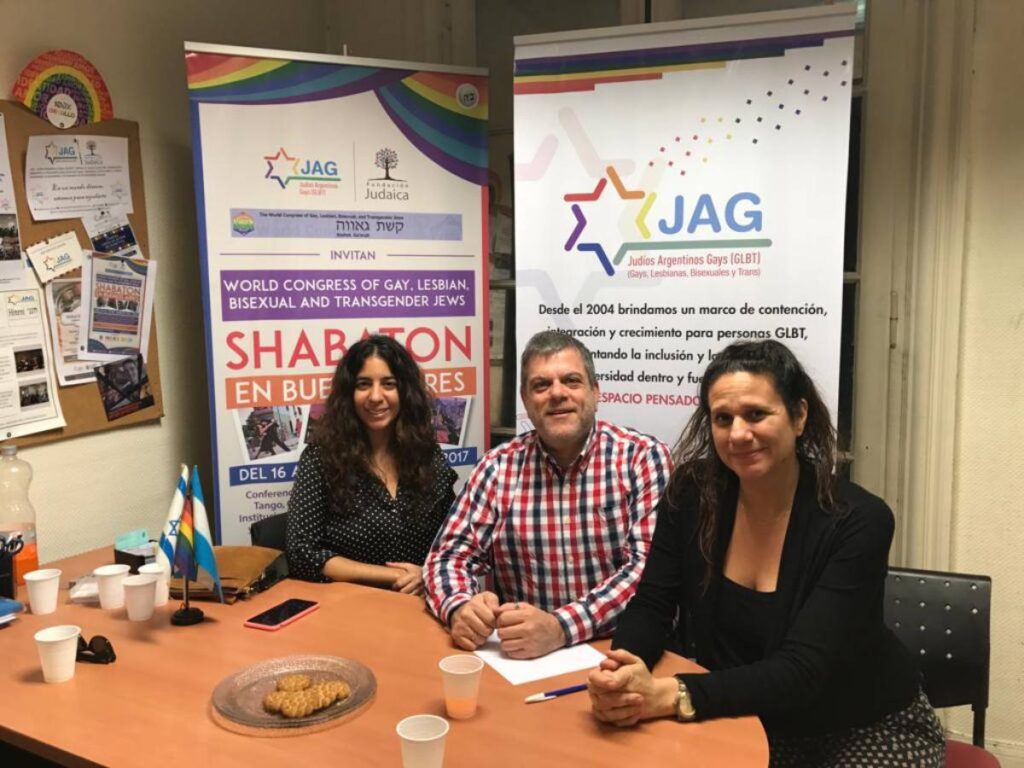
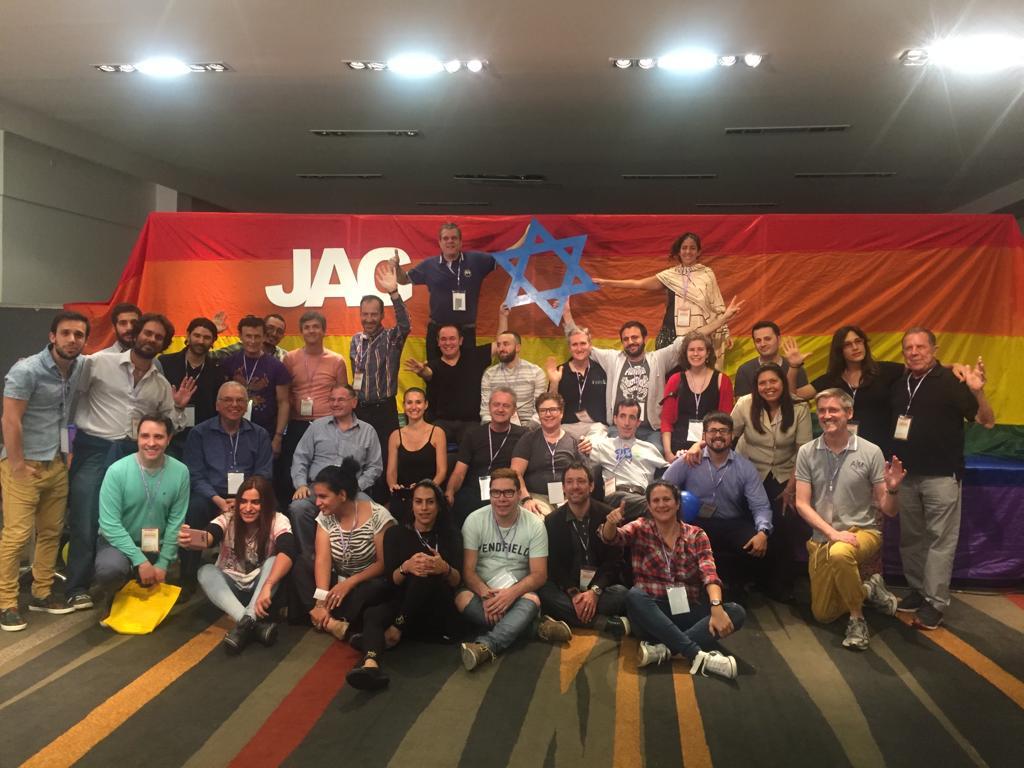
In 2004, a group of gay Argentine Jewish friends wanted to reflect this diversity within the Jewish community in an institutional way. So they decided to name the first LGBT Jewish organization: JAG, which not only stands for Gay Argentine Jews , but also means "party" in Hebrew. "The idea was to have a recreational space," said Gustavo Michanie, former president of JAG. "At that time, the topic was never discussed, and no one dared to come out of the closet."
Thus, JAG functioned not only as a space to go and discuss films, listen to talks by rabbis, celebrate a Shabbat dinner, or play bingo. Above all, it became a space of support. “Once, during a Passover celebration, a man in his fifties approached me and started crying,” Michanie told Presentes . “He told me that when he was 22, he had been kicked out of his home because he came out as gay, and that he had never again shared a family seder like the one that day.”
JAG's work was also intertwined with activism. In 2010, they collaborated with other national LGBT organizations to secure the passage of the Equal Marriage Law. During that period, they held talks with senators and also with rabbis from Orthodox movements. "We always prioritized dialogue," Michanie emphasized. "If the Orthodox tell me no to something, I sit down and talk. Today, I have a good relationship with Orthodox rabbis who invite me to their congregations and call upon me to participate."
JAG has not been active for years, but its work paved the way for the development of similar activities in other institutional spaces. Today, there are several organizations that either have a focus on gender and diversity, such as Judies Transfeministas , or carry out some activities with that perspective, such as Fundación Hillel .
One of these programs, Hamakom LGBTQI+ , emerged in November 2021 with the intention of providing a framework for young LGBTQI+ Jewish people. Today, the project is run by Leandro Kaus, Abigail Lichtenstein, and Constanza Ros.
“We encountered many people who were already involved with the community, as well as people who had no idea about it and approached us because they learned about this kind of project,” Kaus told Presentes . “There are all kinds of people; people who are out of the closet and people who can’t come out because they come from very religious communities. The idea is to support them and also propose events for the rest of the Hamakom organization with the aim of educating about diversity.” The goal of these spaces is also to receive questions not only from LGBT youth, but also from their parents and families. “We show them that there is a community and support system, that their child isn’t planning a life of isolation,” Kaus added.
Recently, Hamakom LGBTIQ+ joined the World Jewish Congress LGBT , as JAG had done previously. There, they learn about the practices of different communities around the world. Mexican society, for example, is much more conservative, while in Brazil they have rewritten the berachot (blessings) in inclusive language. LGBT Jewish movements exist all over the world, from Israel and the United States to various countries in Latin America and Europe. The first inclusive chuppah in the region, however, was in Argentina.
First equal chuppah
Romina Charur decided to approach JAG when she wanted to marry Victoria Escobar under a chuppah (that is, according to Jewish tradition). To do so, she first approached the NCI Emanuel , where Rabbi Karina Finkelstein was the rabbi at the time. “At that time, it wasn't even discussed,” the rabbi explained to Presentes . “It couldn't be my decision because it would change the history of the congregation; it had to be the community's decision.” Finkelstein, then, began as she always does when a couple tells her of their decision to marry: she encouraged Romina and Victoria to become involved in community life. They started attending Shabbat services and the temple's social activities. Thus, when they finally married, “they weren't the odd family out in the community; they were a family within the community,” Finkelstein explained.
Before getting married, Romina joined the NCI Board of Directors. It was there that she began working on the responsa of the Rabbinical Assembly of the World Conservative Movement, which allowed same-sex couples to marry within Judaism as long as the community adhered to it. On March 21, 2016, NCI was the first in Latin America to do so, and unanimously. “It was truly a very important step forward for the community in general because it opened doors for many other communities to follow suit,” Romina said. “Two weeks later, Diego Vovchuk got married, and then many other families followed suit.” Since 2018, Romina has been president of JAG.
“The most important aspect of this process was community education, both for them and for the rest of the community,” Finkelstein noted. “You can’t be Jewish in isolation: you have to build community. In the end, the physical location of the community doesn’t speak to people; what speaks to them is the idea you have. The place is a table anywhere in the world where Torah is discussed. That’s the most creative aspect of the Jewish world.”
We are present
We are committed to journalism that delves into the territories and conducts thorough investigations, combined with new technologies and narrative formats. We want the protagonists, their stories, and their struggles to be present.
SUPPORT US

FOLLOW US
Related notes


We are present
This and other stories are not usually on the media agenda. Together we can bring them to light.