

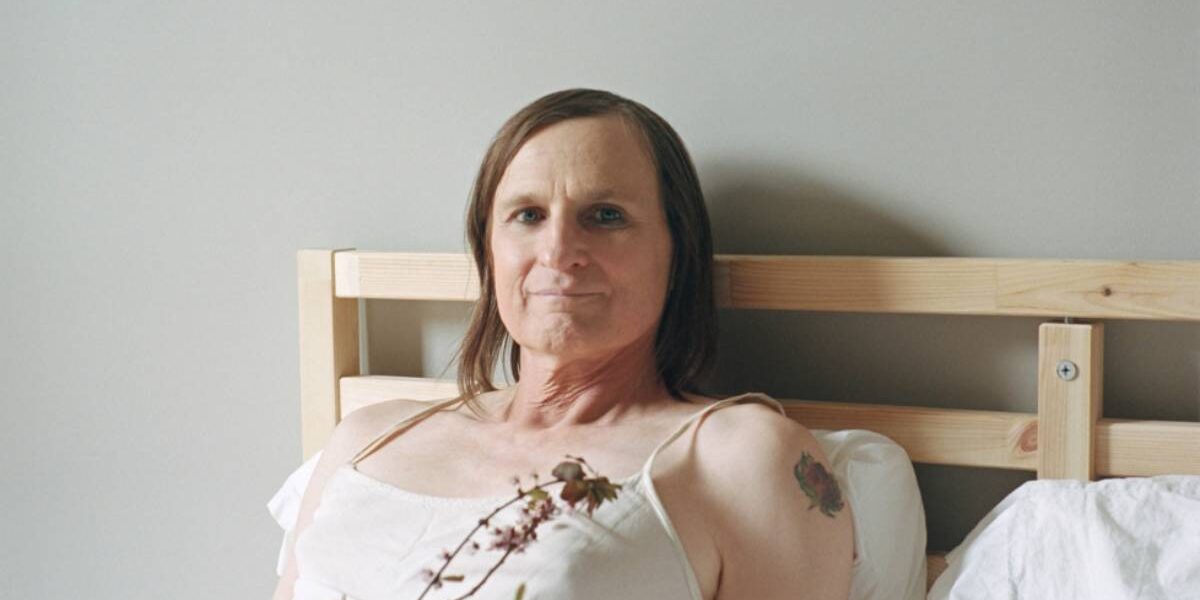
McKenzie Wark: "When you're trans, people assume that's all you know."
The Australian academic's first novel, Reverse Cowgirl, is an "autoethnography of the opacity of the self." With it, she seeks to write for "other trans people, to tell each other's stories."


Share

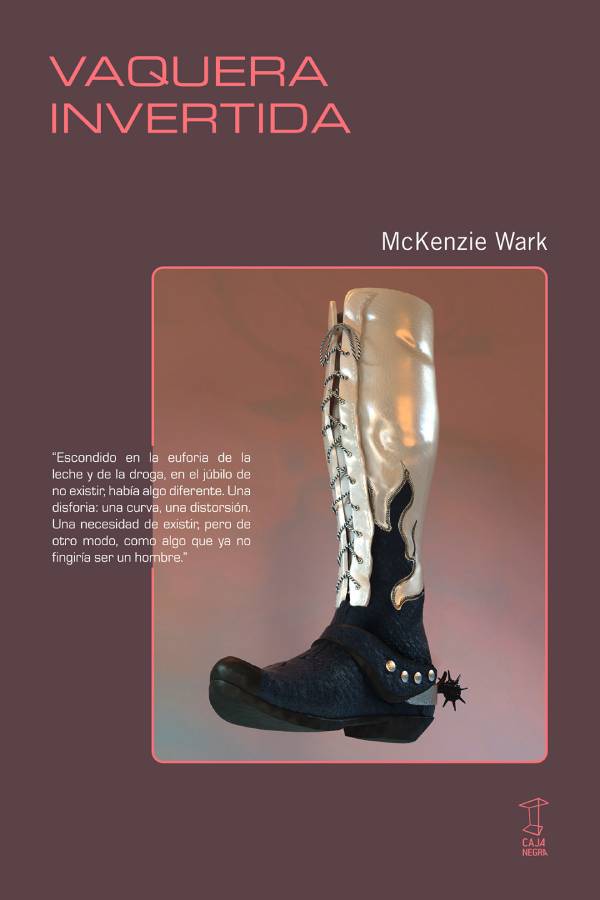
Known for her essays, academic McKenzie Wark—who also describes herself as “an icon of theory, a bad Marxist, and a transsexual menace”—makes her fiction debut with *Vaquera invertida* (Reversed Cowgirl ), published in 2022 by Caja Negra Editora . Its warm reception in the Spanish-speaking world has taken her on tour to Argentina and Spain, where she recently visited several cities to present the book, lead writing workshops, and even recite excerpts from her upcoming project over a techno beat.
The boundless energy she brings to every meeting is the same energy she uses to write now that her transition has led her to experiment with new techniques and languages. And she manages to gather—in the author's words—"a small community of readers who connect with the experiences narrated in the book, spreading it by word of mouth and contacting me to talk about it, which is truly exciting."
We took advantage of his visit to Barcelona to ask him about some of the themes explored in the book, which he does not define as a biography or a memoir but as an “autoethnography of the opacity of the self”.

–In Cowgirl *, you narrate several episodes related to intimacy and desire in which you didn't fit into either the heterosexual or gay man categories. The story ends with your transition, but instead of presenting some kind of inner truth—through which "something that was always there in secret is finally revealed"—you start from the confusion regarding the opacity of the self. What narrative form would be most appropriate to describe the trans experience?
“I’m interested in writing for other trans people and expanding the kinds of stories we can tell each other, but also the underlying philosophies of subjectivity . Classic trans memoirs—'they thought I was a boy, but I played with dolls, I was born in the wrong body'—didn’t work for me; I didn’t feel that way at all. They didn’t work on a narrative level, but neither did they work on a philosophical level: there’s no inner truth, only an internal fiction of the self . So, can we have not only other stories, but also other ways of conceiving of the body, identity, or memory? For me, that kind of opacity of the self toward itself is important. In the act of creating a narrative of one’s own life, how are we creating ourselves and retrospectively pushing the timeline back into the past? Is there an art to modifying one’s own internal fiction?”
–This reminds me of Sandy Stone's Post-Trans Manifesto, in which she criticizes the obligation for trans people to present a single, all-encompassing identity in order to "pass," thus denying significant aspects of their past instead of acknowledging their personal history in all its complexity. Do you think this is something specific to trans identity or to the way all identity is constructed?
I think the stories we use to explain ourselves come later as a justification for a series of accidents, and some of this is found in Post-Trans Manifesto . The word "post-trans" never caught on, and at least in the English-speaking world, the people around me want the word "trans" back. By using the word "transgender," it seems to be solely about social roles. I think what's specific to transsexuality is the modification of the body, but we try not to make too sharp a distinction between ourselves and to have as open a view of trans as possible. In any case, Sandy's text—which was written in the mid-1980s—opened up this question: can we find other ways of being trans in the world and tell stories differently? Can we have our own culture that isn't directly aimed at cis people? That was one of Sandy's goals, and many people accepted the challenge. We've always had our literature and our art, but now we're allowed to do it on our own terms instead of affirming cis ideas . However, I also want cis people to think differently about the body, subjectivity, memory, and experience. Many non-trans people like * Reverse Cowgirl* because it presents a way of understanding identity that goes beyond the trans experience. It's a kind of double wish: that there be more books written by and for trans people, but that they don't just expand on our stories, but also problematize the experience of cis people .
The challenge of reflecting on sexualization
–Your process of self-understanding involves encounters with other bodies: you explain that sex represents for you a “euphoric moment of gender loss” or, more radically, a dissolution of identity into non-existence. To what extent should we continue to consider sexuality (or sexual orientation) and gender identity as two strictly separate things?
“I’m not suggesting this is a universal theory or anything like that. Like many trans people, I’ve experienced a lot of dysphoria, but I also wanted to write about gender euphoria . It’s important for people to be able to find moments of intensity around gender. However, mainstream trans narratives have avoided the topic of sexuality because of prejudice and stigma. In patriarchy, to be a woman is to be sexualized, but to be a trans woman is to be hypersexualized by everyone , including other cis women; so talking about transness when cis people can hear us involves certain difficulties and dangers. Even so, I think it’s worth taking the risk to have an honest conversation about how we discover our bodies, our gender, and our sexuality, sometimes all at once. Let’s think for a moment about trans lesbians: the mislabeled category of trans women who are accused of autogynephilia.” Perhaps it would be helpful to have a conversation about the link between sexuality and gender, and to understand what's called autogynephilia as arousal from one's own gender experience through sex. I want everyone to have that experience, to feel good about their gender and comfortable in their own body. Why would that be a bad thing?
–In relation to this, you explain somewhat ironically that – despite having dedicated all these years to reading gay and queer theory – being fucked has helped you to reaffirm yourself as a woman, and you allude to “the great asymmetry of the human being: there are penetrators and penetrated.”
–When I wrote *Reverse Cowgirl*, I had a personal theory about penetrability that I'm not sure I'd agree with now, although I still think that this openness of the body is linked to certain experiences of desubjectification or gendering. This also determines which people or groups are considered feminized, including cis women, certain types of gay men, and trans women. To what extent have these experiences been treated as categorizable or related to the feminine? Could we articulate a discourse on femininity, its diverse expressions, and forms of solidarity around it? It's a project I'm starting to call feminism.
–In the book, you also explain how important hormones—or “anti-cis-taminics”—have been in terms of gender affirmation. Going back to what you mentioned earlier about body modification and the word “transsexual,” it sometimes seems problematic to talk about dysphoria because of the risk of adopting a transmedicalist position. How can we address this experience, so common among trans people, without making it a requirement for a “legitimate” trans identity?
Gender dysphoria is difficult to explain to those who have never experienced it. Not all trans people identify with the term or experience dysphoria, but most do, and hormones or surgery don't always work; they can alleviate the symptoms, but not the causes. In my case, I wrote * Reverse Cowgirl* before I started hormone therapy. By then, I had already publicly come out as non-binary. In the final pages of the book, I abandon masculinity, but without knowing where I'm going. I wanted to invert the structure of classic trans memoirs, with an arc that goes from not-knowing to knowing ("I'm actually a woman" or "I'm actually a man"). I have no idea where I'm going or what my gender is; I only know that it isn't that. There are other writings that deal more directly with the experience of hormones. I would love for us to describe in more detail which hormones we use and what their subjective and aesthetic effects are. Can we have an aesthetic of transition instead of a medical or legal discourse? What is the art of being trans?
–In addition to gender dysphoria, you talk about another experience closely linked to it: dissociation.
The beginning of the book deals with the first time I dissociated. I was told my mother had died when I was six, and I had an out-of-body experience. It took me a while to realize that dissociation is a result of that traumatic moment, but also of dysphoria. I found a way to turn dissociation into something useful: writing. When I started hormone therapy, I stopped writing for three years. Imagine being right-handed and having to do everything with your left hand for a while: that's what it felt like. I was so bad at it that I had to relearn how to write, and now I do it in a very different way.
“Raves are a safe way to reconnect with my body”
–This new way of writing can be found in your latest book, Raving , which seems to follow some of the lines drawn in Reverse Cowgirl . What is the relationship between transitioning and going to a rave?
“I went back to raves after transitioning because I was still experiencing very diffuse dysphoria, which wasn’t localized to any specific part of my body. That’s why I didn’t consider surgery; I could have surgery on my face or breasts, but it wouldn’t make me feel better. It works for other people, but what helps me is dancing. Raves are a safe way to reconnect with my body; and I can’t be the only one it works for, because I meet so many other trans people. For a while, all I did was go to raves. So when Margret Grebowicz asked me to write a short book for this collection called Practices (Duke University Press), I thought this was the only topic I could write about.”
Raving isn't a memoir; it's about a contemporary experience. How can perceptions and experiences be less about the self and more about the situation? There's another question that interests me: why does techno continue to generate attention and interest? I think the answer has to do with time and history. Some worlds are coming to an end. The Anthropocene means that geological time is moving faster than historical time, and everyone knows it, but we refuse to acknowledge it. In this sense, techno allows access to a kind of oblique time. I don't think messianic time, accelerationism, or hauntology work; they're outdated temporal aesthetics. Oblique time seems more in line with what the people around me are looking for or experiencing. It's not entirely unrelated to trans time, because many trans people don't expect to live very long, and that gives you a very different perception of temporality.
–You mentioned earlier that some topics, such as sexuality, have been underexplored in trans literature due to stigma, and yet you've dedicated your last two books to quite controversial subjects. Were you worried that this might affect your academic standing or your theoretical prestige?
“At some point, I stopped worrying about my academic career. I think the politics of knowledge is much more important and has nothing to do with those elitist hierarchies of the university system. I’ve always been more interested in conceptual work close to social movements, the avant-garde, or bohemianism. Those are the three things that nourish me. Where is there a social movement engaged in a struggle we could call political? Where is there an avant-garde trying to rethink what aesthetics are in everyday life? And where is there anything resembling bohemianism that refuses to accept bourgeois standards? As an immigrant, I needed a career to pay the rent and keep my residency permit; but at some point, I felt it was an obstacle to true intellectual and creative work.”
On the other hand, when you're trans, people assume that's all you know , but I still know a few things about media theory! I also can't be an authority on trans studies just because I've come out; I need a few years of reading and some experience in the field. In general, there are too many presuppositions about what we know. Also, there's often pressure on publicly visible trans people to be ideal moral subjects, and part of our goal is to become ordinary people . It's exhausting having to be special all the time to fulfill cis people's fantasies . So being ordinary or boring is kind of a long-term goal, and that also involves accepting the most chaotic and flawed version of ourselves. That's what literature and art are about: not simplistic caricatures, but the complexity of the human experience. Trans people have a kind of experience that very few cis people ever get to have, so we should share that knowledge.
Times of social media and the internet
–Social media, along with literature and art, seems like a fertile ground for this. This was the purpose of the internet in the 1990s—to communicate and share information—but today it is governed by private corporations that seek to capture users' attention through polarization and echo chambers. Given these conditions, what possibilities do digital media offer for debate and solidarity within the trans community?
“In the 1990s, the internet wasn’t a business, and there was a kind of vanguard that gathered around digital media in various ways. I participated in that culture while also turning my attention to this other one, because trans and queer people also found spaces there that seemed relatively safe to have conversations and share information. Back then, trans culture—both online and offline—revolved around the experiences of a white middle class privileged enough to have internet access at a time when it wasn’t so common, and we’re still dealing with the consequences of that.”
There's a trans community that currently has online conversations, whether on Twitter or Discord, sometimes in private accounts or closed forums, and sometimes publicly, to discover our own language. We often discuss the same nonsense over and over again. In the cis-hegemonic world, no one is ever canceled, but in the trans world, people are canceled all the time for minor, everyday infractions. I think we should abandon this policing mentality. We need space to mess up. We should still be held accountable, but we should be able to forgive ourselves for screwing up. When you talk to people face-to-face, it seems easier to defuse things: you allow someone to apologize, there are mixed feelings… It's a matter of coexistence and being able to share space together. I've had friends who have had other friends try to permanently ban them from queer spaces because they once did something wrong. These procedures are incredibly complicated and don't usually work very well. Kai Cheng Thom has written some very interesting things about this in a book called * I Hope We Choose Love* . She's a trans woman of color who has worked on restorative justice and therapeutic practices for a long time, and she's somewhat pessimistic about how these things work. Ultimately, it's about finding ways to live with one another.
Photo: De BaixaCultura – Wikipedia
This article was originally published on Pikara. To learn more about our partnership with this publication, click here .
We are present
We are committed to journalism that delves into the territories and conducts thorough investigations, combined with new technologies and narrative formats. We want the protagonists, their stories, and their struggles to be present.
SUPPORT US

FOLLOW US
Related notes



We are present
This and other stories are not usually on the media agenda. Together we can bring them to light.