

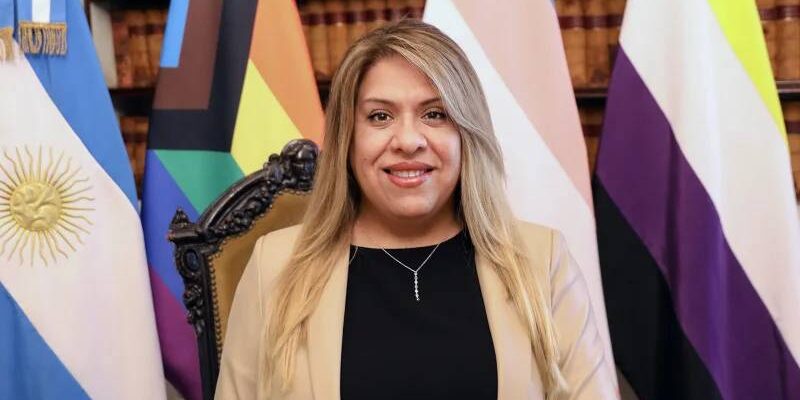
The Supreme Court ruled in favor of the Church and against Argentina's LGBT ambassador, Alba Rueda.
The Supreme Court of Justice rejected Alba Rueda's request to rectify the gender identity in her baptism and confirmation records.


Share

(News updated 24/4)
BUENOS AIRES, Argentina.
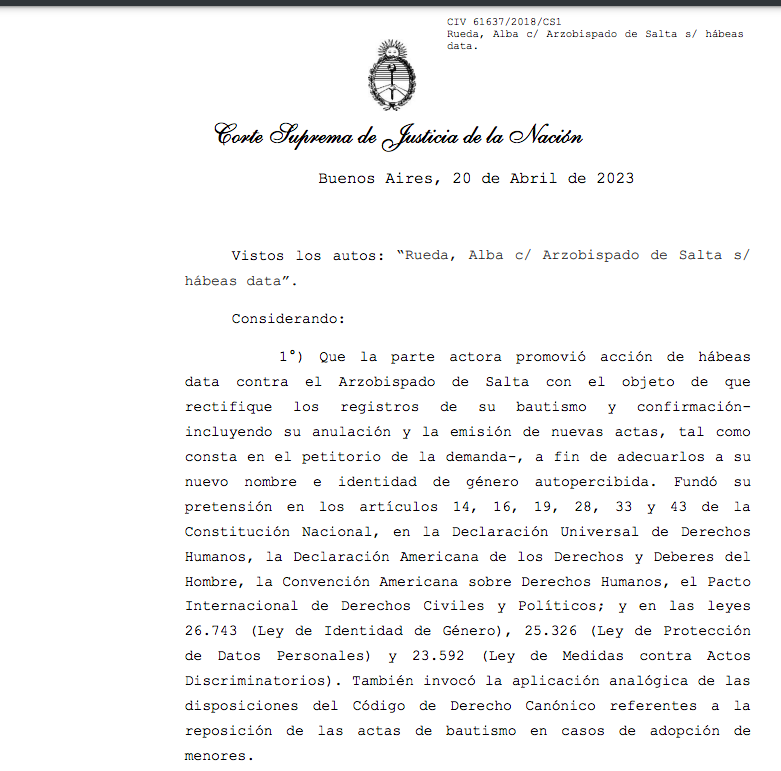
In a ruling issued on April 20, the Supreme Court of Justice rejected the request from Alba Rueda Argentina's Special Representative at the Ministry of Foreign Affairs, International Trade and Worship, and , to rectify the gender identity on her baptismal and confirmation records issued by the Archdiocese of Salta. In statements to Presentes, Rueda announced that she will initiate legal action within the international human rights system.
"Legal fictions"
The request to the Archdiocese began in 2018. After the Salta church refused to comply with the gender identity law by challenging the constitutionality of Law 17.032 (which recognizes the Catholic Church as a religious and spiritual authority), Rueda took the matter to court in 2019. The Archbishop told her that the Church's canon law did not recognize the "legal fictions" of civil law, referring to the Gender Identity Law passed in 2012. The activist filed her complaint in Court No. 58 of Salta. The request was rejected there. In November 2019, the National Civil Appeals Court also rejected the request. Rueda then appealed to Argentina's highest court: the Supreme Court of Justice of the Nation. She did not do it alone, but with the support of 40 human rights and sexual diversity organizations, which filed amicus curiae briefs requesting a public hearing.
The Court's ruling
The Court has now upheld the lower court's decision, citing the principle of religious neutrality enshrined in the Constitution. It argues that religious practice is a private matter and that such records are governed solely by canon law.
“The form and content of sacramental records, as well as matters pertaining to their modification or alteration, are issues exclusively linked to the realization of the specific aims of the Catholic Church.”
In the Supreme Court ruling, signed by Ricardo Lorenzetti, Juan Carlos Maqueda, Horacio Rosatti and Carlos Rozencratz, Rueda is also required to pay the costs of the trial, something that the Justice had not included in the previous instances.
There are thousands of LGBT people in Latin America.
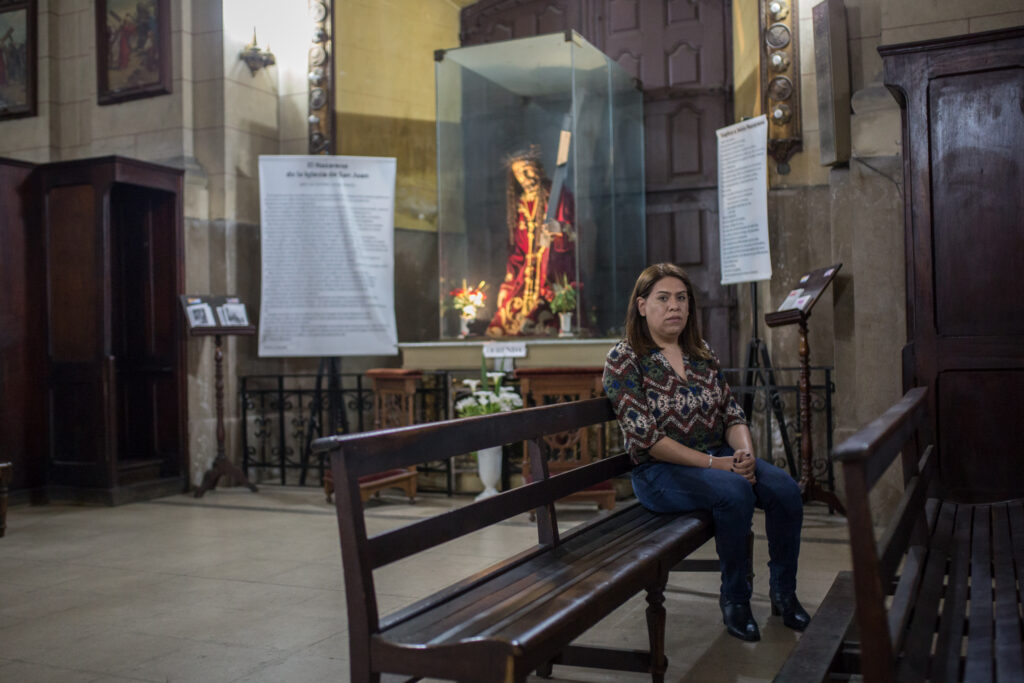
In an interview with Presentes, Rueda said: “ I am not alone. There are thousands of LGBT people in Latin America who are Catholic within the institution, and more than 40 organizations from Argentina and Latin America have appeared before the Supreme Court requesting a public hearing to explain and express our position as LGBT people within Catholic institutions. The Supreme Court has silenced us. The proceedings have ignored our request for a hearing and resulted in a violent ruling that violates our most fundamental rights, such as the right to identity and religious freedom, and also denies us the discriminatory nature of the institution.”
For her part, Julieta Arosteguy, one of the lawyers accompanying Alba Rueda, told Presentes that this ruling by the Court goes beyond the specific case of her client and that it also makes apostasy difficult or impossible for trans and transvestite people who want to renounce the Catholic Church.
“There was a collective act of genocide in 2018 that could never be carried out; some cases were taken to court, and we are awaiting a ruling from the Supreme Court. The Chamber had ruled in two cases that the records of the Catholic Church could not be removed. If we read those rulings together with Alba's decision, we realize that the violation of the gender identity rights of trans people who are part of the Catholic Church will also extend to people who are not part of the Catholic Church. If Alba, for example, wanted to leave, as the Attorney General suggested in his opinion, she would also be unable to exercise her right to religious freedom because the Catholic Church would maintain the records of her birth name without respecting her gender identity.”
“It is a ruling that confirms heterosexism.”
“Many of my trans friends are Catholic. They were baptized, they attended catechism classes, they received communion, they were confirmed. And then they were expelled from their religious communities because of their gender identity,” Rueda explains. “We have the right to participate in the religious life of our churches under conditions of equality and respect. They shouldn’t deny us the sacraments because of our gender identity,” Rueda told Presentes in 2019.
Rueda has a long history of activism for LGBTQ+ rights . Born in Salta, she moved to Buenos Aires with her family as a child. She campaigned for the Gender Identity Law and marriage equality alongside historical figures like Lohana Berkins and Diana Sacayán. She was the president and one of the founders of Mujeres Trans Argentina (Trans Women Argentina), an organization she continues to be a part of.
“There is a collective voice silenced by the Catholic Church and the Supreme Court, which denies us the opportunity to speak on this issue . Historically, we have lost the opportunity to debate publicly with human rights organizations, based on an Onganía law that equates Catholics with deciding who can profess their faith and how. It is a ruling that ratifies compulsory heterosexuality, heterosexism, and cisbinarism within Catholic institutions. The extent of the damage caused by the Court is enormous, and it compels me to denounce our country in international forums in order to seek justice and recognition of my gender identity in the exercise of my religious freedom,” Rueda told Presentes.
In a video posted on social media on April 23, Rueda stated: “The Supreme Court of Justice, led by (Ricardo) Lorenzetti, (Carlos) Rosenkrantz, and (Juan Carlos) Maqueda, has ruled that the Catholic Church is right. That I must abandon my gender identity the moment I enter the Catholic Church. That, for reasons of dogma, they can name me as they wish. They can register me as they wish, they can create any document fictionalizing my identity, and if I want to live my faith, I must accept this situation. This is absolutely unacceptable. It is a tremendous injustice, not only to me personally but also to the thousands of lesbian, transvestite, trans, non-binary, and gay people who are part of the Christian community in Argentina and around the world.”
Rueda also mentioned in his conversation with Presentes the recent documentary Amen, where Pope Francis responds to a group of young people : "The Catholic Church cannot close its doors to anyone. And those who do are infiltrators who take advantage of the Church's teachings for their own narrow-mindedness; it is one of the corruptions of the Church."
A nod to conservatism
Since assuming the role of Special Representative, a position held by only six countries worldwide—including the United States, Italy, Great Britain, France, and New Zealand—Alba Rueda's role has garnered global attention. In 2022, Time magazine included her on its list of the 100 emerging leaders of the future . And in 2021 the BBC named her one of the 100 most influential people in the world . However, this Supreme Court ruling is, in the words of lawyer Alejandro Mamaní—Rueda's representative—a "nod to conservatism."
“One of the most pressing issues this ruling raises is not only the loss of a historic opportunity for debate regarding diversity and religion, which is necessary at this socio-historical moment. A ruling of this kind is a nod to conservatism and the rise of anti-rights movements currently existing in Latin America. Not only in Argentina, but also in Peru, Mexico, and Ecuador. In other words, it's a nod to this kind of denial of rights for the LGBTQ+ community,” Mamaní told Presentes.
In addition to this lawsuit, Rueda has initiated another one stemming from the leak of the file that was confidential in the legal proceedings that began in 2018. When Rueda took her case to court, the Archdiocese of Salta offered to change the records to avoid a court ruling. But instead of creating new records, respecting Rueda's privacy and the confidentiality of her gender transition, they made a marginal note in the existing records, exposing her former identity and violating the confidentiality established by law.
We are present
We are committed to journalism that delves into the territories and conducts thorough investigations, combined with new technologies and narrative formats. We want the protagonists, their stories, and their struggles to be present.
SUPPORT US

FOLLOW US
Related notes



We are present
This and other stories are not usually on the media agenda. Together we can bring them to light.