

“Polarization and transphobia”: The role of the media in the face of disinformation and hate speech from anti-gender movements
The book Polarization and Transphobia analyzes the various anti-rights strategies and their alliance with the media to spread hate speech.


Share

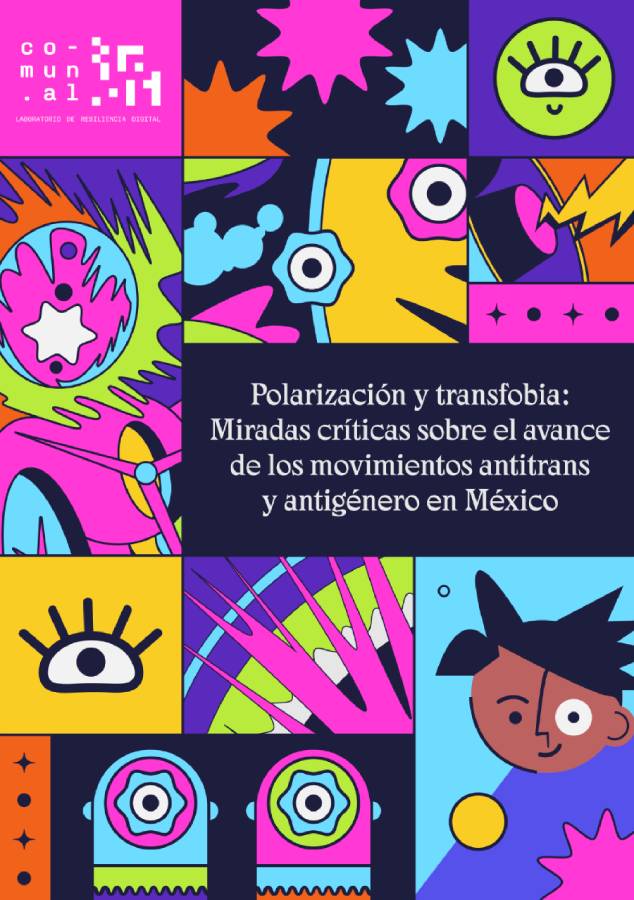
MEXICO CITY, Mexico. Four trans Mexicans with experience in various fields have published the book Polarization and Transphobia: Critical Perspectives on the Rise of Anti-Trans and Anti-Gender Movements in Mexico. sheds light on and analyzes the anti-rights movement and its alliances with anti-trans feminism, and how propaganda, disinformation, and hate speech—also perpetuated by the media—fuel prejudice and violence against trans and non-binary people.
The report, coordinated by Julianna Neuhouser, a Mexican-American translator, journalist, and researcher, includes the work of Alex Argüelles, a technologist; Raúl Cruz, an editor and journalist; Ayla Díaz, an analyst; and illustrations by Astra Lem.
Polarization and Transphobia is a self-managed project, published by the Digital Resilience Laboratory comun.al , a space founded by Argüelles on the construction of knowledge around human rights and technologies in Latin America.
Without spoilers, we'll tell you why this book can be useful as a tool and counter-narrative to understand the present and future of the advance of anti-rights groups in Mexico and how to overcome fear.
“It is not necessary for them to 'give us a voice', to speak for us or for us trans people.”
The idea for this book stems from a series of talks coordinated by Comun.al, called “Watch Out for the Media .” In these talks, trans people, Black people, people living with HIV, sex workers, and dissident experts in various fields analyzed the role of the media in relation to racism, transphobia, censorship, and freedom of expression.
This series of talks is both a tool and a form of protest after a public television channel, Capital 21, opened its airtime to anti-rights individuals to spread hate speech against trans people.
It began as casual conversations between Alex Argüelles and Julianna Neuhouser. But the idea of creating and compiling a report to counter those narratives grew until they consolidated their work into a book.
“This document is a commitment to information as a tool to weaken hate strategies. It is a commitment to recognizing the voices, talent, and work of the people affected by these groups. It is not necessary for them to 'give us a voice,' to speak for us or for us trans people ,” reads the introduction to the report.
Alliances between anti-rights groups and anti-trans feminism
Julianna Neuhouser presents a political analysis of how the anti-rights movement, from the mid-1990s to the present, has allied itself with anti-trans feminism, religious groups, individuals in positions of power, and the media to disseminate its rhetoric, fueled by moral panics and misinformation. This alliance also exacerbates prejudice and stigma, and undermines the lives and human rights of trans and non-binary people.
Neuhoyser cites as an example of these practices the alliances between the anti-rights movement and anti-trans feminism in the United States, and how they construct narratives and bills that seek to violate the human rights of LGBTIQ+ people, mainly trans people (minors and adults).
“They don’t do it by force. One way is through the media and with fabricated debates, with moral panics. But another way is through science,” Julianna comments. She adds that by presenting these kinds of initiatives, legislators are using media content and “expert” voices in bioethics to support their narratives and defend their actions.
According to a mapping exercise by the American Civil Liberties Union (ACLU), 435 anti-LGBTIQ+ bills have been proposed in the United States this year alone. 341 advanced to the next stage of debate, and at least 21 were passed into law.
Anti-LGBTIQ+ legislation in the United States includes: the denial of the right to comprehensive health and gender affirmation; the prohibition of trans people in school sports and other spaces such as bathrooms and locker rooms; the censorship and prohibition of educational content on inclusion and diversity, including drag shows.
So far in 2023, in Mexico, deputies from the right-wing political party National Action (PAN) have presented at least three initiatives in Mexico City, Puebla and Chihuahua that seek to violate the human rights of trans children and criminalize people who provide support to their transitions.
Business leaders, politicians, and religious leaders are pushing anti-rights agendas
Ayla Díaz meticulously analyzes how international organizations, fundamentalist groups like El Yunque (a secret far-right organization), religious leaders, politicians, academics, and businesspeople came together at the most recent edition of the World Congress of Families.
“The Congress had an indoctrination approach that sought to establish a unified political agenda. It primarily emphasized the use of language from environmental activism, human rights advocacy, and the reproduction of narratives from progressive movements. All of this was framed from a family-oriented, pro-life, anti-LGBT, and generally anti-rights perspective,” Ayla explains in her text.
Díaz provides data and names in a chronicle of what this event was, which can be used to consider who allies with whom and what their agendas are in different areas, with special emphasis on "positioning narratives around 'gender ideology' and the 'cultural battle'.".
Transphobic patterns and clickbait in the media
Journalist Raúl Cruz conducted an analysis of media outlets in the United States, the United Kingdom, Spain, Ireland, and Mexico. His research highlights patterns in how stories about transgender and non-binary people are covered, and how these patterns are replicated from one country to another.
Cruz details how these content and disinformation and clickbait have had direct consequences on the lives and rights of trans people.
“The lack of journalistic rigor in the coverage of issues that affect the identities of trans/non-binary people is not only a pending issue, but a worrying one in the Mexican media: the importation of transphobic news stories or stories with clearly anti-rights agendas and the subsequent treatment as 'viral news' only serves to depoliticize and ridicule the struggle of trans/non-binary people for respect for their identity and to exist visibly in the world without being the object of hate,” Cruz denounces.
“The other side of fear is hope”
At the end of the book, Alex Argüelles, drawing on his expertise as a technologist, traces how social movements in the country have utilized both digital space and street protests. He cites examples such as the convergence of the #YoSoy132 student movement, the movement for disappeared persons, and even feminist and trans activist movements.
Just as the digital space becomes a place of protest and convergence, Argüelles explains that “it gradually became a useful tool for surveillance, persecution, and stigmatization. Proprietary social media platforms have become spaces for exchange, representation, and political dispute.”.
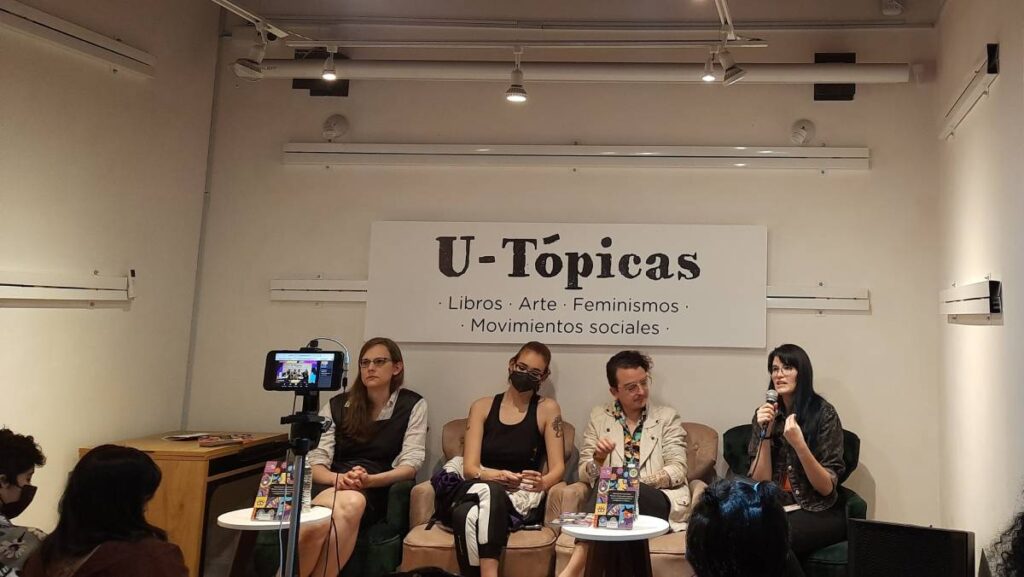
At the end of the book presentation, Alex pointed out: “the other side of fear is hope.”.
“We have been victims of political violence perpetrated by various states. Of gender-based violence perpetrated by both the state and society. And we have been victims of those who control the narrative of history, a narrative that has not been written by us. This book is a way in which we use the media to tell our stories, and there is hope in it as well. And in this way, we confront fear, and in this way, we transform the cruelty we live in into hope,” she concluded.
***
Polarization and transphobia: Critical views on the advance of anti-trans and anti-gender movements in Mexico is available online for free and can be found in physical format at the Utópicas in Mexico City.
We are present
We are committed to journalism that delves into the territories and conducts thorough investigations, combined with new technologies and narrative formats. We want the protagonists, their stories, and their struggles to be present.
SUPPORT US

FOLLOW US
Related notes

We are present
This and other stories are not usually on the media agenda. Together we can bring them to light.