

Indigenous women compete in Paraguay's national elections and hope to make history
Three candidates from indigenous communities in Paraguay are fighting for a seat in Congress to defend access to land, the rights of women and girls, and to support the environmental struggle.


Share

National elections will be held in Paraguay on April 30th, and the party lists are predominantly composed of white men. In this country of 7 million inhabitants, there are at least 122,000 Indigenous people, belonging to 19 different groups and distributed across more than 600 communities. This year, Indigenous candidates represent only 0.2% of the total number of candidates nationwide, according to data from the Superior Electoral Court (TSJE). Nine Indigenous candidates are running for Parliament and 10 for city council positions. Only three of these candidates are women.
The ruling Colorado Party, with former minister Santiago Peña as its candidate, and the opposition National Concertation, with former minister Efraín Alegre as its candidate, appear to be the two forces most likely to win. There are 10 other candidates vying for the presidency, and the country will also elect 45 senators, 80 representatives, and 17 governors, among other positions.
Ángela Salas is from the Ava Guaraní town and is running as a senator for the National Convergence Party of the Guasú Front. Ana Romero is Guaraní and is a candidate for deputy for the Alianza Encuentro Nacional party, and Tania Vera, a Guarani Ava, is a candidate for deputy for the Partido Juventud.
Leaders in their communities
The three candidates share a history of fighting for the rights of Indigenous women and youth in their communities. They are very familiar with the needs of their peers.
Ángela Sales is a native of the Nueva Esperanza community in the Curuguaty District ( Canindeyu Department, in the east of the country) . She is coordinator of the Kuña Guarani Aty Association and is part of ANIVID (National Indigenous Articulation). Sales has a degree and is a teacher in the Guaraní Language. He also has master's degrees in language and in Public Affairs and Governance. She is a senior technician in Communication for Development. He is currently pursuing a doctorate in Public Law and Governance.
Ana Romero is a youth leader from the Guarani people, originally from the department of Boquerón. She currently resides in Mariano Roque Alonso, a city located in the Central Department. A mother, she has a history of activism in grassroots organizations, primarily fighting for the rights of Indigenous peoples, but also closely involved with other popular movements. She is a member of ANIVID and president of the Indigenous Youth Union of Paraguay. She recently graduated with a degree in International Relations.
Tania Vera is from the Avá Guaraní people, originally from Canindeyú. She is a teacher and a law student. She is part of the CONAPI (National Coordination of Indigenous Pastoral Care) Network of Legal Promoters.
Access to land as a priority
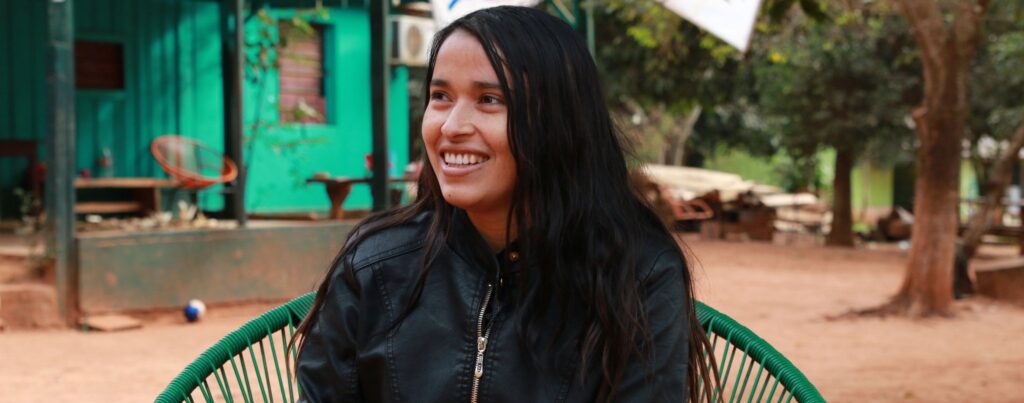
““In these 30 years, the agenda of Indigenous peoples, especially regarding land tenure and security, has never been prioritized during election periods. In these elections, we are represented by myself and other Indigenous colleagues. We only hope to make history and, above all, to begin implementing long-term solutions,” says Ana.
Angela adds more points to consider: “Discrimination by state institutions, for example. The absence of a comprehensive social protection system. Regarding land restitution, there is almost nothing; policies are based on and implemented only for a privatized model, and there is no progress, no possibility of progress for the restitution of Indigenous lands. Currently, the number of communities attacked by agribusiness has increased. There are invasions, dispossession, and evictions in different forms and contexts .”
Tania adds: “ I never saw myself reflected in the candidates' proposals; every legal achievement in favor of indigenous peoples was obtained through the struggle of indigenous peoples.”
They also highlight a reality that affects a growing number of Indigenous communities and families: extreme poverty. They report that most communities lack access to basic services, education, market opportunities, and employment, and suffer from food insecurity and a lack of water. Added to this is the lack of policies to protect and support Indigenous children and adolescents, as well as Indigenous women.
Challenges and lessons learned from party politics
They agree that running for office is a challenge. They have observed for years how candidacies reflect the demands and needs of the 19 Indigenous peoples. Therefore, they consider it a challenge but also a commitment to their struggles alongside their comrades in grassroots organizations.
““I decided to run for office because we belong to an Indigenous organization called ANIVID. There, along with other members, we decided to start a Political Movement of Indigenous Peoples, especially women. We couldn't get it off the ground due to a lack of financial resources, and we only managed to complete half the paperwork. The goal was to have a purely Indigenous movement so we could participate more effectively and be independent from the traditional parties. Since we didn't achieve that goal, we tried to start with the party that best suited us, the Frente Guasú, which is the party of Mr. Fernando Lugo,” says Ángela.
She also recalled that within the Frente Guasú party, they were given two spots on the list, one for a woman and one for a man. She then consulted with her colleagues from the Kuña Guaraní Aty Association and, with their support, took the spot. “They gave me strength, they gave me words of encouragement to motivate me to run,” she affirms.

Change Congress
Ana, for her part, says she is running for office because she believes it is necessary to reform Congress, a place where most of the time, or all the time, decisions are made without taking into account indigenous or peasant people.
“It’s been like 70 years of the same thing. I join in as a person, as an Indigenous woman, as an activist, as a leader, as a mother, and representing all existing identities. I contribute with experience and professionalism, not only for the well-being of my people but for any identity that empowers, supports, and collaborates with others every day for opportunities to improve the living conditions that we all deserve—that dignified life in this Paraguay we inhabit,” she says.
Meanwhile, Tania, a candidate for deputy for the Department of Canindeyú, states that her goal is to offer an alternative to the traditional parties. "As a young woman and an indigenous member of the Ava Guarani people, I am confident in my abilities, which is why I decided to run in these elections, to provide an option for change and give a voice to the indigenous peoples of Canindeyú."
The challenges they face in the campaign are numerous. One of them is securing financial resources, and the other is the structure of traditional parties with a very strong fanaticism, such as the right-wing Colorado Party.
“We are aware that many Indigenous and non-Indigenous citizens don't want to support an Indigenous candidate, and this reflects the discriminatory thinking that persists. Although it may be disguised as false support, the reality is quite different, and we hope to make history in the elections,” Ana explains.
Proposals from the territories
Ana and Ángela are part of ANIVID, which on October 12 presented the Paraguayan State with 34 points outlining a plan that could respond to the demands of indigenous peoples.
In this interview, they confirmed once again that to date the current rulers have not continued the dialogue, despite having prioritized 10 points at the request of state entities.
“My proposal for my administration in the Senate would be to ensure that Congress has the voice of the people, the voice of Indigenous women, and our proposal would be to promote the implementation of the National Indigenous Peoples Plan. This document was recognized by presidential decree, but to this day it has not been developed, nor does it have a budget. The National Plan was a UN recommendation for Paraguay, at the request of Indigenous peoples,” says the Senate candidate.
For both, the central issue is access to land, the central problem in Paraguay, where 85% of the land is in the hands of 2% of the population.
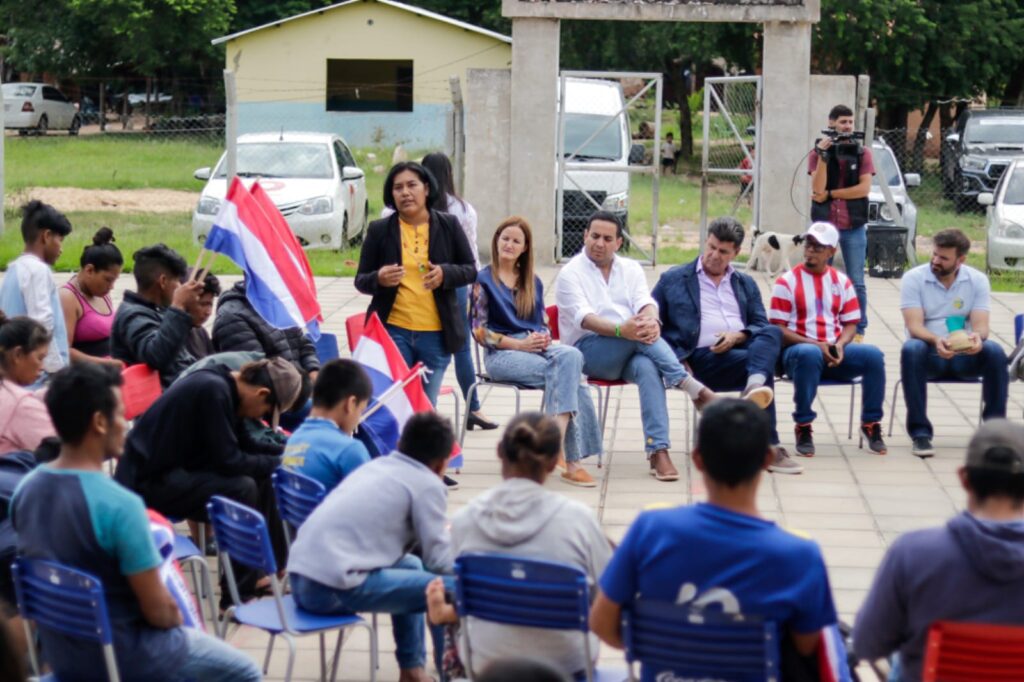
Some proposals from the candidates:
- Territorial defense.
- Support all initiatives of the Linguistic Secretariat.
- Boost budget for the indigenous education law.
- Implementation of the curriculum in the native language according to the worldview of each people.
- To encourage public institutions and organized civil society to work towards Food Sovereignty.
- Strengthen indigenous and peasant family farming.
- Promote the recognition of indigenous people in urban contexts for land security.
- Strengthen the implementation of the national health system for indigenous peoples and provide a larger budget to the indigenous health directorate.
- Promote projects for indigenous girls and adolescents.
- to promote a comprehensive law for indigenous and peasant women.
““For example, there needs to be a disaggregated budget from the State, from the government, so that work can be done effectively on various issues, whether it be territory, health, education, youth, children, or women. Paraguay doesn't have a disaggregated budget. There's a budget that's stretched from one place to another, to do a little something with the communities and indigenous peoples. That was always one of the things I had in mind before running for office,” Ángela emphasizes.
Environmental defenders
For her part, Tania emphasizes her interest in the comprehensive protection of children and adolescents. “Currently in Paraguay, the deficiency is in protection; we are unable to resolve the issue, and early pregnancies are on the rise. There are children living on the streets. Not all programs are being implemented as they should be, and from our own experience as a civil organization, we have done quite a lot—small actions that can be amplified by being in Congress.”
She adds that she wants to work on environmental policy, given that the renegotiation of the Itaipu Hydroelectric Dam is taking place this year . “The climate crisis, deforestation, drought; all these issues must also be addressed within Congress, especially for the most affected sectors, such as the Chaco communities and others. Above all, we must ensure that the Chamber of Deputies fulfills its role of overseeing and ensuring the transparency of public spending.”
Tania and Angela emphasized the importance of a bill to create reserved seats for indigenous peoples, thereby guaranteeing places in parliament for the political participation of indigenous people.

Regarding the situation of girls and women
Candidates Ana and Ángela talk about the need for young and adult women to be leaders in their communities, not just heads of households and mothers, but also representatives and political leaders in decision-making.
“There is much to be done within Indigenous communities. We must work from the ground up, starting with families and communities, and continue to advance in other areas regarding women's rights. As we know, there is a lot of machismo and discrimination in these communities, and this affects women, impacting their self-esteem. Women are seen as objects, as servants who must stay home taking care of their children, managing food for everyone, without being able to meet with others, without being able to study, without being able to take any courses. Some communities still see girls as women, and this is a constant struggle for us Indigenous peoples, and then in other spaces, we must ensure that girls' rights are respected, especially as girls, as adolescents, as young women,” says Angela.
“Today there are many girls with dreams, hopes of being people like others, not just being a mother at 10 years old, head of household,” says Ana.
“If we don’t get where we want, then it will be an experience to continue building political participation for indigenous peoples,” Ángela concludes.
We are present
We are committed to journalism that delves into the territories and conducts thorough investigations, combined with new technologies and narrative formats. We want the protagonists, their stories, and their struggles to be present.
SUPPORT US

FOLLOW US
Related notes

We are present
This and other stories are not usually on the media agenda. Together we can bring them to light.