

Pride March adds another Organizing Committee: Historical Line
More than 50 LGBTQ+ organizations yesterday presented a new Organizing Committee for the Pride March-Historical Line (COMOLH). Their goal is "to reclaim the legacy, plurality, and democratic spirit of the most important LGBTQ+ event."


Share

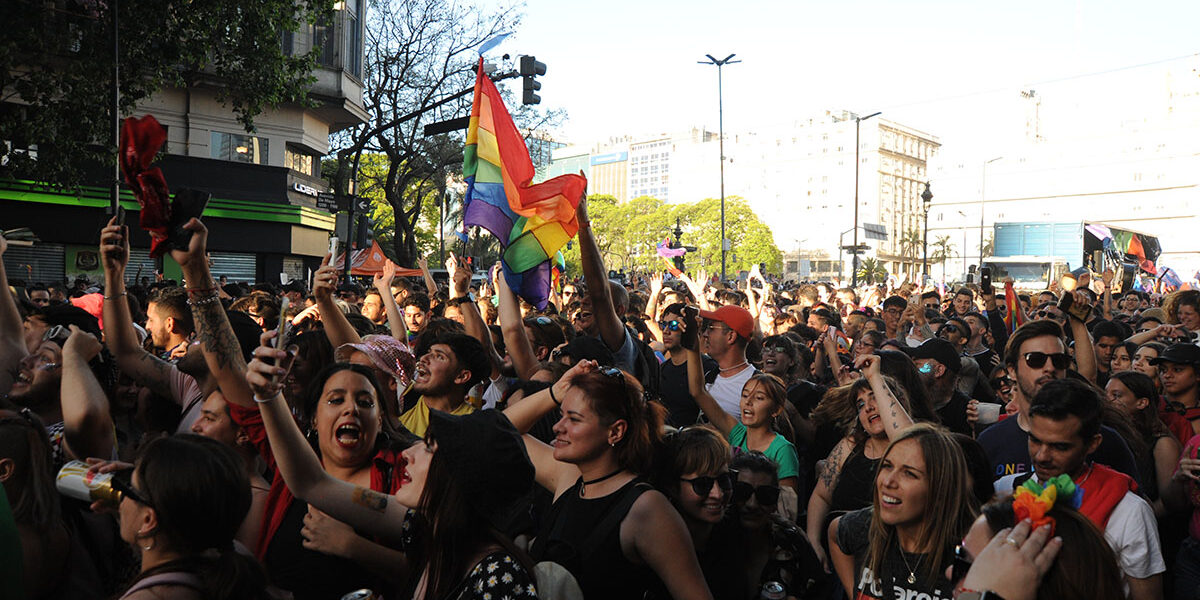
BUENOS AIRES, Argentina. More than 50 LGBTQ+ organizations yesterday presented a new Organizing Committee for the Pride March-Historical Line (COMOLH). The goal, according to what they announced after meeting at the headquarters of the Argentine Homosexual Community (CHA), is “to recover the legacy, plurality, and democratic spirit of the most important LGBTQ+ event.”
The organizations participating in this Commission (see list below) committed to building a pluralistic, democratic, and representative organizational space for the interests and needs of the LGBTIQNB+ community. “In the spirit of those who in 1992 overcame the mandate of shame and called us together to be a community at the first Pride March, we come together again with 'the desire for all freedoms,' as Carlos Jáuregui said, which is the origin of all our struggles,” states the press release announcing the news.
Among the organizations are CHA (Argentine Homosexual Community), the Civil Association Free Childhoods, 100% Diversity and Rights, Mocha Celis Civil Association, Diverse Families Association (AFDA); Organizing Committee 28J – Plurinational, Anti-racist March against Transvesticides, Transfemicides and Transhomicides; Afros LGBT; Furia Trava and Anti-Discrimination Liberation Movement – MAL, Conurbanes for Diversity.
Why two organizing committees for the March?
For many years, there has been an Organizing Committee for the Pride March (COMO). It coordinates activities surrounding Pride, which is commemorated in Argentina in November. COMO comprises more than 40 groups, independent activists, and political parties. The Committee's meetings are preparatory for the March, one of the largest Pride events. Logistics and general coordination are discussed there, and the political slogans for the marches are decided each year. This last point has been a source of considerable tension, and for several years now, there have been multiple calls for the same march.
In 2018, the Argentine Homosexual Community (CHA), 100% Diversity and Rights, Trans Women Argentina, and the La Rosa Naranja Association withdrew from the organizing committee of the 27th LGBTIQ+ Pride March , citing "the loss of the historical spirit of Pride and the lack of representation regarding the substantive demands of our community." The split had its origins in earlier times: in November 2016, the 27th LGBTIQ+ Pride March in Buenos Aires ended abruptly after a series of attacks.
The new commission states that the name “Historical Line” reflects the activism of the organizations that comprise it. “We have worked for decades to build this commission as a space for pluralistic participation, and we will not yield to those who use the march to preserve corporate interests through sectarian decisions and anti-democratic methods.”
“A Historical Line to defend the rights we have won and to build, with unity in diversity, the strength necessary to confront the advance of religious conservatism and the repressive, anti-rights right wing,” they stated. “We founded the Organizing Committee of the Pride March – Historical Line so that there may be more pride, to include everyone, to strengthen our community and amplify the plurality of voices in a great diverse, dissident, plurinational, and popular movement that is anti-racist, trans-feminist, anti-ableist, and anti-punitive, for a proud Argentina, for everyone.” Historical Line, to prioritize the struggles and interests of the LGBTIQ movement, following the legacy of Diana Sacayán because 'it is possible to build with love, in networks and with strength to dream of that world in which we all fit', of Lohana Berkins, who taught us that the love that was denied us is our impulse to change the world' and of César Cigliutti, who proclaimed: 'community is the concept that includes and exceeds each of our identities' and called us to be 'together or together'”.
They also highlight in their genealogy that the new space “reclaims, as did the Homosexual Liberation Front (FLH), a movement committed to its time, when they called on everyone to love and live freely in a liberated country.” And they add, “that is why today we say pride is democracy and it is also defending a country for everyone, just and sovereign.”
“We are part of our people and their struggles; we build and organize in the neighborhoods we live in. Because we are part of the human rights movement in our country. Because we are driven by empathy and solidarity, which has strengthened our networks against the onslaught of cis-hetero-patriarchal violence.” And she concludes, “The march belongs to everyone, and every march is a victory for the collective social, cultural, and political construction of the LGBTIQNB+ community. It is necessary to strengthen this movement so that pride continues to be a political response to shame, violence, and exclusion.”
Who are the members of the Organizing Committee of the Pride March-Historical Line
Argentine Homosexual Community (CHA).
100% Diversity and Rights – National Network.
Abosex – Lawyers for Sexual Rights.
Afro LGBT.
Afro Xango Group.
Friends for Diversity.
Peronist Rainbow.
Free Childhoods Civil Association.
La Rosa Naranja Civil Association.
Mocha Celis Civil Association.
Seven Colors Diversity Civil Association.
Diverse Families Association (AFDA).
Equal World Association (AMI).
Ciervos Pampas Rugby Club.
Anti-Patriarchal Men's Collective CABA.
Mataba LTQ Collective.
LGBT Commission – Merlo.
Organizing Committee 28J – Plurinational, Anti-Racist March against Transvesticide,
Transfemicide, and Transhomicide.
Suburbs for Diversity.
I Cultivate My Rights.
Dissidents in Struggle North Zone.
Diversity in Action Tigre.
Inclusive Spirituality Space Tigre.
Trava Fury.
Lohana and Diana's House.
Lesmadres
Anti-Discrimination Liberation Movement – MAL.
Transvestite and Transgender Movement.
MUNAY – Families and Children. TTBN
Popular and Feminist Social Root – Lanus.
Scouts for Equality.
We Are Diversity – Lomas de Zamora.
Queer Urbanism.
CTERA – Gender Secretariat.
Unified Union of Education Workers of Buenos Aires
. Union of Education Workers. UTE CABA.
Subway and Premetro Workers' Union – Metrodelegadxs.
ATE – National
CTA A – Capital
. La Cámpora Diversia.
Gender and Dissidence Front – Nuevo Encuentro.
La Sublevada – Nuevo Encuentro CABA.
Mala Junta – Soberana.
NuestraAmerica Federal Popular Movement.
National Current United People.
Atahualpa Movement – Gender and Diversity Mar del Plata.
Marea Popular and Dissident Feminism – Barrios de Pie.
Espacio Puebla.
May Movement.
Popular Liberation.
We are present
We are committed to journalism that delves into the territories and conducts thorough investigations, combined with new technologies and narrative formats. We want the protagonists, their stories, and their struggles to be present.
SUPPORT US

FOLLOW US
Related notes



We are present
This and other stories are not usually on the media agenda. Together we can bring them to light.