

Elections in Paraguay: What indigenous women demand of candidates
The needs of Indigenous communities are rarely addressed in political campaigns, nor are their demands heard. Presentes spoke with leaders Daniela Benitez and María Luisa Duarte.


Share

The general elections in Paraguay are on April 30th. Voters will elect president, members of Parliament, and governors for the next five years, beginning August 15th. The needs of Indigenous peoples are rarely addressed in campaigns, nor are their demands and claims heard. To address this, Presentes spoke with two leaders: María Luisa Duarte, an Indigenous woman from the Aché people, an anthropologist, and a mother of six—who is currently part of the National Indigenous Articulation for a Dignified Life (ANIVID )—; and Daniela Benitez, from the Nivaclé people, an artisan and also a mother of six. In the 2018 general elections, she ran for senator. While she didn't receive enough votes to win a seat, her candidacy was important in raising the profile of Indigenous women in politics. She is currently a member of MIPY (Indigenous Women of Paraguay ).
Both highlighted access to land as the primary demand. The country has 7 million inhabitants according to official data, of whom 122,000 are indigenous, belonging to 19 different groups distributed across more than 600 communities. However, 85% of the land is in the hands of just 2% of the population.
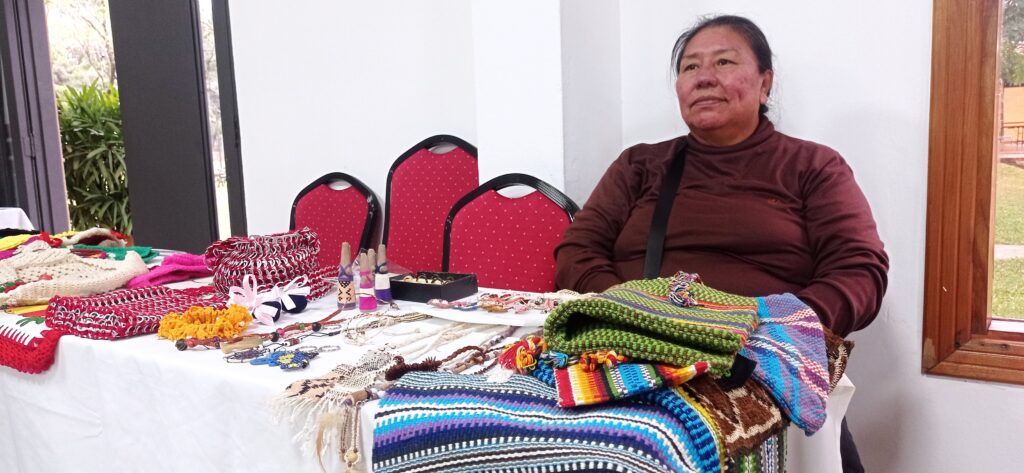
The right to land
Despite representing a small percentage of the population and having rights that predate the Paraguayan state, some Indigenous communities remain landless. This situation has arisen because successive Paraguayan governments have prioritized agribusiness interests in the Eastern Region and the Western Region (Paraguayan Chaco) for cattle ranching and charcoal exports.
“We can speak in general terms. Poverty in some places has deepened now; we are heading towards extreme poverty in some communities, and that is a wake-up call for the Paraguayan State and for us leaders. We have to fight and struggle, and propose fundamental solutions,” Maria Luisa begins explaining.

María Luisa at the October 12th March

For her part, Daniela reflects on the commitments made by the Paraguayan State to international bodies. She emphasizes that it continues to fail to fulfill its responsibility. “Given this situation of abject poverty, I believe there is a wealth that must be recovered for the self-development of Indigenous women. The Sustainable Development Goals ( SDGs) encompass everything. If we wait for the will of the authorities, we will never get there. Paraguay committed to making these goals sustainable, and that is what we must base our efforts on to achieve the objective of integrating them into the programs of public institutions, both at the departmental and national levels.”
Both agree that the fundamental solution is to secure land for the communities. This would guarantee human and environmental rights.
Education and fair prices
Another urgent issue they emphasize is public policy in the field of education and the creation of a market and fair prices for the production of healthy food. They also demand access to job opportunities, decent housing, and other rights.
Maria Luisa recalled that on October 12, 2022, a work plan outlining 34 demands for a dignified life for the 19 Indigenous peoples was presented for the second time to Paraguayan state institutions. Among these demands, access to land is central (cessation of forced evictions, respect for ancestral lands, increased funding for land purchases, etc.). However, almost six months have passed, and to date, the current government has shown no political will to continue the working group to which it had committed.
“As general coordinator of ANIVID, we witnessed a lack of political will because we had already made every effort. They showed no political will. We pursued this issue extensively after October, seeking to sit down and discuss the 34 points with them. We prioritized 10 points to begin with, and even then, we couldn't initiate a conversation. We will continue to try to get them to sit down and talk with us.”
And she adds: “The land sustains us; the land is our priority and our strength. For us, it is fundamental for planting, harvesting our crops, and eating healthy food from our own garden. That's how we feel good, how we feel fulfilled. Education, training, and university development for our communities—that is also a human right. We all have the right to study whatever we like, even if we are poor farmers or Indigenous people; we have that right, and the State must guarantee it,” affirms María Luisa, concluding by stating, “The quality of life we desire is not something we deserve, but rather a human right guaranteed by the National Constitution of the Republic, ensuring the well-being of the population and families.”
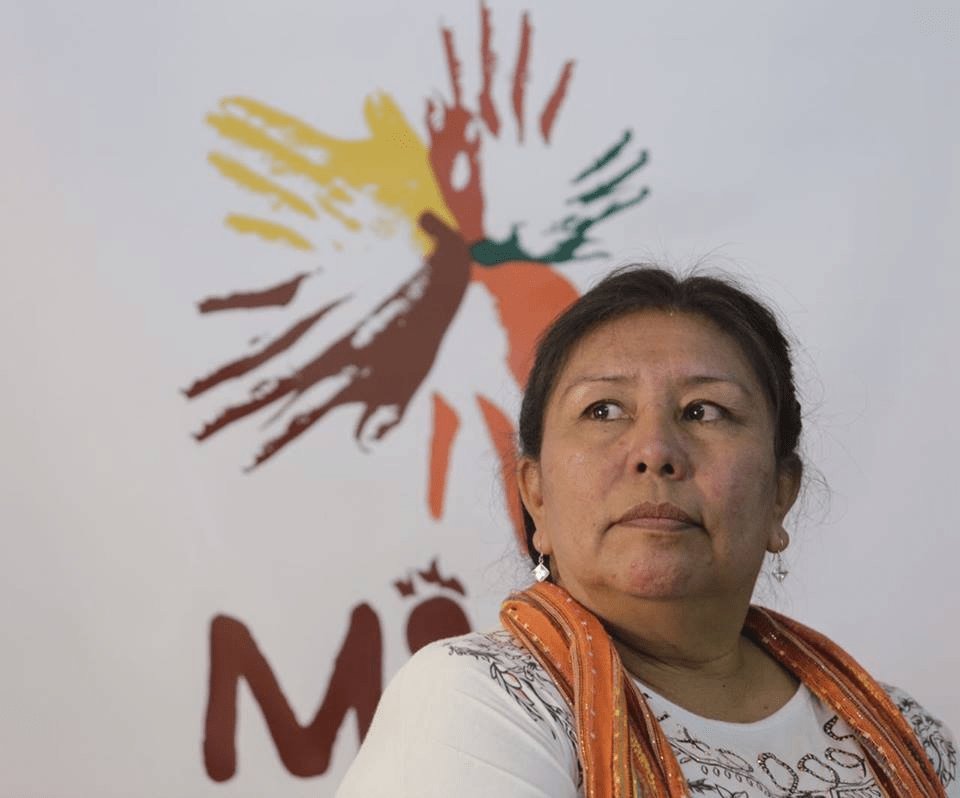
“Women can awaken”
The role of Indigenous women in the five hundred years of resistance to European invasions has been fundamental. Maria Luisa and Daniela's faces light up when they speak of their ancestors, who have fought to pass on their culture from generation to generation. They emphasize that women always do everything with the collective good in mind, a fundamental aspect of the Indigenous worldview.
They are the ones who must face racism, discrimination, and violence daily—social, economic, cultural, structural, and governmental. Maria Luisa poses this question: How many women have died in childbirth because there are no roads or pathways?
“When there is an eviction, it is the woman who resists. So, since the so-called "Conquest," the European invasion, women have resisted, survived, and endured miscegenation for forced reasons. Because they were forcibly possessed and formed homes, they silently transmitted their own culture, and today it is Paraguayan culture.
She adds: “ Today, at the march, we showed that we are still fighting. How many women walked with their children, carrying them on their shoulders! We, the women leaders, continue to believe, to propose, and to fight. We give hope that this situation can be reversed, and it is possible to reverse it; it is not impossible. We must revisit all of that history to know where we come from and to have that strength.”
Daniela, thinking about the indigenous women of the Paraguayan Chaco and the difficulties they face every day, concludes: “We women can awaken. Indigenous women in Paraguay are fighters. There is great hope for tomorrow. They are the ones who solve problems and think for everyone. They are the ones who dream of recovering dignity and learning from whatever can be learned for the common good.”
We are present
We are committed to journalism that delves into the territories and conducts thorough investigations, combined with new technologies and narrative formats. We want the protagonists, their stories, and their struggles to be present.
SUPPORT US

FOLLOW US
Related notes

We are present
This and other stories are not usually on the media agenda. Together we can bring them to light.