

They march for land, health and education for peasants and indigenous people in Paraguay
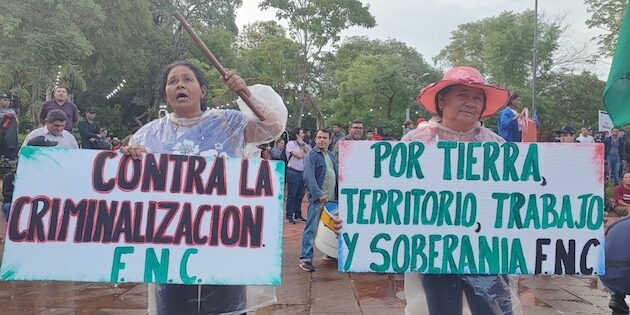
8,000 people from peasant and indigenous organizations mobilized in the 29th Peasant March to demand the fulfillment of the Agrarian Reform and the cessation of criminalization.


Share

ASUNCIÓN, Paraguay.
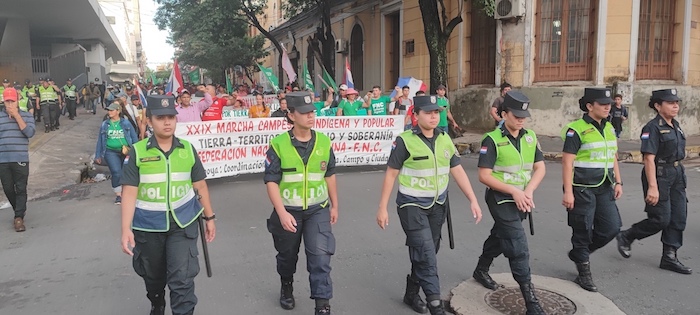
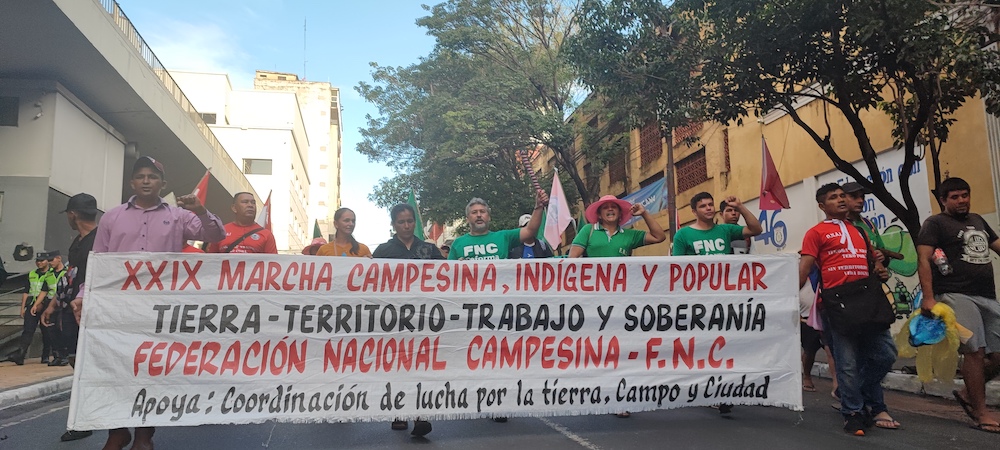
Approximately eight thousand people from peasant and indigenous organizations marched through Asunción on Thursday, March 30, under the slogan "Land, Territory, Labor, and Sovereignty." While this was the 29th Peasant March organized by the National Peasant Federation (FNC), it was the second time they marched alongside indigenous organizations.
The day began with the arrival of activists from different departments of the country, but the storm changed the plans and the mobilization time was brought forward.
The main demands were for the right to access land, work, sovereignty, health, and education. These demands were coupled with calls for an end to the persecution, prosecution, and evictions of peasant and Indigenous communities , as well as urban settlements. The Zavala-Riera Law, passed in 2021 , has led to a resurgence of state violence against people fighting for land rights in Paraguay. In 2022 alone, 11 peasant and Indigenous women were criminalized.
The march covered approximately 4 kilometers. Throughout the route, slogans such as "No more evictions" and "Agrarian reform, urgent and necessary," among others, were heard.
The women had their own column and their banners and slogans reflected their own demands and claims while they carried their backpacks, their tereré thermos and some with their children in their arms.
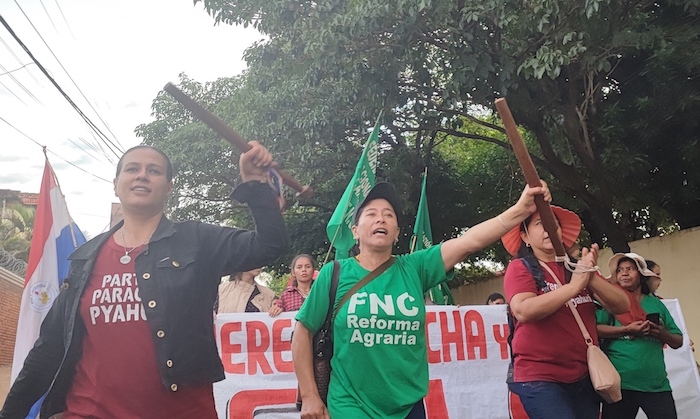
"To have sovereignty is to have a new homeland"
During the main event, Teodolina Villalba, secretary of the FNC, spoke. In a heartfelt speech, she conveyed the main concerns of rural mothers and repeatedly emphasized the uncertainty of not knowing whether they will be able to support their children's education due to a lack of resources and the absence of the State.
“We seek a new homeland where there must never again be violence against women and girls. We also want policies for production, education, and health; to legalize our settlements and no more evictions. We long for housing and work. To have sovereignty is to have a new homeland,” Teodolina expressed before some 8,000 people who listened attentively and accompanied her with chants and applause, feeling represented.
Scandalous figures
To date, land distribution in Paraguay is one of the most scandalous in the region in terms of inequality: 85% of the land is in the hands of 2% of the population . To understand what happened to the lands designated for Agrarian Reform, one need only read the report of the Truth and Justice Commission. This body was created in October 2003 to investigate human rights violations committed by state and paramilitary agents during the 35-year dictatorship of Alfredo Stroessner.
According to the report of the Truth and Justice Commission , 8 million hectares of land were supposed to be allocated to beneficiaries of the Agrarian Reform but ultimately remained in the hands of landowners and cronies, and it is these lands that peasant communities are demanding to this day through occupation.
According to data from the Land Resources Information System (SIRT), since 1936, INDERT (National Institute for Rural and Land Development), the entity responsible for safeguarding the rights of those eligible for Agrarian Reform, had distributed 3.5 million hectares in the Eastern Region. It is estimated that 1,045,000 hectares (35% to 40%) ended up in the hands of people who are not eligible for Agrarian Reform, including prosecutors, judges, supermarket owners, and officials of binational entities, among others.
We are present
We are committed to journalism that delves into the territories and conducts thorough investigations, combined with new technologies and narrative formats. We want the protagonists, their stories, and their struggles to be present.
SUPPORT US

FOLLOW US
Related notes
We are present
This and other stories are not usually on the media agenda. Together we can bring them to light.