

In the last decade, 18,800 LGBT people sought help from the Argentine State due to gender-based violence
The figure is part of the first report from the Integrated System for Cases of Gender-Based Violence. The system aims to measure risk and provide support through the state.


Share

BUENOS AIRES, Argentina. The Ministry of Women, Gender and Diversity presented the first report prepared by the Integrated System of Cases of Violence due to Gender (Sicvg) which compiles information from 2013 to December 2022.
The report states that 669,339 people experiencing violence received assistance in the country, of whom 18,808 belong to the LGBTI community. This figure includes consultations carried out in this regard.
The province of Buenos Aires and the city of Buenos Aires, along with Córdoba, San Juan, and Tucumán, are the districts with the highest number of reported cases. The data shows that domestic violence is most overwhelmingly prevalent, at 97.1%.
It also indicates that 95.8% of aggressors are male. 87.8% are the partner or ex-partner of the person experiencing violence, and 23.2% have access to firearms.
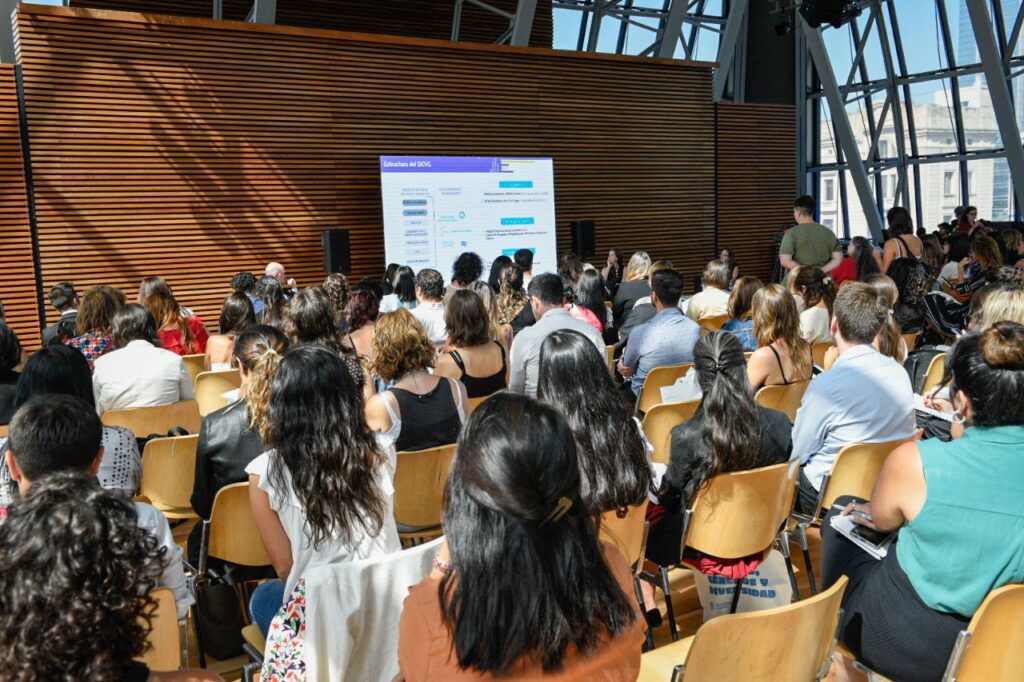
Photo: MMGyD
A long-awaited tool
According to the document, the Sicgv is a tool that allows "systematizing and managing information on situations of gender violence throughout the country."
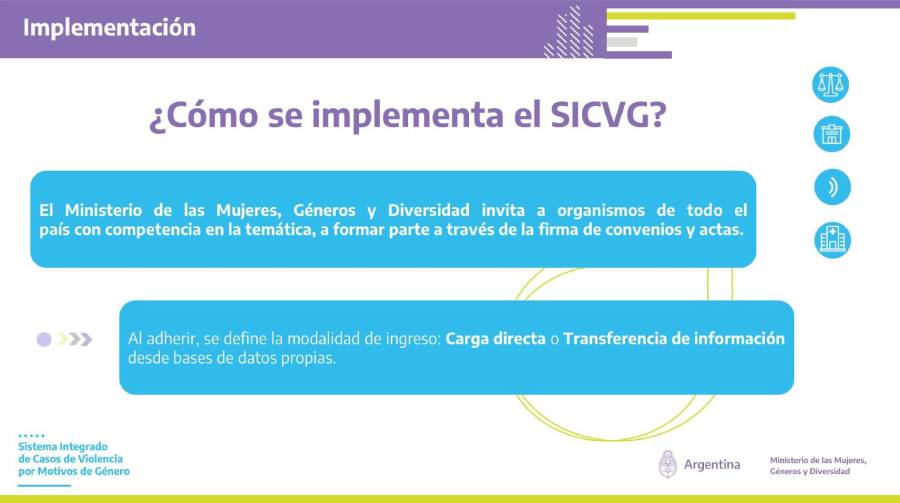
It operates through a web application with an integrated registry where people receiving assistance and consultations are recorded. Victims of any type of violence are identified by their document type and number.
This registry is part of the National Action Plan against Gender-Based Violence, which was presented in 2020 and will continue until 2024.
The report was compiled using data from nine provincial and six municipal gender offices, as well as one judicial body. Contributions were also received from five local protection agencies. Additionally, data from the Single Registry of Cases of Violence against Women, covering seventeen provinces and seven national agencies, were used. Finally, information was gathered from four programs of the Ministry of Women, Gender and Diversity, primarily the " Accompanying and Bringing Rights Closer" .
The system identified victims who are pregnant, live with a disability, are of African descent, migrants, refugees, members of indigenous communities, deprived of liberty, or in conflict with the criminal law.
It states that only 10% of the victims do not have children, adolescents, elderly people, or people with disabilities in their care. In other words, 90% are caregivers.
Regarding interventions in these situations, most people turned to the police and the justice system, and only rarely to the health system or comprehensive protection services.
The data
The report describes as a “new” feature the incorporation of variables and categories that allow for the systematization of specific information on violence suffered by the LGBTI population. This compilation of figures is the responsibility of the Ministry's Technical Directorate of Registries and Databases.
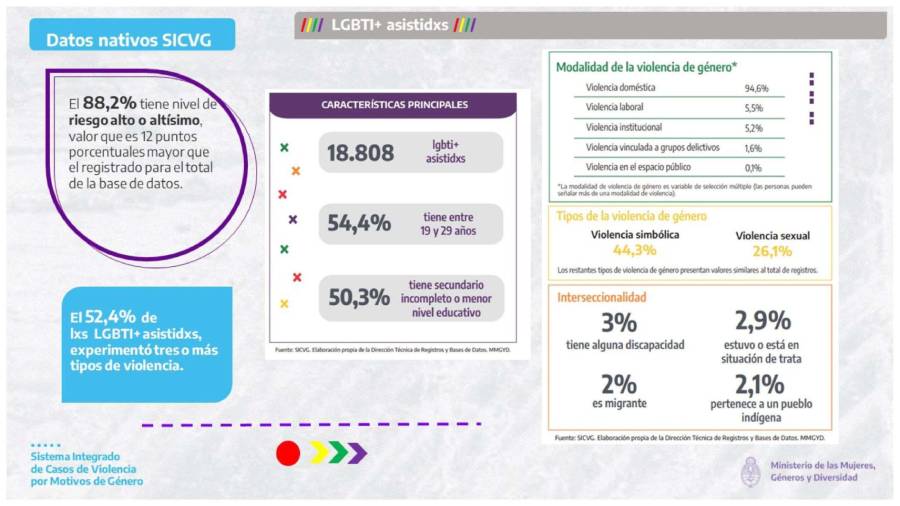
Of the 18,808 people assisted, 54.4% are between 19 and 29 years old. 50.3% have incomplete secondary education or a lower level of education.
Regarding the types of violence they suffer, the report clarifies that this type is variable because people may report having suffered more than one type of violence.
94.6% suffered domestic violence.
5.5% workplace violence
5.2% institutional violence.
1.6% violence linked to criminal groups
0.1% violence in public spaces.
The Sicvg report also identifies two types of gender-based violence: symbolic and sexual. In this category, it notes that 44.3% of participants experienced symbolic violence and 26.1% experienced sexual violence. The remaining types of violence, the report indicates, show similar rates to those observed in women.
Regarding intersectionality, 3% have some disability, 2.9% are or were in a situation of trafficking, 2% are migrants and 2.1% belong to an indigenous people.
How was the data compiled?
“From its inception, the SICVG (System for the Identification of Victims of Gender Violence) incorporated variables that allow us to classify those receiving assistance, those experiencing violence, according to their gender identity and self-perceived sexual orientation, and based on what they express in the interview, where they describe the situation they are living through,” Lorena Balardini, head of the Technical Directorate of Registries and Databases Agencia Presentes . “We developed these variables within the Directorate by reviewing existing information on the subject, as well as the questionnaires and forms used to collect this data. And, above all, we drew on surveys conducted in recent years.”
Balardini states that the gender identity variable in the National Census was taken into consideration and, in fact, expanded. “We worked extensively with the Undersecretariat of Diversity Policies to arrive at a set of categories that was as comprehensive and broad as possible, in order to account for and record these multiple manifestations of gender identity,” the official explains.
“The data we are presenting with this LGBT cut-off was mostly uploaded directly to the Sicvg. That made this classification easy,” he explains.
Balardini explains that this data was migrated from other databases. The historical data comes from the 144 hotline, and was also collected from the Single Registry of Cases of Violence against Women, which was maintained by INDEC (National Institute of Statistics and Censuses). “Here, of course, we find information that is more binary in nature, with variables such as female/male sex and other predominating. We integrated that information, but logically, the universe we analyzed in the report is associated with these cases that were directly uploaded to the SICVG (National System of Violence against Women).”
The possibilities of Sicvg
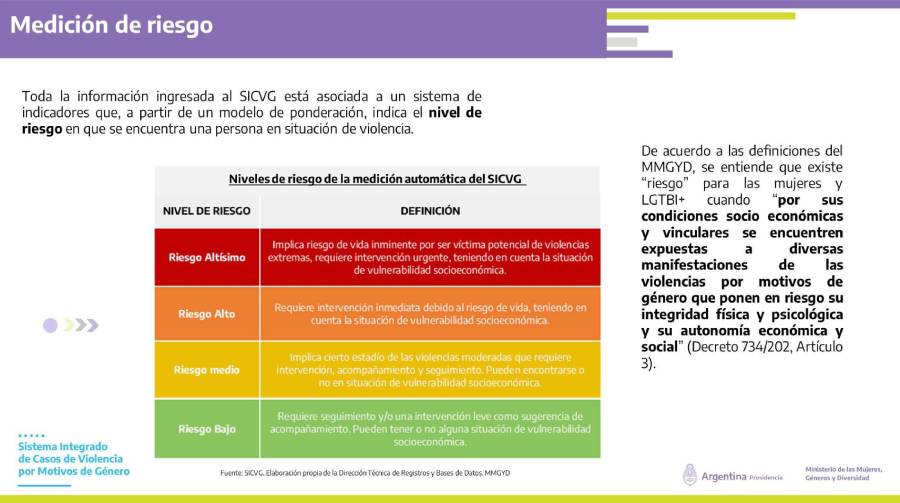
The system allows for the identification and breakdown of the characteristics of violence and, in turn, the determination of the level of risk. In this way, it is possible to frame the contexts in which this violence occurs.
During the presentation of the report, held in the Dome Hall of the Kirchner Cultural Center , the Minister of Women, Gender and Diversity, Ayelén Mazzina, stated: “The Integrated System for Cases of Gender-Based Violence is an important management tool. It provides us with information from across the country, shows us the impact of policies and government responses, and allows us to improve where necessary.”
He added, “Here we are presenting an important tool that is not just data; it includes stories, accounts from people who need institutional support. This tool will bring about the transformation we need.”
For her part, Lorena Balardini, technical director of Records and Databases at the MMGyD, highlighted that by having sophisticated the measurement of risk based on behaviors and violence, they were able to determine that more than 75% of the consultants were high risk.
The presentation included officials from Catamarca, La Rioja, Chaco, and La Pampa who described the impact of this registration system in each locality.
We are present
We are committed to journalism that delves into the territories and conducts thorough investigations, combined with new technologies and narrative formats. We want the protagonists, their stories, and their struggles to be present.
SUPPORT US

FOLLOW US
Related notes

We are present
This and other stories are not usually on the media agenda. Together we can bring them to light.