

Transgender employment quota: employment has grown nationwide, but there is still a long way to go to comply with the law.
According to official monitoring, there has been a significant increase since the law was passed, although it still does not reach 1%. The work with the private sector.


Share

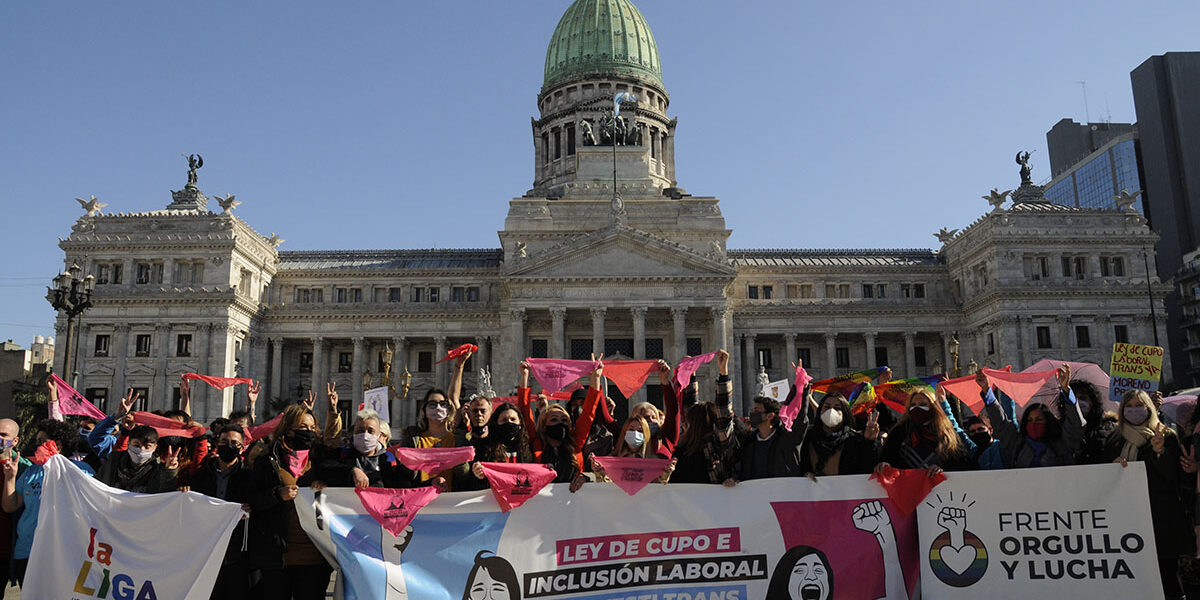
BUENOS AIRES, Argentina. The sixth monitoring of Argentina's Transgender Labor Inclusion Law revealed a 468.32% increase in the hiring of this group in the Executive Branch compared to September 2020, before Decree 721/2020 .
“It’s important to understand how employment changes the lives of transvestites and transgender people,” Undersecretary of Equality Policies at the Ministry of Women, Gender and Diversity Presentes . She also mentioned the two major challenges in implementing the legislation: federalizing the policy and expanding it to the other branches of government, especially the judiciary.
Five hundred and seventy-four transgender and transvestite people are currently working in the National Executive Branch. The increase has been gradual since the decree and approval of Law 27,636, the “Diana Sacayán-Lohana Berkins” Law for the Promotion of Access to Formal Employment for Transgender, Transsexual, and Transvestite People, on June 24, 2021. In September 2020, the total was 101 people; in December 2021, 235; in March 2022, 293; in June 2022, 427; in September 2022, 480; and finally, in December, 574.
This regulation aims to "establish positive action measures aimed at achieving the effective labor inclusion of transvestite, transsexual and transgender people, in order to promote real equality of opportunity throughout the territory of the Argentine Republic."
To this end, the three branches of government (executive, legislative and judicial), ministries, decentralized or autonomous bodies, non-state public entities and state-owned companies and corporations must hire transvestite and trans people in a proportion no less than 1% of their total staff.
Growth in the provinces
The 574 registered hires correspond solely to the national Executive Branch. According to Undersecretary Ponce, further work is needed to incorporate transgender and transvestite individuals into the other branches of government. “We have good news: hires have begun to be registered in the Legislative Branch. However, we haven't had the same success with the Judicial Branch. So far, they haven't reported any. We continue working to make that happen,” the official stated.
Currently, all provinces and the Autonomous City of Buenos Aires (CABA) employ transgender and transvestite people, although disparities persist in the proportions. However, this time, for the first time, jobs in CABA did not exceed 60% of the total. In this regard, the 23 provinces account for 40.24%, while the City's percentage is 59.76%. Besides the City of Buenos Aires, the provinces of Córdoba, Santa Fe, Mendoza, and Tierra del Fuego have the highest rates of employment.
“Much more work is needed to ensure this policy takes hold not only in the AMBA (Greater Buenos Aires Metropolitan Area), but also in the different jurisdictions. We must continue working in the provinces so that this policy can have a positive impact,” Ponce stated.
Registration: a necessary tool
Furthermore, of the 574 hires, 286 came from the "Diana Sacayán – Lohana Berkins" Single Registry of Transvestite, Transsexual, and Transgender Applicants . This is a tool accessible through its website, which includes a registration form for the transvestite and transgender job quota registry. As of early November 2022—the latest data available—there were 6,927 registered profiles.
The undersecretary also warned of the need for “intensive work” with the private sector. Current legislation on transgender employment quotas does not require private companies to hire transgender people, but it does offer incentives to those that do. Specifically, Article 10 of the law stipulates that the government must prioritize purchases of supplies and provisions from companies that employ transgender people. Furthermore, Article 11 provides for tax benefits.
“The private sector is not obligated to respond to this monitoring, but work has been underway because we believe that true social change will come the day it becomes natural to see a transvestite working in a kiosk, attending a pharmacy, and in other sectors,” Ponce told this agency.
There's still time
Presentes asked the undersecretary. "Although all of this data is very positive, we are still far from reaching 1%. That also needs to be said. That's why we continue with our efforts," the official responded.
In this regard, Marcela Tobaldi, the trans activist and president of the organization La Rosa Naranja , told Presentes that "while the national trans labor quota law is a very important step forward, there is still a long way to go."
“We know that people’s needs are very immediate. It’s a debt the State owes to trans and gender-diverse people,” Tobaldi said. She also emphasized the importance not only of the trans and gender-diverse quota, but also of moving forward with a reparations project for older trans and gender-diverse people .
However, she also praised the work being done by the Executive Branch. “We see all of this as progress, without a doubt. We didn't have this before. We know that the current situation doesn't allow us to move faster, and that all these measures that have been taken need some improvements. But 570 colleagues is not insignificant: it's a significant number,” she concluded.
The Ministry of Women, Gender and Diversity has opened registration for the course “Promoting Access to and Retention in Employment for Transvestites, Transsexuals, and Transgender People in the National Public Sector.” It is intended for public administration personnel working in municipal, provincial, or national government agencies.
We are present
We are committed to journalism that delves into the territories and conducts thorough investigations, combined with new technologies and narrative formats. We want the protagonists, their stories, and their struggles to be present.
SUPPORT US

FOLLOW US
Related notes


We are present
This and other stories are not usually on the media agenda. Together we can bring them to light.
1 comment