

“Humor gives me back the power that has been taken from me as a racialized woman.”
Rocío Quillahuaman illustrates and creates animations that often go viral. In 'Marrón' she shares her memories as a migrant woman, creator, and lover of libraries.


Share


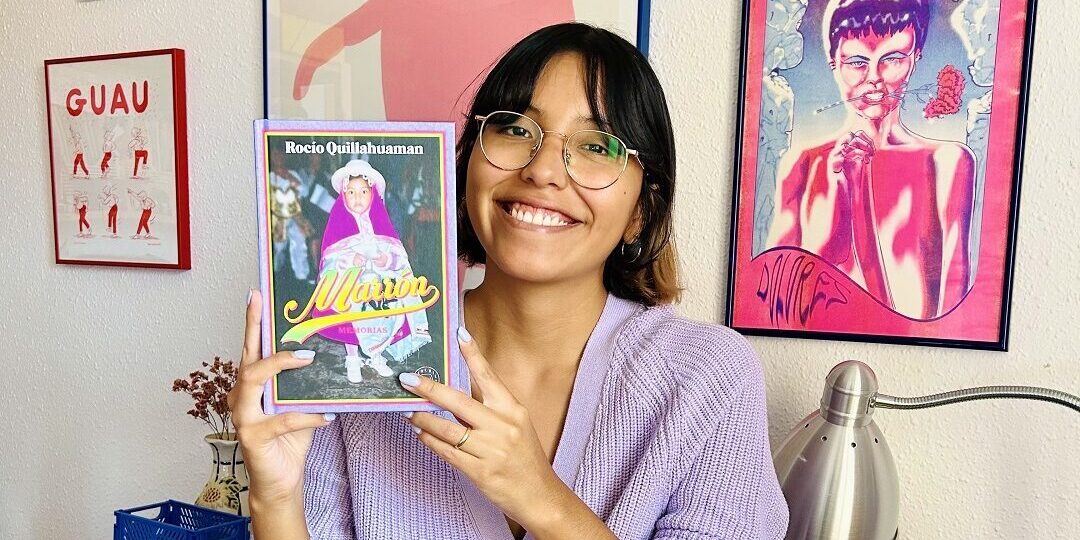
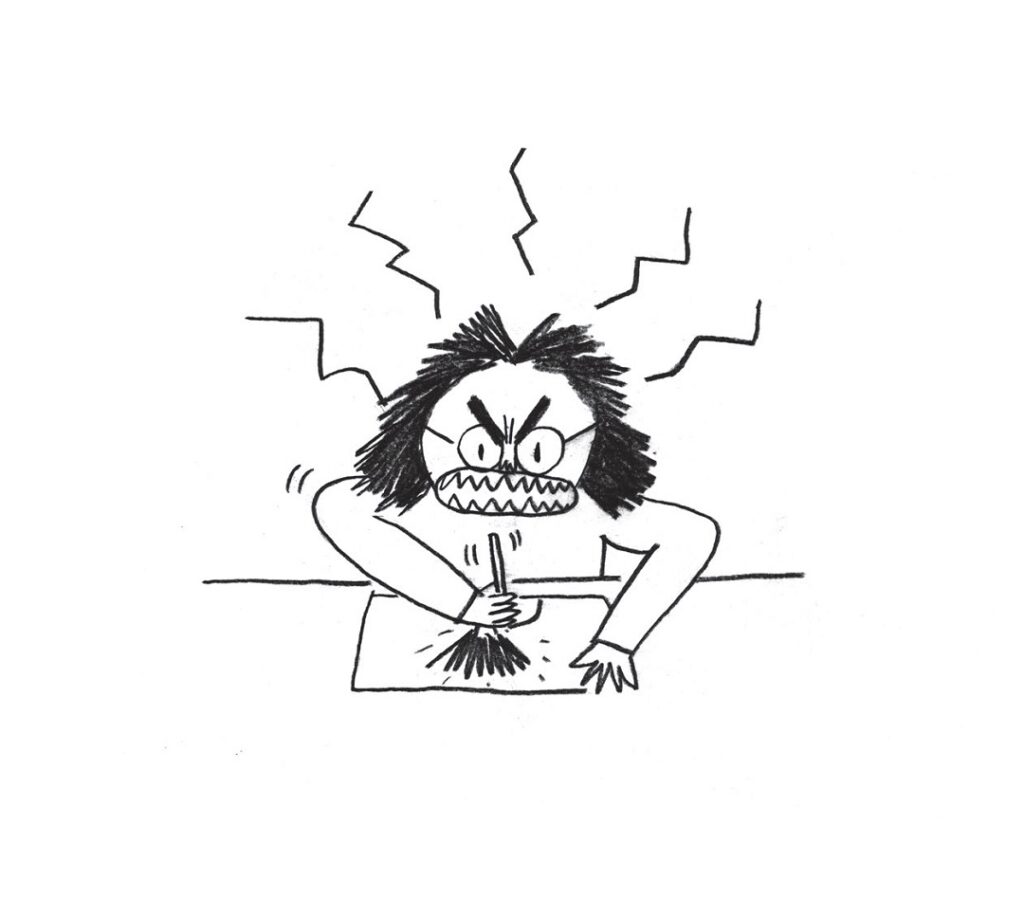
Rocío Quillahuaman (1994) was born in Lima and arrived in Barcelona at the age of 11. She studied Audiovisual Communication and found refuge in animation. Now she dedicates herself to creating comics, videos, and fan art (artistic works, mostly visual, created by fans about a fictional character). Her trademarks: screams, deliberately ugly drawings, sarcasm, and a strong comedic sense. She wrote Marrón (Blackie Books, 2022) so that “when a Latin American girl finds the book, she will feel relief to see that someone with a similar story to hers also exists in the rest of the world, and thus, perhaps, find companionship.”
These memoirs are a collection of anecdotes, difficult situations, tender and loving scenes, and chapters brimming with class-conscious and anti-racist humor. Marrón is ideal for reflecting on privilege, migrants, precariousness, and sexism. It's a perfect read, and one I highly recommend for teenagers (for its engaging, relatable style, simple language, and short chapters).
He recounts in the book that writing it was an odyssey. Why did it hurt so much?
Writing is a struggle, but writing about oneself is incredibly difficult. I wasn't prepared to do either. I'm not a writer; I just wanted to tell my story to represent the stories of many migrants like me. Perhaps that's why it was so hard. It took me three years to write it because juggling writing with a thousand jobs is complicated, but also because it was very difficult to relive things from the past. I'm only 28, but I feel like I've lived much longer; I think that's a feeling shared by all of us who have migrated.
What is the memory that has been most difficult for you to retrieve from the past, rethink, and write down?
The most painful memory was that moment when I tried to peel off my brown skin. It's a memory that haunted me for a long time, but I felt I had to tell it. I wanted to write an honest book, and for that, I had to share things I was sure many of us had experienced. I was never ashamed of being Latina. The rejection I felt toward my skin color came from outside, and I internalized it so much that I rejected myself, but it was never shame about being Peruvian or Latina. In fact, it was quite the opposite; I felt I wasn't good enough to be Peruvian or Latina. That was the point. I felt like I belonged neither there nor here. The rejection was only directed at myself. The process of accepting myself has been hard, but it's certainly essential to be able to fight against everything that made me reject myself.
"My mother raised me to be afraid in order to protect me."
He lived until he was 11 years old in a neighborhood in Lima with a very low per capita income, a place that he says is quite dangerous.
I'm very fearful, and that's because I grew up in that neighborhood. My mother raised me to be afraid in order to protect me: if I was afraid of everything, I would be careful and nothing bad would happen to me. Going to sleep at night thinking about everything that could happen to us was terrifying. I'll never forget those first nights in Barcelona, knowing that I could finally sleep peacefully.
How has the neighborhood and systemic poverty shaped his way of seeing and interpreting the world?
Living in poverty makes you grow up too fast, makes you see things as if you were an old woman even though you're just a child. I was very aware of things that, at my age, I shouldn't have been aware of, I think. I didn't have much time for innocence, and I suppose that has shaped my personality and my way of seeing the world. My mother always tells me how mature I was at six years old… and if you think about it, it's very sad.
And what about living in a matriarchy? What has it been like, and what is it like, for their main attachment figures to be women?
It feels so strange to see good fathers. When I hear a friend speak fondly of their father or when I see my brothers-in-law being good fathers, it surprises me. It's not an image I'm used to; it's not what I saw at home or in my neighborhood in Lima. For me, my mother is everything. I grew up with her and my sisters' care, and they're the ones who taught me how important it is to take care of each other and to take care of the people you love and who love you. This is the most important lesson they've taught me.
Why is it so difficult to escape racism?
She came to Barcelona with her mother seeking better working conditions for herself and for you: to study and grow up in an environment free from violence. She says that for years she felt like she belonged neither here nor there. Is that an easy feeling to bear, or does living between two worlds distort who you are?
It's not easy to deal with, but you have no choice but to keep going, without looking back too much. That's why writing *Marrón* , because when I finally did, I looked back for the first time. You try to adapt, to fit in, but it's not easy. Not only because you yourself feel this confusion of living between two worlds, but also because they make it difficult for you here too. They constantly remind you that "you're not from here," directly or indirectly. It's hard to escape racism because it's structural, and it's something you have to live with, which is unfair. And on top of that, it seems you can't complain, because then you're ungrateful. For those of us who arrived as children, it's a long journey of adaptation. If adolescence is a time to define your personality and identity, imagine what it's like for those of us who, in addition to that, have to fight against a system that marginalizes you and makes you feel worthless.
Her mother used to work cleaning houses and caring for people. Sometimes she'd go with her and pretend the houses she cleaned were yours. Now she's very well-known for her animations, collaborates with prestigious magazines, publishes with a hipster , and might even live in an apartment like the ones her mother used to clean. Is she still aware of class inequalities?
My apartment is still rented, just like the ones I've lived in in Barcelona. It's an apartment where the rent will go up in three years, and I'll have to move again because neither my mother nor I own a place of our own. This is the reality for many people, and for us too. I can take care of myself and my mother now, but with what I do and being self-employed, I have no guarantee that I'll be able to continue doing so in the future. People think that because I have a lot of followers, I'm a millionaire. But that's ignoring the precarious conditions and economic instability that many creators who don't have wealthy parents face, and in my case, my situation as a migrant artist. If I lose my job, I don't have a "parents' house" to go back to. I don't have a home, I don't have an inheritance, we have nothing to hold onto. And I don't just have to take care of myself; I have to take care of my mother, whose job is much more precarious than mine. How can I not be aware of class inequalities? I live in Camp de L'Arpa, not Sarrià. I think you should ask this question to a different kind of artist in Barcelona.
His greatest tool is humor. In his animations, we see him shouting and unleashing a barrage of sarcasm to ridicule fascist attitudes and figures (for example). He may not have inheritances or properties, but when it comes to wit, charm, and spark, no businessman, boss, or tycoon can match him.
It's my natural style. The humor I use in my animations is the humor I've always had; it's not something I've worked on, it's just what it is. Humor is a very important weapon for feeling powerful when someone makes you feel small. It's a tool that gives you back the power that, as a woman of color, has been taken from me on many occasions .
"It's very important to see yourself reflected in role models."
In the book, she talks about classism, but above all, racism: “I’ve been through all this hell so that when a Latin American girl finds this book in the library, she’ll feel relief to see that someone with a story similar to hers also exists in the rest of the world.” Why do we need role models like us?
It's so important to see yourself reflected in role models to aspire to something, to accept yourself and feel valued, to have hope. I think having had more role models as a child would have helped me accept my identity from then on. Being invisible makes you feel like you don't exist for others. That you're not part of here. It's just another way of isolating us, of marginalizing us.
Tell me about the wonderful cover photo.
This is me when I was five or six years old, dressed in a traditional Puno costume for a school parade. I look scared, which was how I always was.
*This article was originally published in Pikara. To learn more about our partnership with this publication, click here .
We are present
We are committed to journalism that delves into the territories and conducts thorough investigations, combined with new technologies and narrative formats. We want the protagonists, their stories, and their struggles to be present.
SUPPORT US

FOLLOW US
Related notes
We are present
This and other stories are not usually on the media agenda. Together we can bring them to light.