

Renee Goust: “Talking about love is political”
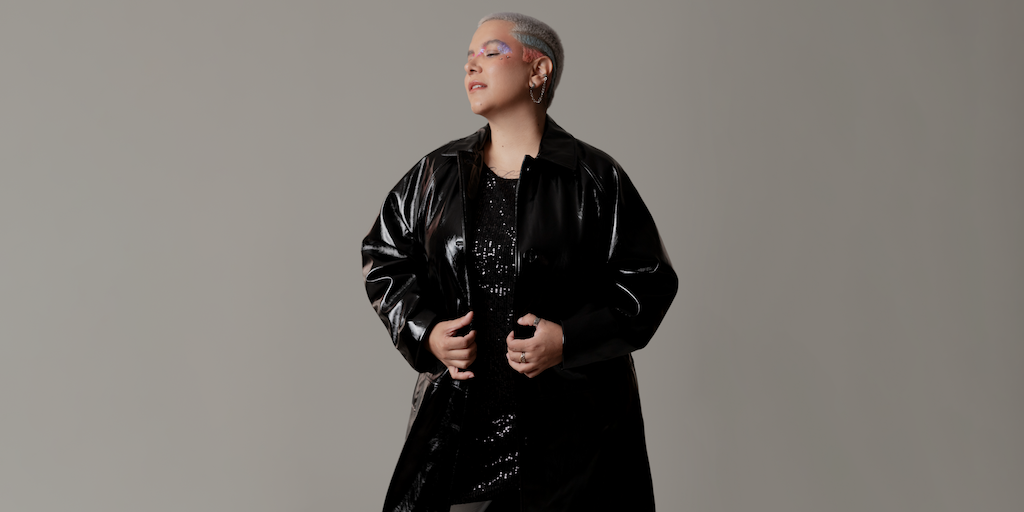
Renee Goust is a singer-songwriter, genderqueer, and transfeminist. In this interview, she discusses some of her favorite topics: identities and borders, music and love.


Share

MEXICO CITY, Mexico. Renee Goust is a singer and songwriter—she uses both gender-neutral and feminine pronouns. She grew up on both sides of the U.S.-Mexico border. She identifies as genderqueer, lesbian, and from the border region. Renee writes about dissident experiences, migration, gender violence, and social justice. One of her central focuses as an artist is telling stories about LGBT experiences through a regional Mexican lens.
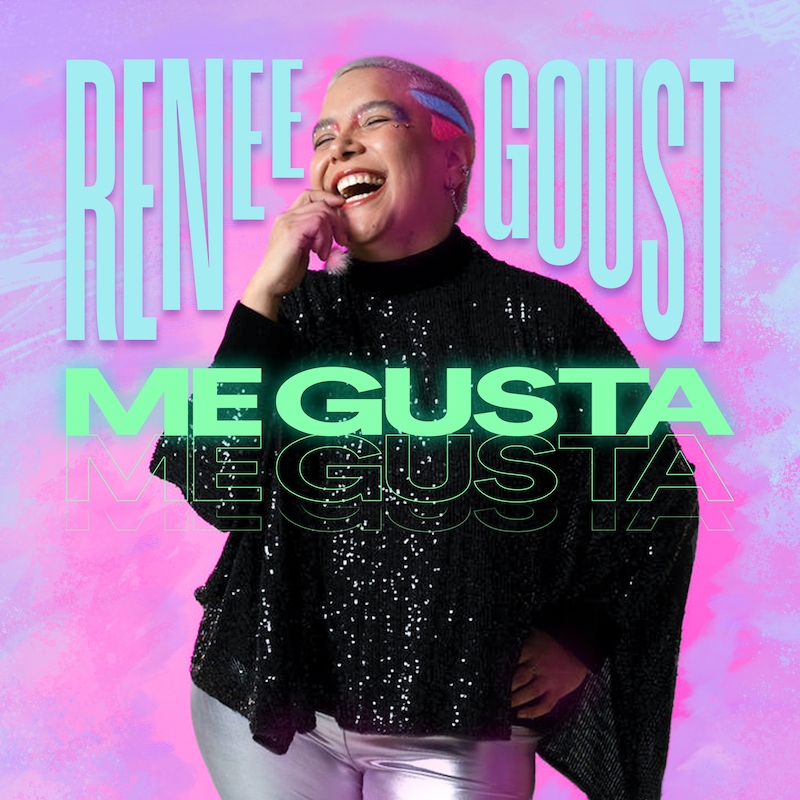
Her songs "La cumbia feminazi ," "Querida muerte (No nos maten)," and "Dios a" are considered feminist anthems. But for the first time, Renee allows herself to speak about love, pain, and the power of vulnerability with two new singles: " Me gusta" and "Me cansé ."
Both songs are part of the double album "La neta ya fue" , part of the life cycle of a couple's relationship, which will be released on February 23.
“I wrote something lighter, but no less political. With “Me Gusta” (I Like It), I talk about a new relational energy based on gratitude . “ Me Cansé” (I'm Tired) is a kind of promise to myself to get out of that situation, an attempt at polyamory with little emotional responsibility towards me. It's a song that I hope can accompany someone who is right on that edge of saying: yes, I love this person, but I'm already exhausted ,” Renee tells Presentes.
The double single “La neta ya fue” was produced by We Could Be Music, a Costa Rican non-profit label. This label aims to promote social change through music and amplify the work of artists from historically marginalized communities.
Presentes spoke with Renee Goust about her border identity, the value she places on regional Mexican music, and her affections.
Of Identities and Borders
-What is your relationship with the Nogales, Sonora – Nogales, Arizona border?
I was born in Tucson, Arizona (United States) but I never lived there, I only went to school there. My home was in Nogales, Sonora (Mexico). When I was born it was very common—not anymore—to cross the border and have your child on the other side (United States). Then come back and act like nothing had happened. It was a common practice because, as everyone knows, the dollar is worth more than the peso. I grew up speaking both languages, a privilege that I now understand opened doors for me, especially in life decisions like having a residence in Brooklyn.
-How do you feel about the concept of borders?
The word "border " itself is interesting as an identity. I've been questioned about it many times, with people saying things like, " Dude, down with borders !" Yes, I completely agree, and at the same time, it continues to be my experience every time I visit my family. And a reminder of why I left Sonora.
When Renee moved to Brooklyn and became more involved with diversity, she understood that leaving Sonora “had been a kind of LGBT exile, when in 2003 I came out as a lesbian. Nobody in my hometown was a lesbian, just me, and my girlfriend, the town's famous lesbian.” At that time, Renee lacked role models among other lesbians. She thought, “ Dude, I'm going to die here, I'm going to suffocate .”
The whole culture was super judgmental. Today, women are very active. But the Nogales border city I knew was pre-internet. It's not fair to talk about the Nogales of 2023 because I don't think I know it. The Nogales where I grew up certainly had very little appreciation for diversity and the arts.
From the root
-How does your border identity influence your music?
When I distanced myself from the place where I grew up, I could truly see it through a different lens. I zoomed out to get a broader perspective and realized: yes, I have a lot of both cultures in me, the influence of Mexican culture, of Sonoran culture. But I've been living in the heart of the United States for 15 years. That longing for the place where I grew up made me want to reconnect with it through music, through rancheras. The first ranchera I wrote was " El Patriota Suicida" (The Suicidal Patriot .
Renee says she also grew up listening to corridos, thanks to “my drunk uncles, and I’m not going to deny that, you know?” For many years she struggled with it, with its violent themes. But today she has the power to take that genre and make it her own.
Telling you about the corrido of Sylvia Rivera that I did in collaboration with La Bruja de Texcoco , or telling you a story about what we know as coming out in a song called La Ap u esta , was healing. It was reconciling my dissent with my roots. I think that dissidents can have a space in Mexican music. To say, " Damn it, this is mine too !" I had to leave because there wasn't space for me, and I want there to be space for me, and I want there to be space for people like me, for the other women in Sonora who might feel the same way .
-What conversations did you have with yourself that allowed you to make "Me Gusta" and "Me Cansé"? They are songs based more on your personal experience and not so much on Renee, who sings about death, street harassment, gender violence…
I like that you use 'allow yourself' in your question because I do feel like it's about giving myself permission, that not everything has to be a fight against what's constantly happening to us. At the same time, it's a struggle because looking at our emotional worlds can be scary. I forgot that for a long time, and I think that's why I got into some bad situations.
Last year Renee had what she calls "a particularly difficult relational experience."
-2022 was about learning tools for the kinds of relationships I want to build, and at the end of the day, with my music I'm also keeping a kind of diary for myself, of my experiences. "Me Gusta" and "Me Cansé" are very opposite sides of the same coin. It's also a message to say that as a trans feminist, I can also feel this way, and it doesn't take away my right to feel vulnerable, to feel hurt , to say: I'm tired of waiting like a scrawny dog for crumbs of love —a lyric that makes me nervous, to be honest.
“My friendships have been the loves that have sustained me.”
-Why do you care about talking about love?
"These days, talking about love is frowned upon, and that bothers me politically. I mean, all the mainstream are all about sex, sex, sex, but I'm never going to commit, and that's fine, we have a right to that. I think we also have—and we're really fooling ourselves—a human need for connection, for closeness and warmth, to feel embraced by a friend, by a partner. I feel like right now intimacy is being ignored, and more attention is being paid to avoidant people."
Last year I realized how poorly educated I was in terms of relationships. That's when I told myself: okay dude, let's talk about love, let's be vulnerable . Talking about love is political. I'm no longer afraid to show this side of Renee. This side that messes up, that messed up, that fell in love, that will fall in love, that had its heart broken, and that was also there, completely screwing up.
-What loves do you celebrate?
For me, one of the most significant loves is the love I have for my very close friends, whom we call " Las Morras Perronas" (The Badass Girls ). My friendships have been among the loves that have sustained me no matter what. I celebrate the love I have for my partner. I celebrate the love I have for the dissident communities with whom I've been able to share my music. I celebrate the love I have for my grandmother. My grandmother is 92 years old and very joyful; she's a role model for me. She's a very revolutionary woman. My grandmother is what connects me to my entire past, to everything. I say "my grandmother" and I feel like crying, you know? " Pozole" is a song for her.
And I celebrate my love for my work, for my music. My music is more than just my job. It's what nourishes my soul and sustains my ability to continue living a full life.
We are present
We are committed to journalism that delves into the territories and conducts thorough investigations, combined with new technologies and narrative formats. We want the protagonists, their stories, and their struggles to be present.
SUPPORT US

FOLLOW US
Related notes

We are present
This and other stories are not usually on the media agenda. Together we can bring them to light.