

Proudly Black and Queer: The Paths of Erick Luna's Photography
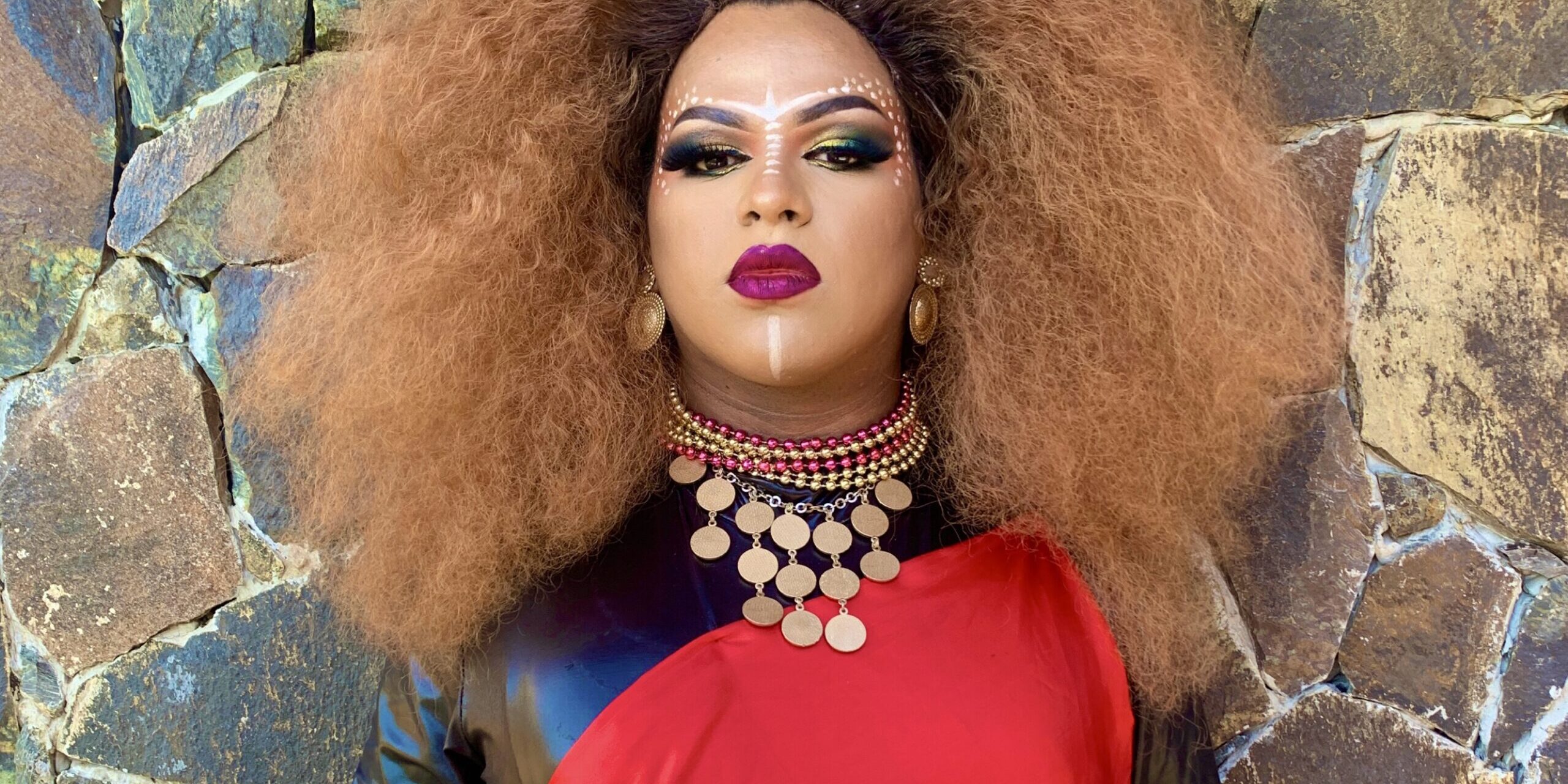
Erick Luna uses photography to explore Afro-descendant heritage in a country where the ideal beauty models are white.


Share

Erick Luna uses photography to explore Afro-descendant heritage in a country where the ideal of beauty is white. Salvadoran advertising is dominated by slender women and men with straight hair and light eyes, in contrast to the majority of the mixed-race population in the Central American country.
Traditionally, the promotion of ethnic heritage with dark skin and curly hair was not disseminated in school textbooks or advertisements; the homogenization of society was the rule after colonization.
Erick, 21, lives in Jocoaitique, a small town 220 kilometers northeast of the capital. According to the last official census in 2007, the town has a population of about 28,000. Most of the population is of Lenka descent, but he didn't feel like he belonged to the Indigenous community, nor to the mestizo population. He was always different from the rest of his family and friends.
“The process has been a bit complicated because in my family, no one identifies as Afro-descendant, only me. I believe my Black heritage comes from my grandfather. I almost always straightened my hair, but one day I decided to let it be natural. Many people say that Afro hair is messy, that it looks bad, but it's my own identity and it has historical significance for me,” she told Presentes.
The department of Morazán is one of the areas with the highest percentage of people who self-identify as belonging to the Lenka and Kakawira Indigenous Peoples. According to the pilot census of population, housing, and food security conducted in the municipality of Cacaopera in 2018, it is estimated that 83 percent of the population is Indigenous.
Afro erasure
“In El Salvador, stereotypes are quite prevalent. Beauty here is defined by being white, blonde, and having blue eyes. Even in the workplace and at school, discrimination is felt, sometimes indirectly, but it's always there,” Erick said.
She remembers being teased as a child for her skin color and curly hair. She didn't have much information about her ethnic background, but it wasn't until 2021 that she learned about the work of Afrodescendants Organized Salvadorans – AFROOS and felt that for the first time she could identify as an Afro-descendant.
According to the latest population census of 2007, some 7,441 self-identified as Afro, representing 0.13 percent of the total population.
Fourteen months ago, Erick stopped straightening his hair as a step towards full self-acceptance. He says that when his curls began to grow back, he decided he would no longer hide his Afro-descendant identity.
“I always try to convey a message with what I do, but the main thing is that people accept themselves, because I am a black person, I am proud of my afro hair and I have no reason to hide it,” he added.
Queer
Erick recalls that he began exploring his gender identity in childhood. At five years old, he wore his sister's clothes, but he didn't know how to feel or name what he was experiencing. He felt attracted to boys a decade later.
“I remember that I never felt like a boy, nor did I feel like a woman. People asked me when I was going to start transitioning because when I grew my hair out they thought I was going to become a trans girl, but so far it’s not something I have in mind because that’s not how I feel,” she said.
The series about diverse identities broadcast on streaming and the workshops on the rights of LGBTI people gave him the answer he was looking for about his identity; Erick perceived himself as a Queer person.
“I’ve asked many trans friends how they started the process, and they told me that they felt like women from a young age. I don’t remember feeling like a girl in my life; I’ve felt like I was somewhere between both genders. Before, I didn’t know what queer meant, but now I do,” she added.
El Salvador does not have disaggregated data on gender identity, however, the report “Current conditions of the LGBTI population in El Salvador 2020 – 2021”, prepared by the Association Communicating and Training Trans Women with HIV in El Salvador – COMCAVIS Trans, of 244 people consulted, 3 percent self-identified as Queer.
Photography and Drag Queen art as an expression
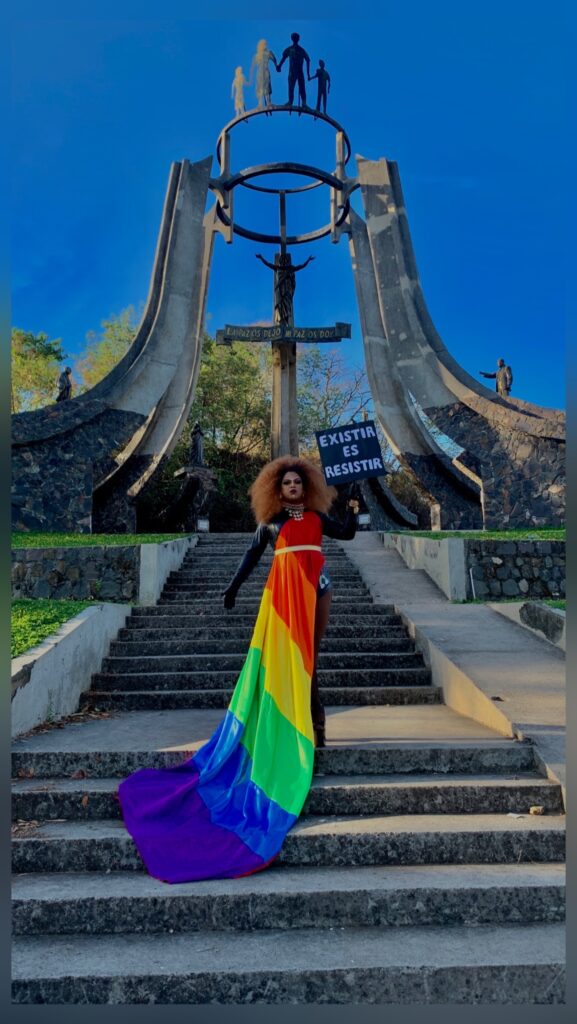
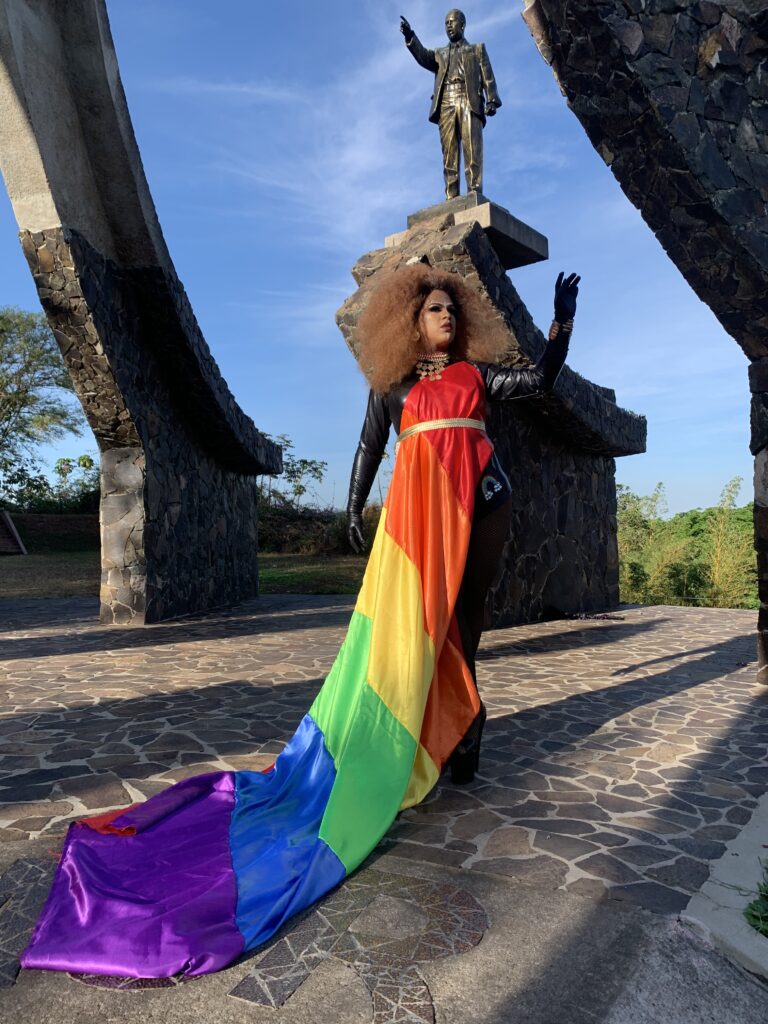
The link between gender and cultural identity materialized in drag art. The exploration of African heritage and queer self-expression merged it with photography.
“When I discovered drag art, I wondered what my gender identity was, and when I discovered it, I felt that I could feel like a woman and like a boy, yet I knew that I was exactly in the middle and I identified with the letter Q,” Erick said.
In 2019, Erick joined the Morazán Squad, a group of cheerleaders who participate each year in the Pride march through the streets of the capital. To participate, they have to travel about four hours from their homes and invest at least $400 in costumes and makeup.
Erick considers himself self-taught, although he studied hospitality and tourism. Lately, he has become passionate about makeup, clothing design, choreography, and photography.
In 2022, he produced his first session to participate in a contest organized by COMCAVIS, in which he won second place.
Her intention is to continue expressing herself through imagery and to motivate others who are still exploring their gender identity and cultural heritage.
“With photography, I try to show that I am a drag queen, an openly gay person, openly queer, and proudly Black. It’s all a process, and all you have to do is be patient with yourselves; nothing is going to happen overnight,” she said.
We are present
We are committed to journalism that delves into the territories and conducts thorough investigations, combined with new technologies and narrative formats. We want the protagonists, their stories, and their struggles to be present.
SUPPORT US

FOLLOW US
Related notes
We are present
This and other stories are not usually on the media agenda. Together we can bring them to light.