

Are gender-neutral bathrooms at the University of Mexico inclusive spaces?
Students at UNAM have reported finding hate messages on the walls since gender-neutral bathrooms were opened.


Share

The National Autonomous University of Mexico (UNAM) has the most gender-neutral restrooms of any Mexican public university. The existence and continued presence of these spaces has sparked debates, assemblies, and acts of resistance against gender-based violence within the university and the presence of transphobic messages in these spaces.
Who are the gender-neutral restrooms at UNAM for? Are they inclusive spaces? What is the university community and authorities doing to ensure that the restrooms are safe and accessible for everyone?
To answer, Presentes spoke with researcher and philosopher of science Siobhan Guerrero, doctoral candidate Leah Muñoz, and members of the university community who use these spaces.
In addition, this media outlet sought out UNAM authorities to ask about protocols for action in case of violence that occurs within the bathrooms, but at the time of publication we did not receive any answers.
Since no response was received, Presentes also does not have the exact number of gender-neutral restrooms currently existing at UNAM. However, in our reporting, we found that they are located at CCH Naucalpan, FES Iztacala, FES Aragón, ENES Morelia, ENES Juriquilla, ENAH, the Faculty of Philosophy and Letters, the Faculty of Political and Social Sciences, the Faculty of Chemistry, the Faculty of Sciences, and the Faculty of Law.

“There are no inclusive bathrooms, there are LGBT bathrooms and that can create segregation.”
Gender-neutral restrooms at UNAM have been implemented in areas that previously had separate restrooms for men and women. These restrooms have been established both through institutional actions, such as at the Faculty of Chemistry, and through student agreements reached in assemblies, as was the case at the Faculty of Philosophy and Letters.
During our visit, we found that not all gender-neutral restrooms are on the ground floor, not all have ramp or elevator access, the urinals and toilet stalls are narrow, and not all have at least one accessible stall for people with disabilities. The sinks are too high, and there are no designated diaper-changing areas.
Both inside and out, the gender-neutral restrooms display LGBT+, trans, and non-binary flags on their facades, and positive messages about being trans, non-binary, and gender non-conforming are visible on the walls and mirrors. Throughout UNAM, these restrooms are generally referred to as "gender-neutral."
Siobhan Guerrero explained to Presentes the importance of the message conveyed by how these spaces are conceived, constructed, and named.
“I think an LGBT bathroom or a trans bathroom doesn't send the same message as an inclusive bathroom because the message of an inclusive bathroom is to recognize that we are all part of the same community and that we can not only coexist, but also recognize each other. I think what happens at UNAM when an LGBT or trans bathroom is established by the student body is that it reflects a sense of fear and an attempt to create a safe space, and the message it sends is precisely that we are incapable of knowing how to coexist with our differences. I think we have lacked reflection on what the creation of a bathroom implies, starting from a response that is betting on a kind of self-segregation as a security strategy.”

On the other hand, the narrative from institutional actions is not so different. The gender-neutral bathroom in the Faculty of Chemistry was a project of the Gender Unit, which, when presented by its coordinator, Paulina Trapagá, described it as a space "for people who belong to the diverse gender and sexual community or who live their gender identity from a diverse perspective."
In that sense, Leah Muñoz finds this institutional narrative problematic because she believes it also leads to segregation.
“At UNAM, there aren't inclusive bathrooms, there are LGBT bathrooms; that's what they're focusing on, and that can generate segregation. The demand for bathrooms specifically affects the trans community because of exclusion and violence, and I think university authorities aren't understanding where it comes from and why it's important to address it. On the other hand, I think using it as a way to give visibility to LGBT groups is a mistake because it doesn't understand exactly who it affects. Trans people want to be included in the bathroom that corresponds to our gender identity, just as non-binary people want to go where they feel safe and don't suffer aggression. The demand isn't for bathrooms just for trans people; that doesn't combat transphobia. We even advocate for gender-neutral bathrooms where everyone can enter because if you remove the gender criterion from a bathroom, you remove the criterion for checking bodies,” she explained.
The first gender-neutral bathrooms at UNAM “were not acts of goodwill”
The existence of gender-neutral bathrooms at Mexico's most important university is preceded by acts of institutional transphobia and harassment.
On January 9, 2018, the Faculty of Higher Studies (FES) Iztacala in Mexico City opened the first "mixed bathroom" at UNAM. By August of that same year, students from various majors at the National School of Higher Studies (ENES) Morelia campus had "de-gendered" the first bathroom outside the Mexican capital.
However, the creation of the first gender-neutral bathrooms at UNAM “were not acts of goodwill on the part of the university authorities,” says Irene Valdivia, a student at ENES Morelia and coordinator of the Michoacán Network of Trans People .
“In 2017, I hadn't legally changed my gender identity, and at ENES (Morelia), this discussion started about which bathroom I should use. The argument was that Sony, a trans man, was potentially vulnerable to sexual assault in a men's bathroom, and with me, it was the opposite—that I could be the one committing the assault. It was a ridiculous argument, and they wanted us to use the nurses' bathroom, even to use a badge accredited by the University City. We said no. Some time later, the whole process for creating gender-neutral bathrooms began,” Irene recalls.

In the case of FES Iztacala, a news article published by Fusión in 2018 reports that, after an act of harassment in the men's bathroom against Ikbal, a trans student, the faculty offered her the key to the bathroom for disabled people as a solution.
“I accepted, it was the only solution at the time. Later I realized it wasn’t cool, because I don’t have a gender disability,” Ikbal said in that note.
Ikbal recounts that after that, a medical professor insulted and misgendered her upon seeing her leave the women's restroom. Following this, she organized talks on diversity for faculty members, which were largely ignored, and in January 2018, authorities announced the opening of the first gender-neutral restroom at a public university in Mexico.
Who uses the gender-neutral bathrooms at UNAM?
Presentes spoke with users of the various gender-neutral bathrooms in Ciudad Universitaria to learn about their experience and what they think needs to be improved in these spaces.
“I think inclusive bathrooms exist for anyone, in theory, who disagrees with the binary architectural norms related to genitalia. I think in that sense they are beneficial for gender nonconformists and can make us feel more comfortable and safe. In my case, since I came in here, I don't get strange looks, no one whispers about me. And I do feel that, although anyone can come in, this space exists for LGBT people. I haven't seen mothers with children or fathers with children, much less people in wheelchairs, for example. I think that's something we still need to improve, making it accessible to everyone.” —Kutzi identifies as agender and is an earth sciences student.
“I have a cis pass, so I don't have much trouble going into the women's restroom, but I have friends who had a lot of problems in the women's restrooms for not conforming to cis norms because it's always a huge problem for trans people just to use the restroom. And honestly, at first it was really nice going into gender-neutral restrooms, but little by little the romanticization faded. I realized the reality is that now anyone can go in with bad intentions. I suddenly see a lot of cis guys, and once two guys scared me. And even though there are emergency buttons, they're useless because there are no protocols to make the restrooms safe. Now we organize ourselves because the faculty administration has hindered everything, and honestly, I don't think it makes much sense if people are still at risk. And even though it might give you a sense of security because of your identity, in the end it's "That's false if the university itself doesn't guarantee our safety in any bathroom." —Selic is a non-binary person and studies philosophy.
“I’m not a student, I work here, and these restrooms have been especially useful for me, like right now, to be with my son. Some girls told me about this restroom, and we came here, mainly for safety, since he’s still little. I haven’t seen any other fathers or men here, to be honest. At first, it does feel strange, but no one has said anything to me, they don’t give you dirty looks for coming in. And even though I don’t use it, I feel better bringing my son here because we’ve found toilet paper, soap, water, and it doesn’t smell bad, because the men’s restrooms often smell really bad.” —Jacinto is a single father and a shopkeeper.
There are also those who use them not necessarily because they find a sense of security related to their gender identity, but simply because of the proximity or because they are "just passing through." And while we did encounter Mr. Jacinto, the students told us that it is not common for adult men with children to enter gender-neutral restrooms.
“An unsafe bathroom is not going to be an inclusive bathroom.”
According to the First University Consultation on Gender Equality Conditions of the LGBTIQ+ Community of UNAM, carried out in 2022, 15.44% of trans women and trans men mentioned that at least someone at the University denied them the right to enter a bathroom because of their gender identity or expression.
In addition to these forms of violence, UNAM faces waves of impunity for assaults, harassment, rapes, and femicides within its facilities. This has led to the emergence, for at least six years, of a strong student and feminist movement demanding justice for victims of gender-based violence.
The violence experienced by women and LGBT+ people has led to assumptions that gender-neutral bathrooms can be unsafe spaces. In this regard, Siobhan Guerrero points out that this represents “a community challenge.”

“You can’t have an inclusive bathroom if it doesn’t meet a series of minimum requirements, which of course include safety. An unsafe bathroom isn’t going to be an inclusive bathroom. The concern that inclusive bathrooms might be unsafe isn’t just a concern for women, without any qualifications, but also for LGBT people, especially not only trans people but also those with non-conforming gender expressions. So, a precondition for addressing this is a community intervention that leads us to think that, indeed, we want to inhabit ourselves as a community where it’s possible to coexist positively with our differences and not see our differences as an enemy or a potentially aggressor. And in that sense, achieving these bathrooms isn’t just an architectural challenge; it’s fundamentally a community challenge,” she points out.
In November 2022, the Faculty of Philosophy and Letters went on strike after a man entered one of the gender-neutral restrooms and took photos with his cell phone without consent. The student assembly demanded that the administration install floor-to-ceiling metal screens between each stall to prevent photography.
Students we interviewed commented that to date the authorities have not addressed the assembly's requests, including the creation and implementation of a specific protocol for cases of gender violence in all the faculty's bathrooms.
Currently, only one of the two gender-neutral restrooms in the Faculty of Philosophy and Letters has floor-to-ceiling stalls. They have been this way since it was a women's restroom, as acts of violence had already occurred there.
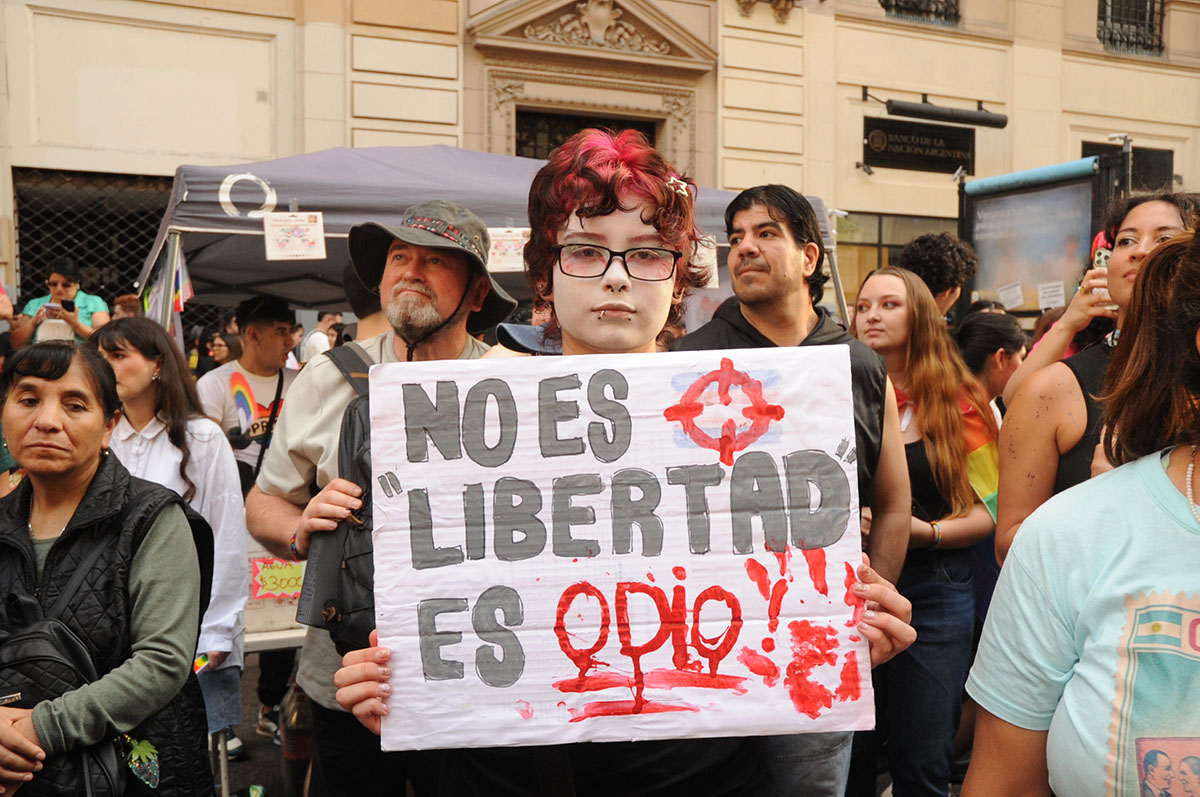
In addition, UNAM students have reported finding hate messages on the walls since gender-neutral bathrooms were opened.
In response, trans, non-binary, dissident people and those who use these spaces take group photos celebrating their identities, make TikTok videos dancing in drag , and decorate mirrors, cubicles, and walls with positive messages about their existence.
We are present
We are committed to journalism that delves into the territories and conducts thorough investigations, combined with new technologies and narrative formats. We want the protagonists, their stories, and their struggles to be present.
SUPPORT US

FOLLOW US
Related notes

We are present
This and other stories are not usually on the media agenda. Together we can bring them to light.