

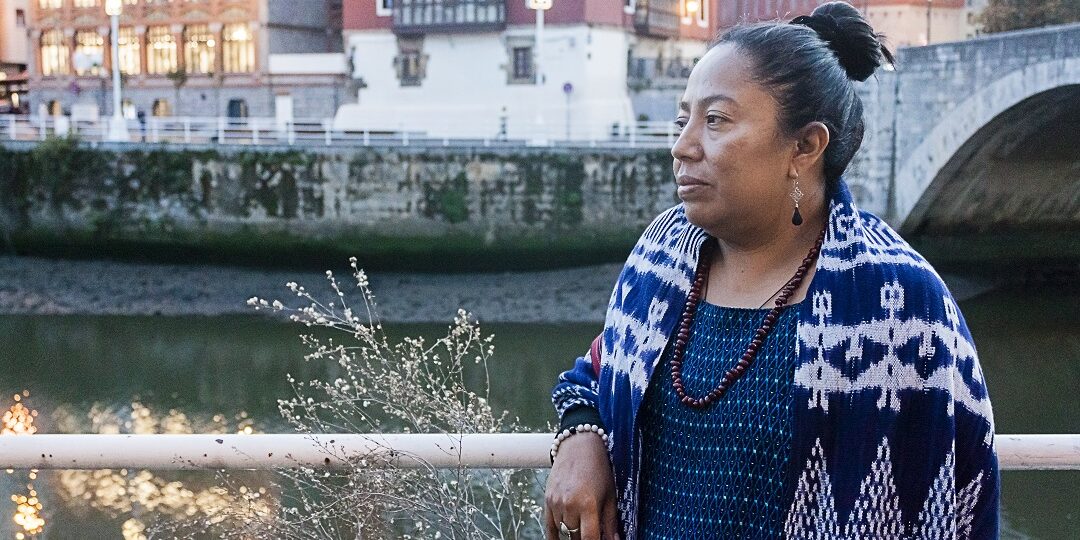
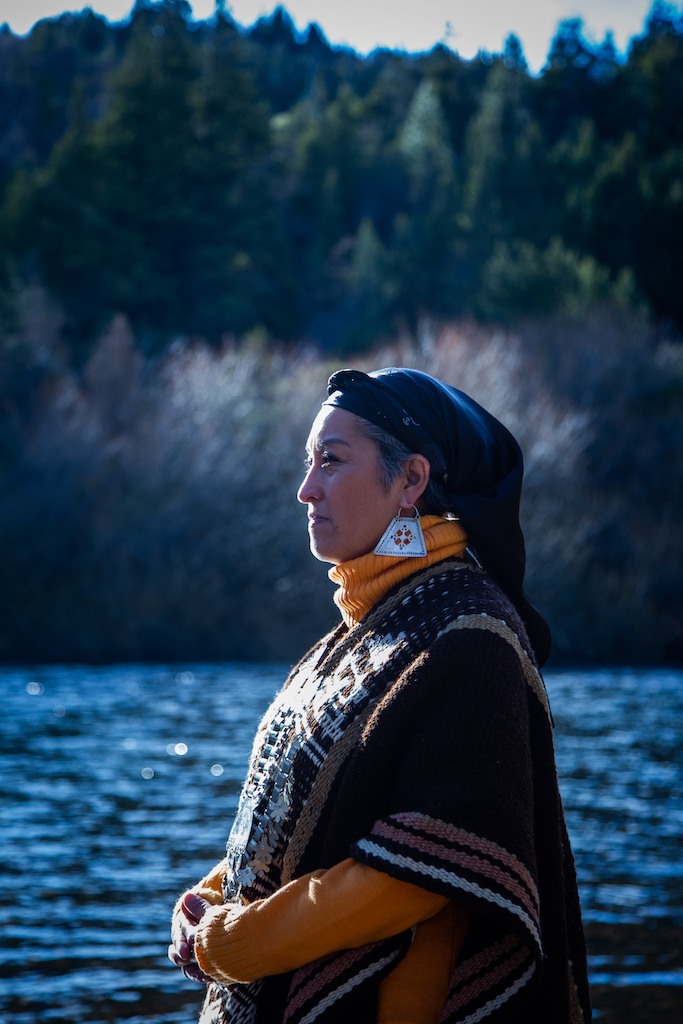
Lorena Cabnal, Mayan healer: "Healing is a personal process that becomes communal."
Lorena Cabnal is part of the Network of Ancestral Healers of the Territorial Community Feminism of Iximulew in Guatemala.


Share

The interview takes place in a corner bar in Bilbao, but Lorena Cabnal transport her to another context, distant not only physically, but also conceptually, epistemically, as the healer says. Distant words, yet resonating, not only because of the force with which they are spoken, with cadence, care, and reflection, but because they constantly seek unity and forge connections; to embody, as the healer says.
Lorena Cabnal, from the Network of Ancestral Healers of Community-Based Territorial Feminism of Iximulew, has traveled from Guatemala to participate in the event 'Weaving Territories 2022, a meeting of migrant activists and defenders of dignity here and there ,' organized by Calala. “While it’s true that there’s a very broad and quite strong and important feminist movement here, the voices that come from your own territory are also necessary,” she responds when asked about the importance of these gatherings. “We want to understand the perspective of the immigrant women who are here and how they have been engaging politically, challenging, questioning, but also contributing to the feminist movement,” she adds.
– You speak of embodying and proposals close to the land. These concepts, embodying or body-territory, weren't so deeply ingrained in feminism here; they are political concepts and practices that are being learned from the women of Abya Yala. Is there receptiveness, or are there still things to understand what they entail?
– Community-based territorial feminism is not written theory; it is a form of assertive, feminist, community-based, and territorial oral tradition that comes from Mayan women, and the Mayan code is very oral. The community-based territorial feminist proposal has no statement, construct, or concepts, in principle. Mayan thought stems from a deep feeling for life, from feeling and thinking, and that is another point for developing thought. And in that relationship of feeling and thinking, we have brought in the dimension of how the everyday becomes political for Indigenous women. We have a very political everyday life to which we will give a cosmogonic meaning, but at the same time a political one, with a feminist intentionality. And we are talking about territory-body-land: we always put territory first, because that is where our political relationship begins; we don't speak of it as body-territory. In the Spanish word "territory," we want to approach all the relationships of life that exist, and territory is not limited to the geographical, to the map; that is only one part of territory in the original or Indigenous configuration. The territory encompasses languages, lunar cycles, calendars, textiles, forms of organization, medicine, planetary relationships—everything. And when we speak of body-earth, there is a conscious relationship between our bodies and the earth in that time. If you tell an Indigenous woman in her language about the life-territory-body-earth relationship, she feels it and reflects on it in order to act. We Indigenous women are epistemic subjects; we possess profound epistemic knowledge, but with different codes.
– The absence of written texts makes physical spaces for dialogue more important.
– To look at each other, to listen to each other, to feel the oppressions that run through our bodies, and also to feel the healing. We question feminist rationality, so naturalized in many theories. We are bringing another proposal: to feel and think about life. We talk a lot about plurality, because plurality is a principle of cosmogony in our peoples.
– You often refer to the defense of the land; I don't know to what extent feminism here has internalized that struggle.
– One of the criticisms we've made, for several years now, of the feminisms that have reached us from other territories is precisely that we found a disconnect between bodies and the land. We embrace the idea that the personal is political and we embrace the free self-determination of bodies—I have abortions, I decide my sexuality with whom I share it, whether I want to be a mother; and we, as community-based, territorial feminist women, are clear about this—however, we also began to find that this body that has abortions, that decides, that is very clear about feminist principles, has a void that undermines the sustainability of the political proposal: because this body drinks water every day, breathes every day, takes in air. And what is happening to the forest? What is happening to the mountains? To the water sources? For us, the political sustainability of feminisms, of any feminism, would have to include the dimension of the personal as political, but also the relationship with the land. And that's why we've coined the phrase "the communal is political," because the strength of the communal will bring you back to the land. We don't want feminisms to come and take over our territorial defense, to displace us. We want to weave together plurality to be strong, because we believe that women defenders of the land are contributing, and that's where we can see the possibilities of joining forces with other feminisms. We have to keep unlearning or learning together. For us, joining forces also means denouncing the sexist violence against the land. All forms of extractivism against the land—hydroelectric dams, widespread monoculture—are forms of sexism against the land. Many citizens of the Spanish State don't know that their retirement money is being used to finance large-scale projects of death and grave violations of the rights of Indigenous peoples to life in countries like ours.
–You work with women subjected to different axes of oppression: the patriarchal system, sexual violence, and also the extractive economy. What do they have in common?
The forms of the patriarchal system are manifold. As Indigenous women, we fight against all forms of Indigenous sexist oppression, which white bodies don't experience. But at the same time, you confront expressions of sexism that exist outside the community, such as mestizo bodies, government officials, and private security guards. And you are a defender of life, waging a battle within the community, because we Indigenous women who are visible in this have also broken down quite stereotypical patterns of Indigenous women and have placed ourselves in a situation of political risk for being dissenting. There is a very ancient thread, the patriarchal one, which becomes a historical, structural system of oppression on our bodies and on the land. And it is a common thread. The ancient patriarchal system combines with forms of Indigenous sexism and forms of colonial sexism that were brought to us, and then configures a racist system: expropriation, sexual violence, genocide. Indigenous peoples and Indigenous women are living through a messed-up web of oppressions; there's a historical continuum of violence against our bodies and our land. This accumulation is messed up and complex. And you realize that the creation of a colonial nation-state is being reinforced, that colonizing continental policies are being created, and all of this is leading to what has us today in this historical continuum of violence, counterinsurgency warfare, a neoliberal era, and now the pandemic. We are waging a very complex struggle. And we are also doing other things to heal consciously, because we also have the right to joy, to pleasure, to happiness, to delight.
– What does decolonial analysis contribute to this struggle?
– We value the contributions being made from a decolonial perspective, but we don't start from there. It's important that feminist movements recognize that there's a dialogical approach that's contributing its own interpretation through oral tradition. We can't start from the colonial era onward; we can't interpret the oppressions of Indigenous women from 534 years ago onward. We're going further back into ancestral time. That's why I don't propose a decolonial approach, because we're engaging with Mayan calendars, with Mayan temporalities, which breaks with the interpretation of temporality as it relates to how the patriarchal system was configured in Indigenous communities in relation to the Western world. And there we've asserted that my body is my first territory of defense; In that realization, we can gain clarity on how patriarchal logics have been expressed, how they have impacted us, and how today, for us, forms of colonization converge, creating patriarchal agreements, pacts, and mandates. This is why Indigenous women are so impoverished; it has an accumulated logic, which is why we speak of a historical and structural framework of oppression. These are very epistemic designations. Black feminism has proposed intersectionality, and we welcome it, but I cannot approach the topic from an intersectional perspective to explain what happened in Indigenous communities, because we have to decode the cosmogony and bring in other foundational, historical relationships with the land and with our bodies. And the concepts of decoloniality are under profound critique from the other side. We believe that the places of enunciation, the bodies from which decoloniality is articulated, are a vital political point for understanding who is speaking about decoloniality.
– How would you define yourself?
– I like to refer to myself as I've been referred to, even if you will, through an incoherent and colonial naming of this body, but I make it political precisely to make visible in this embodiment that coloniality has shaped: Lorena Cabnal. Cabnal [Kab'nal] is my Mayan surname. I really like to say that I am an ancestral Mayan healer, I like to say consciously that I am a territorial community feminist. There is a plurality of community feminisms, and that's why we like to use the political label of territorial community feminism. And I am an active member of the Network of Ancestral Healers of Territorial Community Feminism of Iximulew. I really like to say, in my ancestral Mayan name, where I am from, where I was born, what my place of enunciation is: Iximulew, in Abya Yala. There is a criticism that the place of enunciation carries more weight than what is done, said, or contributed.
– If it's seen through the lens of bias, perhaps; but, on the contrary, we have given a strong political dimension to our places of enunciation because we approach it from the first-person perspective of someone who lives everyday life, and if you live it, you don't speak only from a specific location, you transcend it; the place of enunciation is your body, not just a geographical location. That's why I don't know what interpretation the debates are giving it. For us, places of enunciation are your body's territory and your land's territory, and the places where you walk. Places of enunciation are the bodies of immigrant women here who are bringing into political debate the instrumentalization or commodification of the bodies of immigrant women working for white feminist women. We deeply believe that speaking in the first-person political sense is to have epistemic authority. I cannot come and speak for Indigenous women if I am not an Indigenous woman, and I cannot remain only in a geographical location; I have to transcend politically and I have to bring other interpretations to these relationships that shape oppressions and emancipations.
– What does your work as a healer involve?
– We, as part of the Network of Healers, come from a history of criminalization and political risk due to territorial defense. We bring a proposal we call healing as a cosmic-political path; that is, all the somatizations, pains, and illnesses that affect our bodies are linked to histories of oppression, and decoding them through our ancestral ways and practices is vital. We approach processes of recovery and emotional, physical, and spiritual sustainability for Indigenous women affected by political risk who have been displaced from their territories, threatened with death, and who have arrest warrants. We walk into the communities, supporting one another as women according to our own codes: accompanying pain, anger, and indignation. But also indignation as political action: supporting denunciations, visiting political prisoners, supporting the community in the face of hunger, walking between planting and harvesting. The territorial community feminine is conceived only in the form of communality. Being here [in Bilbao] is also about supporting women far away: the absence of the land and its territorial significance leads to profound existential emptiness, much pain and despair. There are feelings of being so far away and seeing a very bleak outlook, but our coming here brings other, healing relationships. The land doesn't discriminate against us; it's our bodies that wield power, not nature. The nature of this place and our way of relating to the land or the forest here sustain and support us.
– Must healing always be collective?
– We start from the premise that healing is a personal, political, and conscious process that becomes communal; we don't believe in individual healing. We come from a very individualistic, hegemonic struggle in the Western world. Of course, there are times when approaches will focus on the personal dimension. For us, a very ancestral concept is bringing to bear the relationship of "you are me" and "I am you." As you strengthen yourself, you heal, you also heal my relationship with you, and we both heal, and by healing both of us, we become strong on this path. Healing is much more than seeing it only from the perspective of depoliticized or highly commodified self-care; it transcends self-care to a communal political healing, which is what sustains us. Our immigrant sisters here have a very strong sense of community; they seek each other out, they form families—not blood families, but political, community families—because we carry a very deep-rooted memory of communality, and that is a communal way of healing.
– What does it mean to be a human rights defender in Guatemala now? Some speak of a dictatorship, of the dictatorial path the current government is taking.
We like to call ourselves defenders of life, to reclaim the memory of women who opposed very ancient patriarchal forms of government, because the concept of human rights has a very short, political, and colonial history. But it's also important to make the defense of human rights visible, because I think that in these times it means being aware of how to survive in such a complex country. Twenty-three years after the signing of the peace accords in Guatemala, and we're talking about a state of siege, political, territorial, and forced displacement, political prisoners, territorial femicides—we're talking about the complexities of wartime.
We are present
We are committed to journalism that delves into the territories and conducts thorough investigations, combined with new technologies and narrative formats. We want the protagonists, their stories, and their struggles to be present.
SUPPORT US

FOLLOW US
Related notes
We are present
This and other stories are not usually on the media agenda. Together we can bring them to light.