

Descendants of victims of the Napalpí Massacre have no water to drink
With temperatures exceeding 40 degrees, residents of Colonia Aborigen in Chaco are carrying out a series of actions in protest against the lack of water for human consumption.


Share

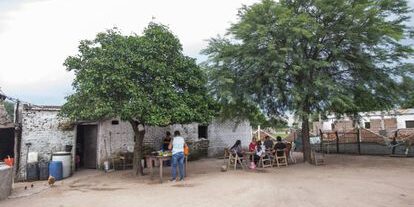
With temperatures exceeding 40 degrees Celsius, residents of Colonia Aborigen Chaco are carrying out a series of protests against the lack of drinking water. It was there, in 1924, that the Napalpí Massacre took place, the killing of between 400 and 500 Indigenous people by the national police.
Colonia Aborigen comprises 22,600 hectares. It is located in the central region of the province of Chaco, in the department of Veinticinco de Mayo, 200 kilometers from the provincial capital, Resistencia. It falls within the jurisdiction of the municipality of Machagai, whose municipal building is more than 22 kilometers away.
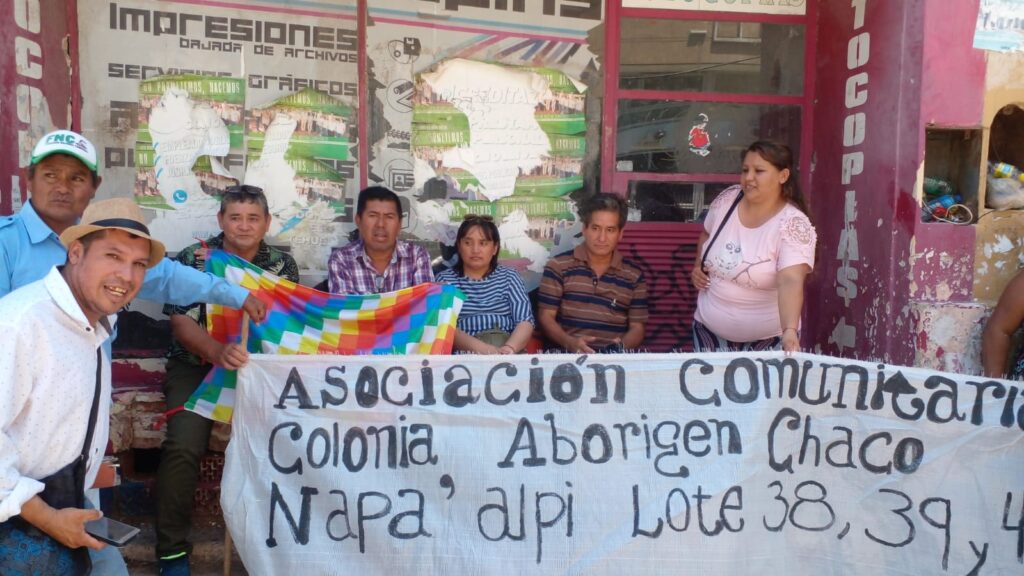
Today, approximately six thousand people from the Qom and Moqoit communities live in Colonia Aborigen, descendants of victims and survivors of the 1924 Napalpí Massacre. The territory is divided into three lots: 38, 39, and 40. According to Mario Paz, a community communicator, the lack of water is a long-standing problem, and the community is requesting that the government undertake projects to address this deficiency. In the immediate term, they are requesting water trucks to distribute the water they draw from a deep well located very near the site of the Napalpí Massacre, between Machagai and the town of Quitilipi.
The governor is not responding.
“We women are the ones who most notice the need for water. And it’s not just water; there are many other deficiencies that the community suffers from as well,” Sandra Barrientos, secretary of the Colonia Aborigen Community Association, told us.
According to the Association, after submitting letters and making other demands, on January 10th the community took to National Route 16 requesting a meeting with Governor Jorge Milton Capitanich. A meeting was granted for the 17th, but once in Resistencia they were informed that the governor would not be available and instead met with three officials: Miriam Carballo, president of the Provincial Water Administration (APA); Lourdes Polo, Undersecretary of Justice; and Beatriz Bogado, Secretary of Municipalities.
Barrientos clarified that what was discussed with Carballo were “proposals” for the construction of water tanks and reservoirs, and for drilling wells. However, he emphasized that these are projects that take time, while what they expect is for something to be done “right now” to provide water, “to alleviate the need that people are suffering.”
Waiting for the tanker truck
Except for the urgent delivery of the truck, Carballo confirmed the statements made by the community members. “We are working with our technical team and, in this specific case, with the Chaco Colony Community Association to define a plan of community and individual actions. One of these actions is a truck for transporting water, and before the end of the month, we will have a work plan that may involve different types of solutions,” he said in response to Presentes' inquiry.
In Colonia Aborigen, they were expecting the truck to arrive on January 18th . Since that didn't happen, the Community Association announced that on January 25th they will take to the highway again, “camping out until we can have a meeting” with the governor of Chaco . The organization also criticized the lack of response from the Municipality of Machagai. “He turns a deaf ear,” they stated, referring to Mayor Juan Carlos García. They also noted that this year marks the 13th anniversary of the governor's apology for the Napalpí Massacre, “but nothing has changed; there's still no attention.”
Barrientos emphasized the lack of communication from the Chaco government, adding that meanwhile, “people keep insisting on the need for water, and we don't even have a small truck to deliver it.” “What we really need here is more trucks to transport water because the main plant is still supplying it. We have no way to deliver water to the people, so the most necessary and urgent thing would be a truck for the institution, at least one or two trucks that can supply the plots,” he explained.

Water in whatever
The main plant, where a deep well is located, is situated between Napalpí, Machagai, and Quitilipi. This well reaches an aquifer that is not yet depleted, and from there, Quitilipi and Machagai are partially supplied with water. From there, the water is piped to the plant or reservoir located in the urban area of Colonia Aborigen itself, from where it is distributed to the town. However, Barrientos clarified that even this amount of water is not enough to supply all the urban residents. This is why there is an urgent need for vehicles to distribute the water within the town and in the surrounding rural areas, which cover an area of 22,600 hectares.
He explained that currently, “people are hauling water from wells. I don’t know if it’s safe to drink, but people are still going to their neighbors’ wells, hauling it in cars and on motorcycles, in whatever they have, and that’s how they’re managing . Lately, they’re consuming the water wherever it comes from, if you will,” he simplified. The problem is that there haven’t been any significant rains, and that’s why water is becoming increasingly scarce.
Paz added that the water distributed in the town, which comes from the smaller tank or plant located there, is cloudy, and the tank also has a significant leak; “they fill it with water, and it's completely lost.” “Here, we neighbors have to get together and pay to have a truckload of water brought to us from the town of Machagai,” she said.
An indigenous municipality
Mario Paz works at the Qom La'aqtac community radio station (Toba language) in Colonia Aborigen, whose urban center is located one kilometer from the exact location of the Napalpí Massacre.
“The Community Association is essentially like a municipality,” Paz explained, “because it is responsible for the 22,600 hectares inhabited by Indigenous communities.” She recalled that the governor had promised them that Colonia Aborigen would be elevated to the status of a municipality. She detailed that the municipal boundaries were established in 2011 for this purpose. In 2015, the Chaco legislature approved the creation of the municipality in the Veinticinco de Mayo department; it now only needs to be implemented.
In the urban area, many people make handicrafts from carob and guayaibí wood, while in the vast rural area, residents raise cattle, sheep, and other livestock, and cultivate low-lying crops for their own consumption. Both the town and the surrounding rural area suffer from water scarcity, although the local custom is to build ponds or reservoirs to collect rainwater for livestock.
Paz recalled that the tank repair “was also a demand that was going to be raised with the governor, something that couldn't happen because he wouldn't meet with us,” he lamented. “That hurts us because we didn't want to go out and block the highway, but unfortunately we have to do it for the government to listen to us.” The spokesperson insisted that the Association did everything to avoid this drastic measure, “all the paperwork, this and that,” but “they haven't received any response from the government, and so they had to go out and block the highway.”
Other outstanding debts
In addition to the most pressing demand for water, the Community Association has been requesting housing construction plans and improvements in healthcare and education. “ Here we have a hospital where we don't have a doctor on call 24 hours a day; we only have one doctor,” Paz explained as an example. The secretary emphasized that if the three health posts, one on each lot, were functioning properly, the hospital would be much better served.
As things stand, she said, mothers have to walk 15 to 20 kilometers “to come and get a package of milk.” “Most people in rural areas aren’t up to date with their vaccinations because of the lack of functioning health posts,” she maintained.
He explained that one health post has only one health worker, another has one assistant, and the health post in Lot 39 has been closed for three years due to staff shortages, a situation made worse by the fact that the memorial for the Massacre is located there. “It’s always being talked about, the Napalpí Massacre, the trial, and so on… now the health post is closed, there’s been no assistance for three years.” A memorial to the 1924 massacre stands at that location. But, “We have the health post closed, I ask you: where is the historical reparation that is so widely publicized if our health post is closed? It can’t be,” Barrientos lamented.
Historical reparation?
“All of this is very painful because we are talking about historical reparations,” said Paz. The national and provincial governments are obligated to provide historical reparations, which were partially fulfilled by the governor when he apologized for the Massacre in 2010. Mario Paz is the grandson of a woman who survived the Massacre. “ My grandmother told me that when she was seven years old, her older sister carried her in her arms, firing shots, ” he recalled, from the little his grandmother told him, because, “at that time, the Massacre wasn't talked about much. She told us about it, and she was afraid, which is why most of the people here don't speak the language much,” because “the fear remained.”
In May 2022, Federal Judge Nilda Niremperger declared the Argentine State responsible for the massacre of between 400 and 500 people from the Qom (Toba in Spanish) and Moqoit (Mocoví) communities, committed on Saturday, July 19, 1924, and ordered reparations. “And that’s what I’m saying, that there was so much talk about historical reparations and now we’re taking to the streets demanding something so essential: water,” Paz reasoned.
The ruling states that the massacre was a crime against humanity committed within the framework of a genocide against Indigenous peoples. In addition to establishing that the Argentine State must widely publicize the trial and the sentence, the judge ordered a public act of acknowledgment of responsibility and the construction of a museum and memorial site at the location of the events. Furthermore, she urged the national government to implement a plan of historical reparations for the Qom and Moqoit peoples.
We are present
We are committed to journalism that delves into the territories and conducts thorough investigations, combined with new technologies and narrative formats. We want the protagonists, their stories, and their struggles to be present.
SUPPORT US

FOLLOW US
Related notes
We are present
This and other stories are not usually on the media agenda. Together we can bring them to light.