

Indigenous gay men experience dissent through Mayan spirituality
Being gay and indigenous means double discrimination for some men in Guatemala. In this article, we share some of their experiences.


Share

Alas! Our fire is gone. We will die of cold, they said.
Then Tohil answered them:
"Do not grieve! The lost fire you speak of will be yours," Tohil then told them.
Popol Wuh
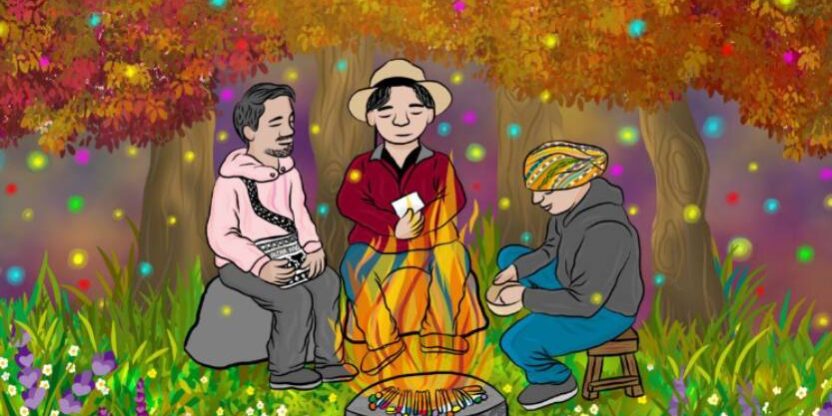
Oh, our fire! That's the expression that resonates in the sons and daughters of Tohil, the god who bestows fire in Mayan culture. Fire is a kind of portal that connects people with their grandmothers and grandfathers, the cosmos, and the energies transmitted by the earth.
Enrique Salanic and Arcadio Salanic are two gay Maya K'iche' men from Cantel, Quetzaltenango. They are from different generations and, from their own perspectives, work to reclaim their sexual orientation through the Maya worldview, where fire becomes the mirror and the passage that allows them to see and express their sexuality.
From Enrique and Arcadio's perspective, fire is that inner warmth that accompanies them, that moves and inspires them. They say they see in the flame of fire that light that illuminates their path to reclaiming their sexual orientation because it connects them with their ancestors and fills them with the energy that comes from the earth.
In Salanic's case, at the age of 23 he made the decision to live his human experience through Mayan spirituality: “I discovered an important difference. In religion, it's either black or white, but in Mayan spirituality, you live according to what your heart and the fire tell you, and you make that decision.” Arcadio feels the same way: “In spirituality, I feel my vital force to live as I am, to continue believing that I can contribute to making the world different, less dangerous for everyone, and I discover all of this in my nahual; it's like my guide.”
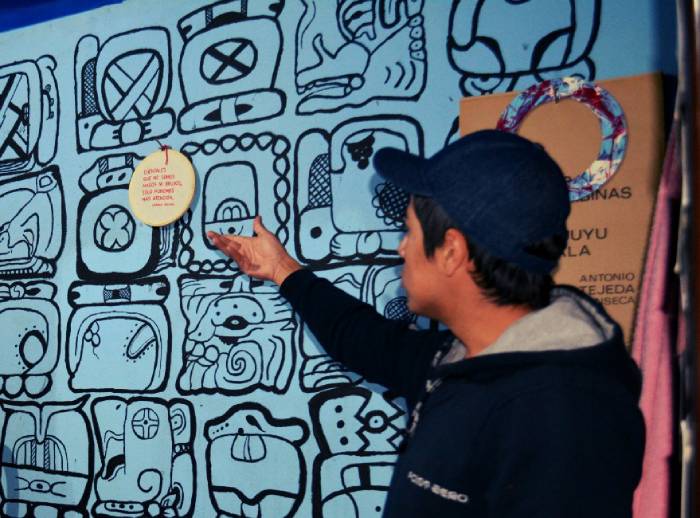
From a café in the historic center of Quetzaltenango, Enrique Salanic tells his story. His voice is calm and steady, though a smile occasionally slips through. “I knew it was me since I was little,” Enrique says, not finishing the sentence, but not because he wants to hide it; it’s so much a part of him that speaking this way is more of an automatic response. Enrique Salanic is 29 years old and identifies as a gay Maya K’iche’ man.
He was born and raised in Cantel, Quetzaltenango, a department located 210 kilometers from Guatemala City. Cantel is surrounded by mountains that descend from the Sierra de la Madre range in Chiapas, reaching the Guatemalan highlands. From any point in the small town, you can see the Santa María volcano, which is covered in snow between December and February, and whose low temperatures envelop the houses of Cantel in a dense fog during the mornings.
This is the town where Enrique Salanic also ignited the fire that he now considers the cornerstone of his freedom to express his sexual orientation and his art as a film and theater actor. Enrique is known for starring in the film José, which premiered in 2018. It tells the love story of two young gay men and was directed and written by the Chinese-born director Li Cheng, who said in an interview that he decided to film it in Guatemala with indigenous Guatemalan actors after researching the most homophobic and racist countries in Latin America. Enrique Salanic sees this film as a way to give visibility to the indigenous LGBTQ+ community. Salanic has also appeared in the films Días de luz, Roza, and La llorona, the latter directed by the Guatemalan filmmaker Jairo Bustamante.
Over tea, the actor elaborates on his perspective on his homosexuality. He says it's from a different perspective on diversity. He calls this dissent, because for him, being an Indigenous gay man is not just about identity and sexual orientation, but a political stance. "With this, we're saying that we exist and that we've always been here, even though we're not being taken into account," Enrique explains in a calm voice that nonetheless conveys great conviction as he speaks his mind.
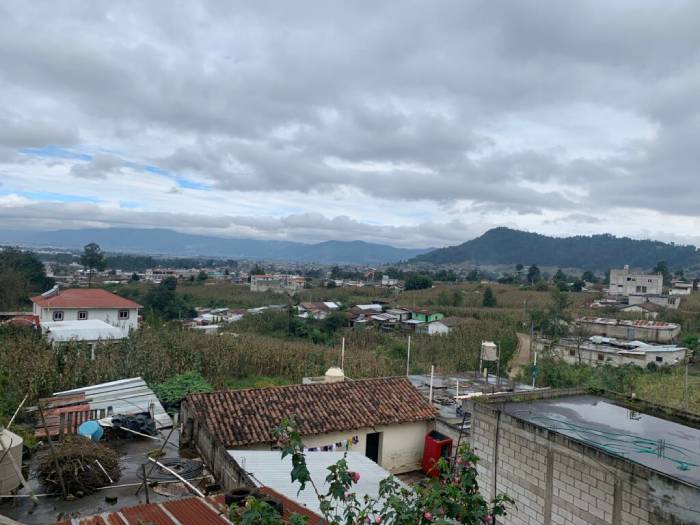
Photograph: Teresa Son
By the light of the fire
Although he now experiences that freedom in his hometown, it wasn't always this way. The process of self-acceptance and self-recognition had to take place outside of Cantel and Guatemala. When Enrique was 15, he won a United World Colleges scholarship to study for the International Baccalaureate in Canada, where he also studied acting. "It was like a bucket of cold water, because they told me that feeling those emotions and attraction for another man was normal." Enrique says this now with great calm and composure, but he remembers that those days of self-discovery were a very frightening time for him.
Canada was where he discovered himself; his nahual and the Mayan ceremonies were where he reclaimed his identity as a gay man and as an Indigenous person. Enrique says he understands his life, his mission, his profession, his dream, and his sexual and cultural identity through the experience of his nahual. “In the Mayan worldview, the nahual is the channel of communication and connection with the energies of the cosmos that people possess. It is the energy-spirit of each person, which illuminates, inspires, guides, and harmonizes life.” This is how Ana Puac, an Aj'quij' (Mayan priestess) from Quiché, explains it. She was consulted to better explain the processes of Mayan spirituality.
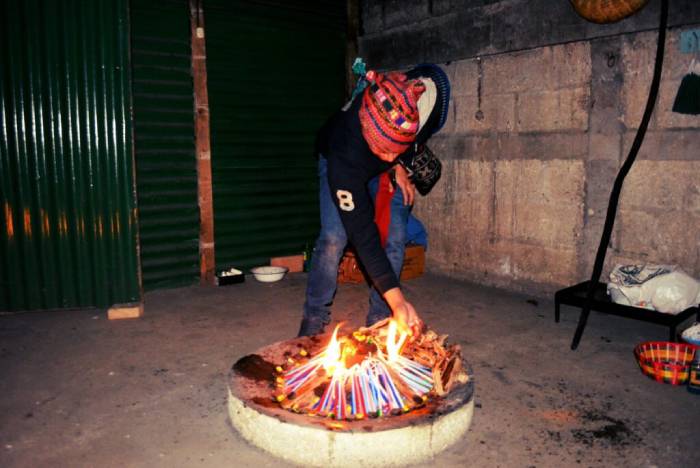
It's 5 a.m., and the chill of Cantel contrasts with the warm colors of the candles illuminating the elements of the Mayan altar. Alongside this, incense, poom (a type of turpentine), pine resin, panela (unrefined cane sugar), sweets, and chinchines (small, round rattles) provide the scents and sounds of the Mayan ceremony that Enrique is about to begin. "It's a moment to connect with our grandmothers and grandfathers; the most important thing is to be willing to experience it," says Enrique as he adds more candles to his altar, as part of the ritual that helps him connect with himself.
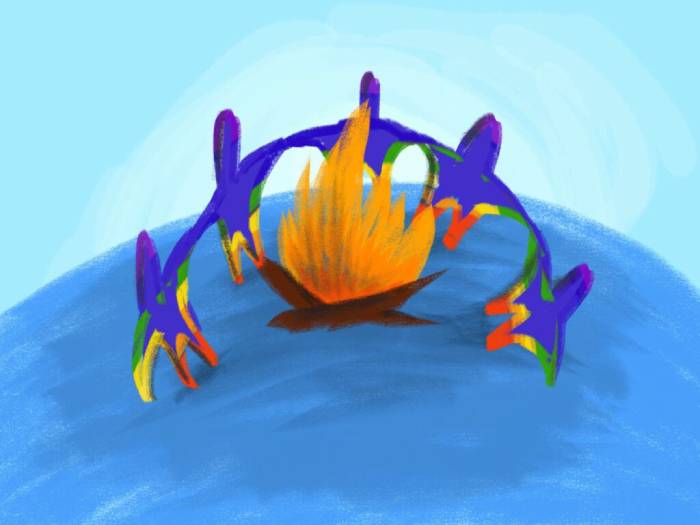
The actor continues, explaining that a ceremony requires goodwill and the desire to experience fire. This incandescent element, the flame, is seen in the Mayan worldview as generating a connection with the heart of the sky and the heart of the earth. People then attune themselves to their heart's desires to connect with the energy that drives them in life. For the Mayan worldview, the ceremony is the center of heaven and earth because it unites all of life: Uk'ux kaj, Uk'ux ulew.
“Connecting with your own energy is not only about understanding the meaning of life, but also about feeling that what you experience and do has its purpose; it's like feeling that you and what is around you are confirming that this is you and you are creating your own path,” Enrique recounts, describing the experience that the ancestral ritual brings to his life each time he performs it.
A less Western vision
The quest to reclaim one's sexual orientation through the spirituality emanating from the fire lit in ceremonies is something that has been passed down through generations. Arcadio Salanic, a 52-year-old gay Maya Quiché man from Cantel, Quetzaltenango, also discovered himself in this way, but his life and his place of struggle are different from Enrique's.
“I speak with my nahual every day. It is the energy that balances me; I feel it is another person who accompanies me, guides me, and protects me from life's adversities. It's like feeling an inner strength that accompanies and inspires me. This experience sometimes cannot be explained, but it is lived.”
for being gay, and in other spaces and places in Guatemala for being indigenous.
“It’s not the same to be an indigenous gay man as it is to be a ladino gay man, because they look for you because of your beautiful body, your skin color, your homogeneous beauty, and someone who is dark-skinned is not accepted,” Arcadio says about how he has felt in other spaces of the same LGBTIQ+ community in Guatemala.
Arcadio is an Indigenous leader from Cantel, which, from his perspective, is one of the most conservative municipalities in Quetzaltenango. His leadership and constant political and social involvement have not prevented him from facing discrimination, even to the point of receiving death threats for freely expressing his sexual orientation.
Discrimination and threats led him to seek support from others in the LGBTQ+ community, but he didn't always find acceptance. This prompted him to find his own way to raise awareness of human rights struggles from his cultural perspective. It was for this reason that he began working to create the LGBTQ+ organization K'ab'awil, which, from the Mayan worldview, means "double gaze" or "duality."
This organization is made up of gay, Indigenous men from Quetzaltenango. Its goal is to reclaim the pride of the Indigenous LGBTQ+ community. Arcadio Salanic says that their main focus is reducing violence against the Mayan LGBTQ+ community, because they face discrimination due to their sexual orientation, even from their own K'iche' neighbors.
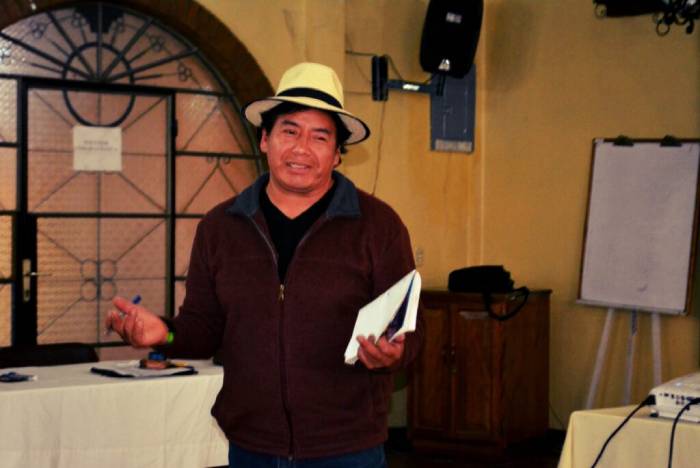
The academic and filmmaker delves deeper into the double discrimination faced by the Indigenous LGBTIQ+ community in Guatemala. He calls it “non-existence” and says it is an exclusion that Indigenous peoples have endured since colonial times. “In the social imaginary surrounding sex, since colonial times it has been viewed only through a heterosexual lens, and the pursuit of racial improvement gives preeminence to marriage as a sure mechanism for preserving racial purity. Therefore, sodomy is not only frowned upon because it is homosexual, but above all because of one's race,” he concludes.
This report was produced with the support of the International Women's Media Foundation (IWMF) as part of its Express Yourself! initiative in Latin America.
This emerging organization represents the dual perspective, the duality of being, explains the Indigenous leader. They believe that through this form of organization they can defend "their masculine and feminine sides," while through the spiritual connection of the Mayan worldview they find the strength and conviction to confront discrimination based on their sexual orientation and racism. Currently, it comprises eleven people from different locations; most are bisexual men, and the rest are gay men and lesbians. The organization is in the process of legal incorporation to obtain legal backing and operate in the western part of the country.
As of October 2022, the Public Prosecutor's Office (MP) had received a total of 97 complaints documenting violence against the LGBTIQ community nationwide. The MP does not keep records of complaints based on cultural identity, as this is not included in the complaint form. However, nine of the individuals who came to the MP after being victims of violence due to their sexual orientation and gender identity self-identified as indigenous Mayans.
Lambda, an organization that defends and assists the LGBTIQ+ population, reports more than 25 murders against people from this community during 2022, but the MP only reports one homicide in the department of El Progreso.
Double discrimination
Marco Chivalan, a gay Maya Kaqchikel scholar and filmmaker, explains the perspectives of Enrique and Arcadio, who represent two distinct generations of Indigenous gay men. The scholar, who has researched this topic, agrees with Enrique Salanic. He says that for them, it's not just sexual diversity, it's dissent, describing it as "stepping outside the norm." The scholar points out that gay Maya people are seen as a minority within the LGBTQ+ community, as a nonexistent group, and considers this a form of racial violence. "I prefer to say dissent rather than diversity; this is a Western term and doesn't fully reflect the existence of us, the dissident people," Marco adds.
The social researcher continues, explaining that dissent refers not only to being different and diverse, but is a concept that addresses altering an established conception of "being a man or being a woman," or worse, what it means to be a person and how to express one's sexuality. "Dissent because it responds to giving strength and energy to the firm decision to live according to one's own choices and not according to what society or the LGBTIQ+ community itself imposes."
The academic and filmmaker delves deeper into the double discrimination faced by the Indigenous LGBTIQ+ community in Guatemala. He calls it “non-existence” and says it is an exclusion that Indigenous peoples have endured since colonial times. “In the social imaginary surrounding sex, since colonial times it has been viewed only through a heterosexual lens, and the pursuit of racial improvement gives preeminence to marriage as a sure mechanism for preserving racial purity. Therefore, sodomy is not only frowned upon because it is homosexual, but above all because of one's race,” he concludes.
This article was originally published in Factor Cuatro and republished by Agencia Presentes through a partnership with that media outlet. This report was produced with the support of the International Women's Media Foundation (IWMF) as part of its Express Yourself! initiative in Latin America.
We are present
We are committed to journalism that delves into the territories and conducts thorough investigations, combined with new technologies and narrative formats. We want the protagonists, their stories, and their struggles to be present.
SUPPORT US

FOLLOW US
Related notes


We are present
This and other stories are not usually on the media agenda. Together we can bring them to light.