

A project to guarantee safe abortion in indigenous communities in Argentina
The aim is to provide information in indigenous languages and in an adapted way so that the IVE (Voluntary Interruption of Pregnancy) can be implemented with all the protocols.


Share

Two years after the enactment of Law 27.610 on access to voluntary termination of pregnancy (VTP) , this practice has spread significantly throughout the country. However, challenges remain in implementing the law in a way that considers the diverse realities of people who have abortions. Within this context, a project in which women and pregnant people from various Indigenous communities play a leading role seeks to guarantee this population's access to information adapted to their needs and the practice of terminating a pregnancy.
This initiative, spearheaded by the organization Catholics for Choice (CDD), began in 2019 in partnership with Indigenous and peasant women and sexual minorities organized in 10 provinces. It forms part of the project “ Feminisms: Indigenous, Peasant, and Afro-descendant Women for the Right to Abortion and Sexual and (Non)Reproductive Rights in Argentina .”
Through it, training, advocacy actions, meetings, and collaborative production of graphic and sound materials in the native languages of the Wichí, Chorote, Guarani, Qom, and Mapuzungun peoples are carried out.
Veróniza Azpiroz Cleñán is a Mapuche political scientist who lives in Los Toldos , Buenos Aires Province, and belongs to the Epu Lafken rural community . She is also a doctoral candidate in Public Health at the National University of Lanús and was one of the local coordinators of the CDD project.
Health and native languages
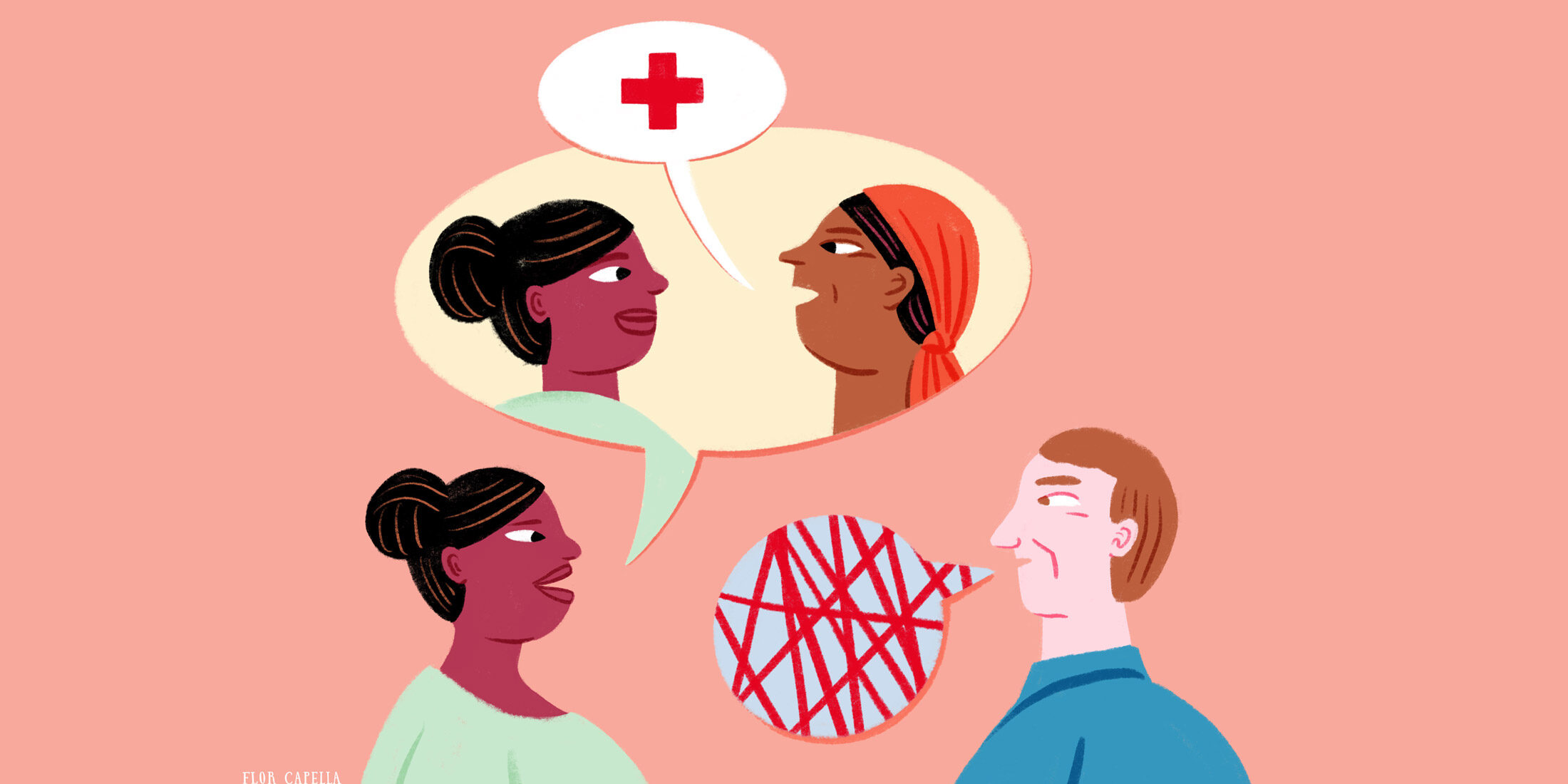
For her, the proposal not only serves to break down a barrier in access to the public health system, but also as a "linguistic revitalization tool for women who are recovering the mazunugun" (the Mapuche language).
“Although Mapuzungun is in decline, it remains in use and is still spoken as a priority language in many territories. Therefore, it presents a barrier to accessing the public health system, where doctors and medical professionals generally do not speak the native language, creating difficulties, especially during the initial interview, request, or clinical practice,” Verónica explained.
Given the loss of the language in some areas, Azpiroz Cleñán explained that many Mapuche women are working to revitalize it. In this regard, the CDD initiative, together with the Epu Lafken community, brought together Mapuche leaders, native speakers of Mapuzungun, and those recovering or learning the language to carry out this work.
The virtual workshops included the participation of women from diverse territorial identities within Pwelmapu (the historical Mapuche territory east of the Andes Mountains). Through these workshops, they successfully adapted the protocols for comprehensive care for individuals with the right to a voluntary and legal abortion and for victims of sexual violence, as established by the National Ministry of Health.
The product of this local initiative was 11 audio recordings summarizing the protocols, which can be used as training materials or for community radio stations. They also adapted the Informed Consent forms— mandatory documents within medical records—for Legal and Voluntary Termination of Pregnancy, as well as for access to Surgical Contraception. Finally, they produced four short videos on sexual violence and abortion.
Reach all provinces
As of September 2022, a total of 59,267 legal abortions had been performed that year. The highest concentration was in the province of Buenos Aires (22,665), followed by the city of Buenos Aires (7,007), Santa Fe (4,362), Tucumán (3,613), Salta (2,799), and Córdoba (2,459). This data comes from the 2022 annual report, “ImplementAR IVE-ILE .”
Meanwhile, 1,443 providers in the public health system reported performing pregnancy terminations from January to September 2022. This is 59.8% more than in 2020, when there were 903 providers, and 7.5% more than in 2021 (1,342 providers).
The provinces with the highest number of healthcare providers who performed the procedure were Buenos Aires (482) and Santa Fe (171). Meanwhile, those with the fewest providers were Tierra del Fuego (8), Santiago del Estero (9), Chaco (9), Santa Cruz (11), Mendoza (13), San Juan (14), Catamarca (15), and Corrientes (20).
"All provinces, including San Juan and Corrientes, which have the fewest services and the most access difficulties, have also made progress compared to the end of 2020," Valeria Isla, director of Sexual and Reproductive Health at the Ministry of Health of the Nation, Presentes
The countryside and the city
According to Isla, there are still "differences between cities and the rest of the provinces" in access to abortion. Specifically regarding Indigenous and rural populations, the director maintained that "there are greater difficulties in accessing" the procedure.
"On the one hand, it's due to the availability of healthcare teams. On the other hand, sometimes it's due to the stigma within the community itself towards women who need to access this right. There are also difficulties with girls and adolescents who are victims of sexual violence or rape in general—not just in this population—which is why they arrive at the healthcare system later," Isla explained .
In this regard, she highlighted the project "Rolling Rights: Strengthening Health Teams in the Argentine Provinces," by Catholics for Choice, with the support of the Canadian Embassy. "In the province of Formosa, where there were few health centers offering abortion services, we traveled throughout the province with the help of obstetricians, psychologists, social workers, and general practitioners. Today, there are more than 30 health centers across the province that guarantee abortion services with medication," said the National Director of Sexual and Reproductive Health.
Regarding the challenges of implementing the Law that guarantees the voluntary termination of pregnancy, Isla listed: "increasing the number of health teams that guarantee the procedure, continuing to support the distribution of medication and supplies, and disseminating information to the population. Also, continuing training to reduce inequality gaps in access and improve the quality of the entire care process."
We are present
We are committed to journalism that delves into the territories and conducts thorough investigations, combined with new technologies and narrative formats. We want the protagonists, their stories, and their struggles to be present.
SUPPORT US

FOLLOW US
Related notes


We are present
This and other stories are not usually on the media agenda. Together we can bring them to light.