

Argentine television doesn't want trans romances
Transvestite activist Violeta Alegre reflects on how transvestite and trans people, despite the rights they have gained, continue to be excluded from mass spaces.


Share

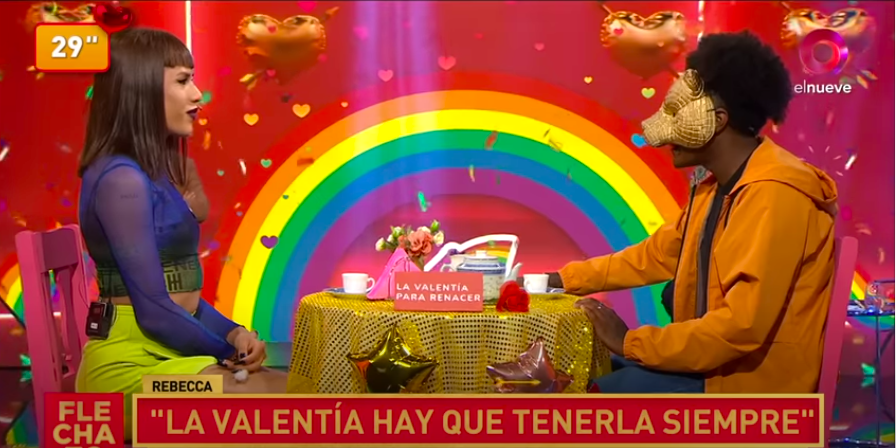
BUENOS AIRES, Argentina. Last week it became public knowledge that journalist Franco Torchia had been fired from the daily program “Flechazo, amor oculto” (Love at First Sight), broadcast on Channel 9, a dating show to find a partner.
But what kind of “love” do TV programs intend to reproduce and uphold? Does it still happen in the media that expressions of affection from people who don't conform to heterosexual norms are hidden and discussed?
Torchia stopped appearing on the program and a few days later we read on his Twitter that it was because he opposed discriminatory decisions.
“For those asking, Channel 9 fired me from the show #Flechazo. Its management maintains a discriminatory policy according to which the show only pairs cisgender heterosexual couples.
At Torchia's insistence, one of the programs featured trans women as participants. But that episode wasn't aired at the time; instead, it was shelved (as often happens to our demands) for several months. After much protest, the program was finally shown.
When was it broadcast? On November 30th, the day Argentina played Poland. Due to the World Cup frenzy, the program had virtually no visibility.
Are gender and sexual relationships and expressions that do not conform to the hegemonic demand being intentionally made invisible? It is a significant detail that, after the episode was uploaded to YouTube, in that particular broadcast, the video preview was the only one that did not show the faces of the participants, but rather the hosts.
Because of “the people”
In most cases, making our existence visible in any expression that grants us citizenship—which are nothing more and nothing less than human rights—remains a battleground. The excuses are often confusing. We encounter "cool" people in different spaces who tell us that "everything is fine" with dissent, but when they do give us space, we end up in subordinate positions. Inclusive ethics has its limits.
The limits, those usually cited by the people who exclude us, are often "the people": an amorphous mass of society that is supposedly not prepared to see what is known and prefers to continue speaking in euphemisms.
For trans people, concealment has always been present in many aspects. In the workplace, we've had to fight for a quota that guarantees our right to work, and that continues to be a constant struggle—not only for entry but also for job security, not to mention the recognition of our identities and "dignified treatment."
The emotional aspect—expressing our kisses, hugs, and caresses—still carries a direct link to what “shouldn’t be seen” in the media, in public squares, or in any public space. “Because there are children,” they say. And in doing so, the capacity to grow in the world as it is—diverse—is underestimated and limited.

Are these spaces worth occupying?
The question these discriminatory actions raise for me is: is it worth trying to occupy those spaces? In many cases, occupying them means waging cultural battles with producers, bosses, colleagues, and institutions whose policies are governed by a ratings system, which is nothing more than the "sale" of goods or services. It's a capitalism we can't escape. If we turn a blind eye, we remain complicit in these systems of violence.
So is it worth it? And the answer, at least for me, is: yes!
Because our lives are filled with collective stories of battles we must continue to defend. Because abandoning the fight is to relinquish our hard-won rights, not granted out of mere "goodwill." These are struggles that often seem foreign to us, but at some point, we will always be targeted for discrimination. Like what's happening to Franco today, like what happened to that coworker whose boss told her: "It's not a problem here that you're trans, but come to work looking as feminine as possible and dress normally."
Love as a driving force for change
The engine of change is love, our beloved Lohana Berkins told us. And that love, in many cases, is a battle against hate, which continues to curtail our expressions and our very existence. We don't want a future where we can't express ourselves, where we can't appear in the media and have our love seen, because that means being able to sit with our loved ones and hug each other in a public square without people walking by and insulting us or throwing things at us. We don't want that future for children, or for anyone, and to achieve it, we must unify this "everything is fine with diversity" with consistent actions; otherwise, it will remain a lie.
We stand with and thank Franco Torchia because, despite the difficult time he is going through in this situation, which is not only work-related, he paves the way to dismantle hypocrisy and allows us to reflect on it.
We are present
We are committed to journalism that delves into the territories and conducts thorough investigations, combined with new technologies and narrative formats. We want the protagonists, their stories, and their struggles to be present.
SUPPORT US

FOLLOW US
Related notes



We are present
This and other stories are not usually on the media agenda. Together we can bring them to light.
1 comment