

Qatar: FIFA sanctions players who speak out in favor of LGBT rights
The national teams that joined the One Love initiative had to withdraw due to FIFA's decision. The teams protested.


Share

BUENOS AIRES, Argentina . Protests against the lack of rights for LGBT+ people in Qatar and against the actions of the International Federation of Association Football (FIFA) continue to grow. Four days before the start of the World Cup, players, fans, and organizations expressed their outrage at the country's laws that criminalize homosexuality and FIFA's threats against freedom of expression.
The captains of the national teams of England, Wales, Germany, the Netherlands, France, Denmark, Switzerland, and Belgium had expressed their desire to support the LGBT+ community at the World Cup. As part of the "OneLove" initiative, spearheaded by England captain Harry Kane, these players were going to wear rainbow armbands. They did so in protest against discrimination against the LGBT+ community.
However, faced with threats of sanctions from FIFA, they ended up abandoning the initiative.
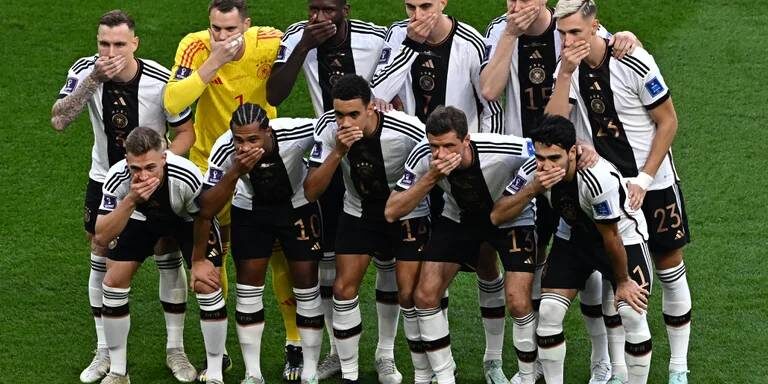
In response, before the start of the Germany vs. Japan match, the German national team posed for the classic group photo covering their mouths in rejection of the threats to their freedom of expression and protest.
Even during the Germany vs. Japan match, the referee, in compliance with FIFA recommendations, went to check if the German goalkeeper was wearing his armband.
"FIFA will have to rethink the next World Cup venues."
On Wednesday, November 23, the fourth day of the competition, the International Lesbian, Gay, Bisexual, Trans and Intersex Association (ILGA World) together with its Asian region (ILGA Asia) sent an open letter to FIFA President Gianni Infantino.
In it, they deemed FIFA's commitment to human rights "totally questionable." Furthermore, they stated that the World Cup "failed spectacularly" in its objective of "uniting people on equal terms."
For these reasons, they issued a call to action: “We trust that FIFA will change course from now on. That it will do everything in its power to make a meaningful commitment to human rights for all people, and rebuild the trust that these past days and months have so seriously tarnished.”
“We’re four days into the World Cup and there’s already a lot of controversy and protests. This is going to keep growing, and that’s a good thing. Not everyone agrees with what’s happening: both individually and collectively, it’s going viral, and people are looking for strategies to keep raising awareness. I’m sure FIFA will have to rethink where to hold the next World Cup tournaments,” Ingrid Bravo, Coordinator of Institutional Development and Outreach at Somos Versus Presentes . This Mexican organization aims to “achieve a more inclusive society through sport.”
For Bravo, “sport should be a tool for creating more inclusive societies, but they're doing the exact opposite.” His organization shared a Basic Guide for Inclusive and Unbiased Communication with the goal of helping the media provide respectful coverage of sports in general, and now, the World Cup. They also launched a campaign to raise awareness of the human rights situation in the countries participating in the tournament.
A change is still expected in Qatar.
Qatar is one of the 68 countries where homosexuality is illegal . The country, hostile to the LGBT+ community, promised a safe environment for the community but has so far failed to deliver .
"Everyone will be welcome in Qatar in 2022. Regardless of their race, origin, religion, gender, orientation or nationality," Fatma Ali Al Nuaimi, Executive Director of Communications for the 2022 FIFA World Cup, had declared.
Following discussions with FIFA and various organizations, the Qatar Supreme Committee pledged to implement a series of measures to guarantee the rights of the LGBTQ community. These included a protocol and guidelines on how security forces would address LGBTQ issues during the World Cup, as well as training for these forces to ensure sensitivity towards the community. However, the protocol was never presented, nor was any information provided about how the training was conducted.
The power of campaigns
For their part, Amnesty International and other organizations pointed out that in Qatar, LGBTIQ people "are denied their right to freely live their sexuality or gender identity. Qatari laws criminalize consensual same-sex sexual acts, which can even result in prison sentences."
Together with Abosex , Brandon , Mocha Celis , Fundación MujeresxMujeres , Synergia, and Transformando Familias, they created a video to raise awareness and celebrate sexual diversity under the campaign “ Let Pride be Global ” They also seek to counteract “a rise in discourse that incites discrimination and violence based on gender, not only in Argentina but also globally.”
“In Qatar, where the World Cup begins this week, being lesbian, gay, bisexual, trans, or intersex is a crime. Faced with hatred, repression, and violence, we show the world that we respond with pride,” said Mariela Belski, executive director of Amnesty International Argentina.
We are present
We are committed to journalism that delves into the territories and conducts thorough investigations, combined with new technologies and narrative formats. We want the protagonists, their stories, and their struggles to be present.
SUPPORT US

FOLLOW US
Related notes


We are present
This and other stories are not usually on the media agenda. Together we can bring them to light.