

From Guatemala to Kurdistan: ancestral healers weave networks of feminist struggles
The women of the Network of Ancestral Healers share their experiences to unite struggles across borders.


Share

The Network of Ancestral Healers was born in Iximulew in 2013. It came to light publicly on October 12, 2015, on the Day of Resistance and Dignity of the ancestral and original peoples of Abya Yala.
It was created by Indigenous Maya women, defenders of life who, for their activism, have experienced—and continue to experience—criminalization, political persecution, and political risk . The active members of the Network combine their healing knowledge to support other women who are seriously threatened for defending their territories.
These actions “are part of a community fabric, which was created in the mountains of Xalapán, in the northeastern part of Guatemala. There in 2004, prior to the Network of Healers, the slogans 'My body is my first territory of defense' and 'Defense of the territory-body-land' emerged,” says Lorena Kab'nal, with a soft and firm voice.
The women of the Network were pioneers in building resistance through marches, walks, and denunciations, but also through the embodiment of healing as a cosmic-political path. “When this body becomes ill in the face of so many injustices, so much outrage, so much violence. When we are affected emotionally, physically, and spiritually, we need to be lovingly sustained with the wisdom of our ancestors, the strength of nature, and the love between women,” says Lorena.
A feminist and ancestral experience
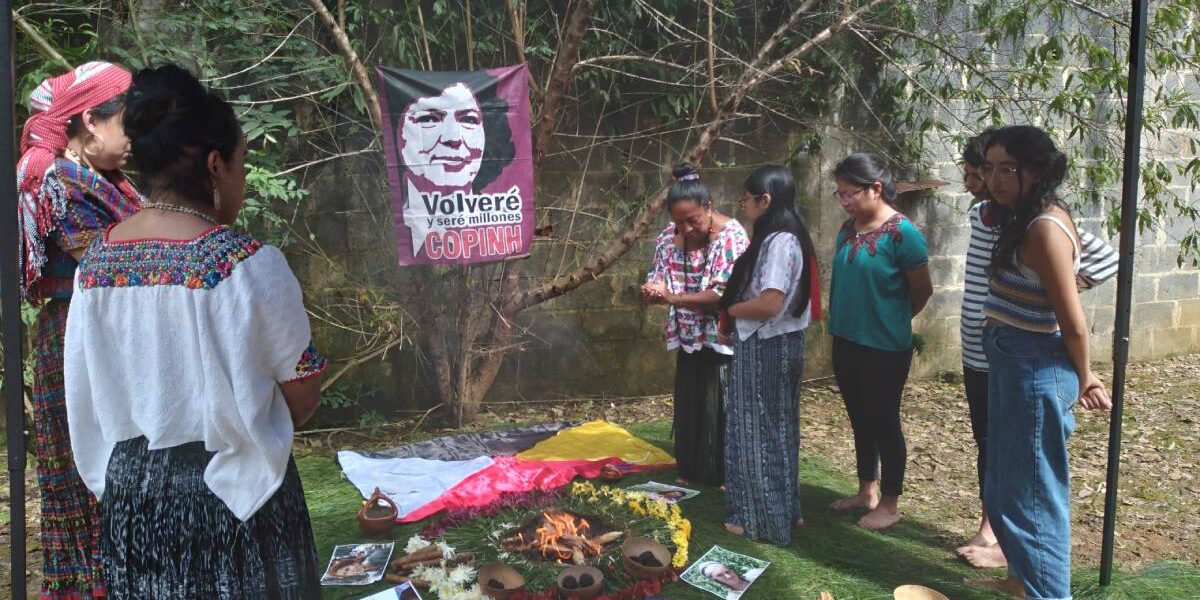
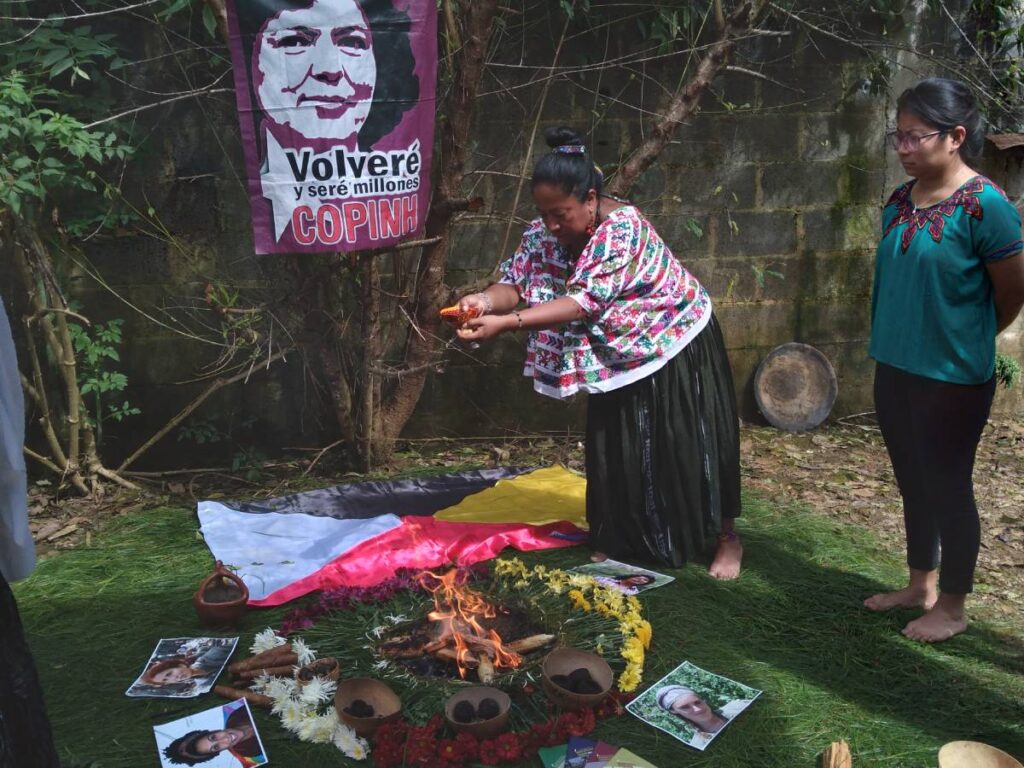
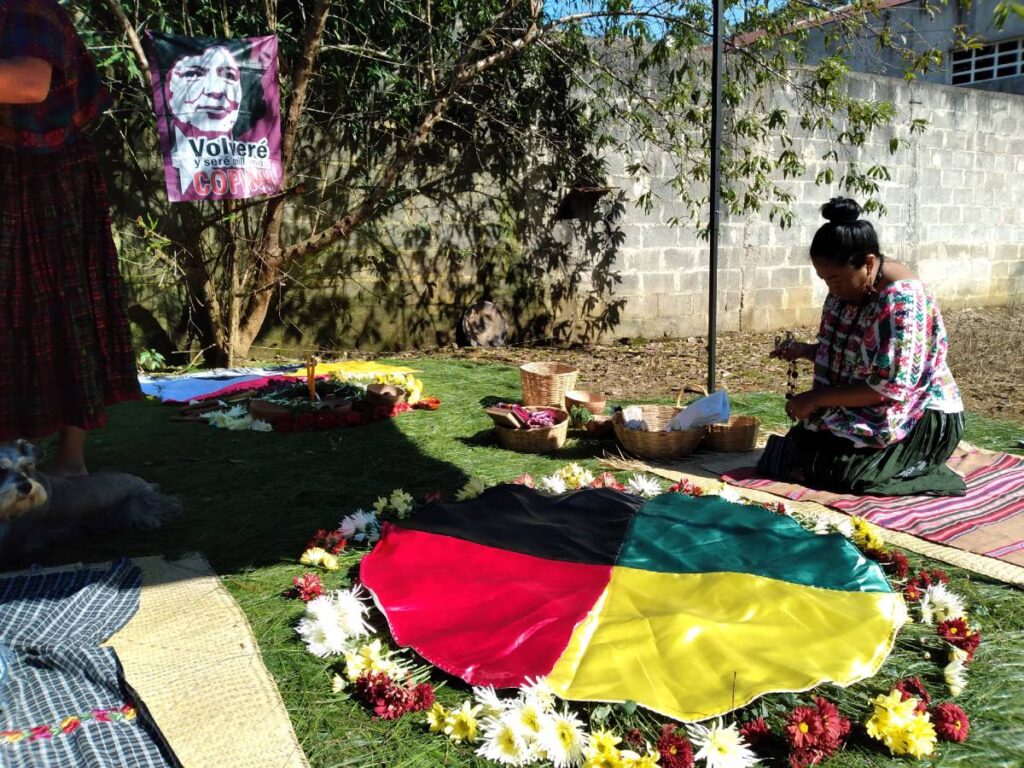
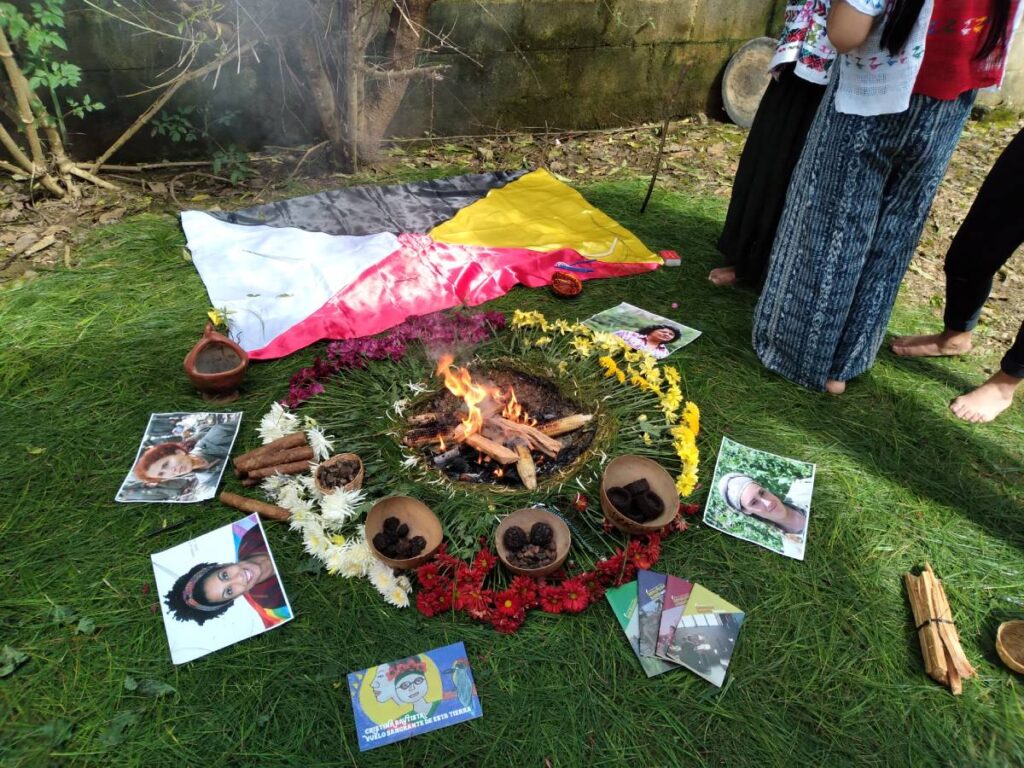
Together with Lorena, Chahim, and the other political allies of the Network in the Q'eqchi' Maya territory, we gathered in Iximulew for hours around the fire, sharing an energetic healing process. Our dialogue wove together the experience of resistance in Rojava (Syrian Kurdistan) with that of the territorial fighters in Guatemala. These experiences travel between ancestral memory and the dignity of the loving and pluralistic rebellion of women who defend life.
—How did the Network of Ancestral Healers come about?
Lorena: — It emerged during a political moment of rupture, of breaks with urban kaxlan feminism (urban NGO feminism), to strengthen the proposal of territorial community feminism. To heal the territory-body-land through an anti-patriarchal struggle, from within Mayan territories, in everyday spaces of communal life. We were often accused by various feminists of redirecting our political energy toward Mayan men. We are in communal spaces, where the political presence of the body manifests its plurality. It is in ceremonial spaces where girls, boys, children, grandmothers, grandfathers, leaders, Indigenous authorities, and midwives, among others, coexist. I gradually became aware that the community has many plural ancestral relationships with life.
We, as ancestral peoples, have a different code for understanding life within the community. This is where we, as territorial community feminists, struggle: decoding sexism, violence against women, and misogyny from the perspective of our cosmogonies. That is, from how we feel and think about life. And therefore, from where we perceive the disharmony of life in our bodies and on the land.
Territorial Feminists
For us, it's important to see that the fabric of the community is pluralistic for life. And it's not that we're spending our energy transforming our relationships with our male comrades. I publicly identify as a feminist, and being a feminist within the community, and naming yourself as such in Iximulew, is complex. It can be dangerous, it has risks, because it's alienating if you state it outright. It's not the same as a white, academic, non-Spanish feminist body that comes to engage in dialogue with a community that doesn't speak Spanish. Why does the community have to incorporate Spanish concepts to unveil its reality? When do we explain patriarchy using theoretical categories from Western feminisms? There are communal life relationships that we need to see clearly: relationships of ownership and control based on machismo.
But it is we, the Indigenous women, who, with epistemic authority over our communal life, propose our emancipations based on our cosmogonies of harmonizing life. That is why, today, it is politically non-negotiable that they come to tutelage us, to tell us how to defend our bodies and the land using theoretical categories that are challenged, for example, when there are evictions and we are absent. We, the communities, stand together, united, fighting against the neocolonial death of the extractive industries.
Our Network promotes women-only healing awareness gatherings. But at the same time, we live in community and possess epistemic, political, and territorial authority. This applies not only to women-only healing spaces but also to mixed-gender groups. And we emphasize that plural bodies exist here. Because here, life is plural by virtue of our cosmogony. Our temporality unfolds in community, and we have no reason to debate or impose our will.
We are tired of the nebulous, hegemonic, academic, NGO-driven, and cooperative Western feminist theories: Western feminist rationality is so naturalized that it has stripped us of our political awareness of life. Because these theoretical-epistemic forms of rationalization are not solving problems. They are beautiful, they are necessary. But we question whether they are vital, because every day our bodies take in water, eat fruit, seeds. And how can this be sustained if not through our life-giving relationship with the earth? And what are we doing with the forest and with the water?
—What work do you do as a Network?
Lorena: — We begin with the awakening of women's healing memory. It is vital to share knowledge among women, knowledge that strengthens and supports us. And to bring forth the ancestral memory of women with their ways of inhabiting the land, because these are also forms of resistance, sometimes unspoken and unacknowledged. Many Western medical practices are taken for granted, but vital elements are overlooked when we talk about the knowledge woven by our grandmothers in women's resistance. In the context of the counterinsurgency war, for example.
It's so complex because indignation and fear are deeply internalized, and the body generates an impressive system of alerts. Because we are surrounded by so many life-threatening situations, the outrage provoked by the patriarchal system, colonialism, racism, neoliberalism, and war takes root in our bodies. We somatize. The patriarchal system is not abstract: it is so real and manifests itself in our bodies. Cancers, for example, are closely linked to the patriarchal power exerted over highly polluted territories, and to women's bodies constantly exposed to pollution and violence.
The Network argues that a feminism that does not embrace the self-determination of the land and bodies lacks political sustainability as a theoretical current. We cannot speak of emancipated, free, and self-determined bodies if these bodies are consuming genetically modified corn or living in a territory of widespread monoculture. The proposal of healing as a cosmic-political path is to reclaim the knowledge of the women who came before us in resistance in these territories. Or the knowledge of contemporary Indigenous women who, from their understanding of lunar phases, solar and lunar calendar cycles, herbs, seeds, ceremonies, words, silences, songs, smoke, incense, rest, meditation, gatherings, dance, flowers, infusions, baths, oils, and ancestral medicine, have woven together a tapestry of healing, to joyfully challenge the patriarchal system and to heal bodies and the land.
While we are in the process of these encounters, the sisters who come to us for healing enjoy themselves, let go, and regain their vitality and energy. We do a lot of catharsis, and this can be a very helpful element. There are times when the sisters are going through a very complex personal situation and need our support.
Listening as an act against patriarchy
"It's very important to listen, to empathize, because words are something over which the patriarchal system has exerted a lot of power. But words spoken, uttered with awareness, also heal the pain we feel," Lorena explains.
Lorena: —When we speak of a cosmic-political path, in connection with the wisdom of our grandmothers, we bring them into our spaces. We awaken healing memory by summoning the elder grandmothers, whether or not they identify as feminists. They come, whatever paths they may take, to feel with our hearts. And we have the love and patience to reciprocate by listening to them for many hours, and they tell us everything, and from there they return to their communities with our feelings and our shared experiences. Then, their loving patience with other women continues to be woven to heal so much violence suffered.
This is very radical here. Because women, in their plurality of being, often have indigenous essentialisms, and sometimes in ceremonies they aren't allowed to touch the fire: but here, energies are welcome to heal life. To heal the bodily and political presence of all women in their plurality of existences. And that's where we stand together with the grandmothers, the elder midwives, and when we begin a ceremony, we also call upon the ancestors, we invoke the grandfathers who taught us to plant corn, grandfathers who never touched a girl's body, who cared for her, respected her, and loved her. Even when men see us so strong among us, their dynamics and their energy shift to another dimension of consciousness.
And they see among us a great deal of solidarity and joy in intimacy, which was denied to them. It is then that they feel, and their feeling becomes political, and we take the opportunity to reflect on it so that they can understand the dimensions of their healing. Here, and in other territories, the defense of the territory-body-land is a proposal that is deeply ingrained in the struggle, the walks, the marches.
An experience that transcends all borders
—I think of what I experienced in Rojava (Syrian Kurdistan) and how vital it was after the revolution to see the liberated territory come alive in its communes, among different communities and spiritualities . Free from homogenizing tendencies after years of Islamic law and the Syrian regime, with the plurality and diversity of expression of each community placed at the foundation of life. In this dimension, health promoters, like our colleague Alina Sánchez—who chose the Kurdish name Lȇgȇrîn, which means “search”—shared healing processes rooted in joy, outside of a positivist approach to medicine, moving beyond a purely emergency perspective.
All this community health work in Rojava was also accompanied by the practice of collective reflection and the ritual of tekmil: criticism and self-criticism as a space to express needs through deep, collective listening . Where, if someone leaves because they are not well, they can still count on the closeness and support of everyone else.
Chahim: —I think it resonates with the importance we give to temporalities: how to create political temporalities. Because we are always in moments of emergency, and therefore we accumulate fatigue, physical, spiritual, and emotional ailments. While you were talking about the tekmil , I was thinking that, in resistance, the point is also how to respect personal and communal temporalities. These political temporalities require our political patience and respect for our actions and self-determinations.
While the important point of critique is knowing how to weave it lovingly, perhaps what we need to do sometimes is simply respect and restrain ourselves. And to discern when we are the ones who need to take this time to be more present or engaged in inner, intimate, profound work with our consciences and our personal actions, which become communal. I believe both movements are necessary, because the collective is sometimes inhabited by the ego. A challenge for us as organized women is how to genuinely avoid inhabiting the collective from an individualistic perspective, but rather to approach it with a temporality that leads us to sit among ourselves and with the grandmothers, that leads us to spiritual spaces, to dance. Not out of obligation, but because we feel it is necessary, and how to create these possibilities of temporality and infuse these moments with intention and love.
plural perspective
—Lorena: I think it's historic to come together at a moment like this, surrounded by such diversity. It will still take some time for Indigenous peoples to achieve this. We have a deeply ingrained, heteronormative interpretation of Indigenous customs and traditions. That's why it's so wonderful when we come together in other territories with such great strength, because there you find sisters of all ages, with different histories and paths, women of diverse bodies and sexualities, diverse identities, with a beautiful political commitment to defending our bodies and territories. There, we embrace the plurality of bodies as a principle of our cosmogony; it's not denied, it's not debated within the community, it's greeted, embraced, and woven together. Our male comrades enter into a different dimension of awareness in relation to us.
Because healing also means healing the way we see each other, how we feel and perceive one another. And because we do not subscribe to the hegemonic radical feminist positions that fail to acknowledge the other forms of embodiment that exist in our communities. Our communities are pluralistic by virtue of our cosmogony.
Lovingness is an act of liberation
—With Jineolojî, the social science of Kurdish women, there are profoundly anti-normative reinterpretations in the face of essentialisms. To understand how heteropatriarchy operates, dialogues have been opened, encounters between dissident communities, and struggles from different parts of the world, reflecting collectively, taking up what Chahim said about how we liberate life through love.
Lorena: —Because healing is very multifaceted. It doesn't just focus on the body, but also heals the spirit and the ingrained thought patterns in each person. This brings us closer to the "Web of Life," which in the K'iche' Maya language is called "K'at." But if you add the glottal stop "tz'," it becomes tzk'at, which means not only "Web of Life," but also that "everything is connected to life." So, for us, community-based feminists, there's a principle in the Maya cosmogony that is the plurality of life: nothing is the same in the Web of Life. No two flowers are alike, nor are any two bodies.
All of this is a symbolic, spiritual representation. And we love that your eyes and feelings come from this plurality of internalized life, because it is a call to deep reflection. We look at the textiles of our peoples: the colors of the textiles are not uniform; we are not all the same, so there is plurality in the Web of Life.
In the Q'eqchi' Mayan language, there is a saying, “Laa' in ut laa't, laa't ut laa'in”: “You are me, I am you.” And if I don't uphold this principle of cosmogony, I am falling into a relationship of injustice. This relationship of injustice is created if I deny the existence or vital presence in the Web of Life. If I deny the presence of trans sisters, if I deny the presence of heterosexual sisters, because that is their desire, their taste, their pleasure—emancipated heterosexuals exist. Therefore, welcome to the presence of sisters of plural sexualities with whom we love to move lovingly through affective, felt, and erotic energies.
These feelings deeply support us, and we walk together in community, experiencing plurality. For this reason, we don't talk so much about sexuality, but rather about the vital, plural dimension of life from our worldview.
Heal
—From this plurality, how do you see the act of healing and how do you ensure that your achievements, your processes, are guaranteed by your decisional autonomy? I think of the confederal movement of women in Kurdistan, where each one, in the mixed sphere, will always have a network of support women who accompany her as a common force.
Lorena: —I feel that healing is a personal, political, and conscious act that becomes communal. But one doesn't heal individually, one doesn't heal just to feel good. We reflect a lot among ourselves and we respect and embrace our sisters with different paths of self-care. We respect them because they too have been built upon the needs of a specific context. But, for us, self-care is politically complex, a form of conscious and political healing. Healing is a very deep, political, and conscious dimension that stems from the personal and is not delegitimized in that personal dimension, because healed bodies come together as a healed communal force.
Personal intimacy is respected and then brought into the communal sphere to be sustained and embraced. The patriarchal illusion of this is to create an individualistic relationship, but personal intimacy and essentialist individualism are two different things. And I'm referring to radical forms of solidarity. I don't align myself with the struggles in Kurdistan on the basis that the planet is one universal home, and for this reason, I don't want to transgress borders simply so that all flags can coexist peacefully.
On the contrary, I believe there is a radicalism when we feel part of a common struggle. This "you are me and I am you" comes from that feeling, because I feel that where there is suffering and pain, there are paths to emancipation. And where there is hegemonic power, there is rebellion. And this has always been the case throughout history; it is a founding principle of all transformation.
Knit with joy
Chahim: —And rebellions are also plural; they accompany one another, and one doesn't delegitimize the other, in the sense that there's a common rebellion we can weave together. What I heard from you about the experience in Rojava revitalizes me, and I feel a rich sigh knowing that, everywhere, we are breaking down the systems that want to threaten our existence and territory. I believe that when we lose the guilt, we take responsibility and fill it with color and joy.
This allows us to understand our own rhythms, the rhythms of others, and to stop imposing a single, universally valid emancipatory framework. The further we move away from the comfort of essentialism, the closer we are to genuine and profound freedom as part of this fabric. And in this profound self-realization, the entire fabric also becomes emancipated. Healing must be holistic, encompassing all our dimensions. It's important to understand our political creativity, beyond what we've inherited or acquired, perceiving it from our own bodies, because it's a constant battle.
Body and territory
When Lorena spoke of "embodiment," it meant more than just physically being there for your sister. It meant giving your time in moments of emergency, and you had to be there. Not out of obligation, but out of the awareness that being there is vital for the sustainability of the network we are weaving. And to help us all heal. Through listening, it's important to create spaces of trust and not to bring out into the open what we sisters share with each other, because it's an intimate space.
This reminds me that, in this intimacy, we must also be able to identify the gaps and knots in our social fabric, so that strength is not lost due to a system of oppression or oppressive bodies that speak of historical rivalry between women, when what is truly historical is the complicity between women . This embodiment always carries a mutual responsibility. The complicity between women, in the plurality of existence, entails a reciprocal responsibility. I feel that even this dialogue, which you have built as a bridge between cultures and peoples from Abya Yala to Kurdistan, was already present with the grandmothers of different peoples, in the loving, reciprocal sustainability of the fabric we weave together.
This article was also published in La Tinta Magazine–
We are present
We are committed to journalism that delves into the territories and conducts thorough investigations, combined with new technologies and narrative formats. We want the protagonists, their stories, and their struggles to be present.
SUPPORT US

FOLLOW US
Related notes


We are present
This and other stories are not usually on the media agenda. Together we can bring them to light.